Sermons
- Thout
- Paope
- Hathor
- Kiahk
- Tobe
- 2026-01-11: 1st Sunday of Tobe - Joseph Discerns God's Will
- 2026-11-18: Theophany Feast
- 2026-01-25: 3rd Sunday of Tobe
- Amshir
- Paremhotep
- Great Fast
- Holy Pascha Week
- Holy 50 Days
- 2025-06-01: 6th Sunday - I have overcome the world
- 2026-05-10: 4th Sunday - Reading the Scripture
- 2025-05-24: 6th Sunday - Ask in My Name
- Pashons
- Paone
- 2026-06-28: 3rd Sunday of Paone - “By Your Words”
- 2026-07-05: 4th Sunday of Paone - “Love your enemies”
- Abib
- 2025-07-13: 3rd Sunday of Abib - Characteristics of Successful Ministry
- 2025-07-20: 4th Sunday of Abib - Raising of Lazarus
- 2026-07-19: 2nd Sunday of Abib - Become As Little Children
- Mesore
- 2021-08-29: 4th Sunday of Mesore - Watch
- 2025-08-10: 1st Sunday of Mesore - Stewardship
- 2025-08-17: 2nd Sunday of Mesore - Follow Me
- 2025-08-31: 4th Sunday of Mesore - Watch
- 2026-08-09: 1st Sunday of Mesore - The Stone Which the Builders Rejected
- 2026-08-23: 3rd Sunday of Mesore - A House Divided
- Little Month
- 2025-09-07: Sunday of the Little Month - Abomination of Desolation
- 2026-09-06: Sunday of the Little Month - Be Ready
- 5th Sunday
- Events & Occasions
- Revivals
Thout
2026-09-20: 2nd Sunday of Thout - Revelation of God
Introduction
Today's Gospel from Luke 10 starts right after the disciples returned from their mission. The Lord sent the 70 to go into every city ahead of him, to heal the sick and preach the Kingdom of God. The disciples return very excited and very happy and say "Lord, even the demons are subject to us in Your name." So the Lord tells them not to rejoice over this, but to rejoice that their names are written in heaven. And then, He rejoiced!
This is where our gospel reading today begins - The Lord Jesus, Himself, rejoiced in the Spirit! And this word that is used in the Greek for rejoice - it means to rejoice exceedingly, to jump for joy! And then He prays to the Father. And of course, this is a lesson for us that in our rejoicing, we praise and glorify and thank God. He says:
"I thank You, Father, Lord of heaven and earth, that You have hidden these things from the wise and prudent and revealed them to babes. Even so, Father, for so it seemed good in Your sight. All things have been delivered to Me by My Father, and no one knows who the Son is except the Father, and who the Father is except the Son, and the one to whom the Son wills to reveal Him." (Luke 10:21-22)
And here, we see this word "reveal" twice. That the Father has hidden some things from the wise and prudent, and revealed them to babes. And then that no one knows the Father except the Son and the one to whom the Son wills to reveal Him.
What does this mean? Is it possible that something could be understood by a baby or by a child, but not by a wise and prudent man?
God's Revelation
Consider these points:
- God is Trinity: Three in One and One in Three
- If you tell this to a child, and you explain to him with an analogy, he understands, he believes, he trusts
- But if you try to tell it to an adult, who is "wise and prudent" and learned to trust in himself and in his mind, he will say "this is foolishness!"
- Jesus Christ is God, the Son of God, the Logos of God, the Second Person of the Trinity
- Tell this to a child... he understands, he believes, he trusts.
- Tell it to a learned man - what do you mean God became man? What do you mean the eternal became temporal? What do you mean the One who fills all, was restricted to a body?
- The Lord Jesus Christ was born of a Virgin
- The Lord Jesus Christ lived a perfect life, and was crucified and killed of His own will
- He rose on the third day.
- Our sins are forgiven because of His Sacrifice
- He gives us His Body and Blood on the altar every Sunday - we take bread and wine, and we pray on it and it becomes Body and Blood. And we eat.
- What do you mean it becomes Body and Blood? How? When?
- What do you mean it becomes Body and Blood? How? When?
How Does God Reveal Himself?
How does God reveal Himself to us?
- Holy Scripture
- The Holy Scripture is the word of God, the breath of God
- “Knowing this first, that no prophecy of Scripture is of any private interpretation, for prophecy never came by the will of man, but holy men of God spoke as they were moved by the Holy Spirit.” (2 Peter 1:20–21)
- "All Scripture is given by inspiration of God, and is profitable for doctrine, for reproof, for correction, for instruction in righteousness, that the man of God may be complete, thoroughly equipped for every good work." (2 Timothy 3:16-17)
- God reveals Himself to us through the Scripture
- How do we know God created the world? Genesis 1
- How do we know that the Son is begotten of the Father? John 3:16
- How do we know that the Holy Spirit proceeds from the Father? John 15
- How do we know that the Eucharist is truly the Body and Blood of Christ? John 6
- The difficulty with the Holy Scripture, is that some things are hard to understand
- "Our beloved brother Paul, according to the wisdom given to him, has written to you, as also in all his epistles, speaking in them of these things, in which are some things hard to understand, which untaught and unstable people twist to their own destruction, as they do also the rest of the Scriptures." (2 Peter 3:15-16)
- "Our beloved brother Paul, according to the wisdom given to him, has written to you, as also in all his epistles, speaking in them of these things, in which are some things hard to understand, which untaught and unstable people twist to their own destruction, as they do also the rest of the Scriptures." (2 Peter 3:15-16)
- Holy Tradition
- So the Church gives us the Holy Tradition. This is why if you remove the Holy Tradition, you will fall into error like St Peter says.
- Holy Tradition includes the Traditional Interpretation of the Scripture
- Holy Tradition came even before the Scripture
- "Orthodoxy is what Christ taught, the disciples preached, and the Fathers kept" - St Athanasius
- Holy Tradition includes the Traditional Interpretation of the Scripture
- “Contend earnestly for the faith which was once for all delivered to the saints.” (Jude 3)
- “Therefore, brethren, stand fast and hold the traditions which you were taught, whether by word or our epistle.” (2 Thessalonians 2:15)
- Actually, most of the time, the apostles PREFERRED to go and preach with their voice, rather than to write in a letter. St John in both epistles 2 and 3, he says this - he says "I do not wish to write to you with paper and ink." St Paul says in 1 Corinthians "The rest I will set in order when I come."
- God reveals Himself to us through the Holy Tradition
- Where do we get the word "Trinity" from? Holy Tradition
- Where do we learn to sign the cross on ourselves? Holy Tradition
- How do we understand the difficult verses in the Scriptures without falling into error like St Peter says? Holy Tradition!
- So the Church gives us the Holy Tradition. This is why if you remove the Holy Tradition, you will fall into error like St Peter says.
Reason
- You might say, "what about reason?" God gave us a mind, God gave us logic and reason...
- Yes! Reason is very important, because our faith is not unreasonable.
- But let me understand it for what it is - that the bread and wine becomes the Body and Blood is not a scientific question. It is not a question that can be reasoned about from scratch.
- The existence of God is not something that can be empirically tested and proved or disproved in a lab.
- Revelation starts from a different point than science!
- In the scientific method, you ask a question, then you gather information, you propose a hypothesis - an educated guess or assumption, and try to prove or disprove the hypothesis, and make a conclusion.
- In Revelation, the conclusion is given to you, and then you can use your reason to build on what you know by revelation, explore the implications, etc.
- "For since the creation of the world His invisible attributes are clearly seen, being understood by the things that are made, even His eternal power and Godhead, so that they are without excuse." (Romans 1:20)
- The Natural Creation attests to God
- Beauty
- Order
- Seemingly Infinitely small
- Seemingly Infinitely large
- The Revelation is that God created the world, and so using my reason I can see that this must mean that God is a God of order. That God is infinite. That God is all-powerful. That God is beautiful and the source of all beauty!
Experience
- I can talk about God by referring to the Scripture, the Tradition, Reason, but eventually reach the point where I cannot say more. Because I didn't experience God.
- This is what happened to Job, after God reveals to him His power over all creation, Job reflects on the last forty chapters and says "I have uttered what I did not understand, things too wonderful for me, which I did not know."
- But then he says this: “I have heard of You by the hearing of the ear, But now my eye sees You." (Job 42:5)
- When I see the work of God in my life, then I can witness to Him.
- When I see the work of God in the lives of those around me, then I can witness to Him.
- That's why when they went to choose someone to replace Judas in Acts 1, they were looking for someone who had witnessed everything from the beginning of the baptism of John until the day of the ascension. And they chose St. Matthias. Because how could he preach the gospel message - how could he DIE for the gospel message, unless he had personally experienced it.
- The Fathers of the Church have such rich interpretations of the Scripture, not because they were skilled in rhetoric or philosophy, but because they had a strong personal relation with God. So their theology was supported by a personal experience. That's why they could stand firmly against any false teaching.
-
"Theology" means "study of God" - "Theo" + "ology." But it's not like Biology or Archaeology, where you can open a book and read it, and learn. Theology is a little bit different - because to know God, is more than just intellect.
-
God is personal - Three Persons. So to know a person, I can't just read about them. Like if I gave you a book about my wife, and you read the book and you memorized it, will you know her like I know her? Of course not! Because she is a person. And persons are known through relationship.
-
Evagrius Ponticus, one of the disciples of St Basil from the 4th Century says:
The theologian is the one who prays, and the one who prays is a theologian.
What Should I Do?
- Be simple, like the babes
- Watching debates, learning words and arguments, etc. - if it's not your calling (given to you by your FoC), don't get sucked into them. You will drown.
- "But sanctify the Lord God in your hearts, and always be ready to give a defense to everyone who asks you a reason for the hope that is in you, with meekness and fear;" (1 Peter 3:15)
- Many times we are trying to prepare for the "be ready to give a defense" but we skip "sanctify the Lord God in your hearts" and we skip "the hope that is in you" and we skip "meekness and fear."
- This is the danger of YouTube debates and videos and discussions and all of that
- The more I lean on my own understanding, the more I lean on my own wisdom, the more will be hidden from me.
- That's why the Lord said "Let the little children come to me and do not forbid them, for of such is the kingdom of heaven." and "Unless you are converted and become as little children, you will by no means enter the kingdom of heaven."
- Develop my Relationship with God
- God is personal - if I want to know Him, I need to know Him personally - in the prayer corner. In the room by myself. And He will reveal Himself to me.
- I was just telling some of the catechumens this week that the most important part of catechism is not the classes or the theology or the arguments or the knowledge... those things are very important. But the most important is the spiritual canon. This is where I will succeed as a Christian.
- I was just telling some of the catechumens this week that the most important part of catechism is not the classes or the theology or the arguments or the knowledge... those things are very important. But the most important is the spiritual canon. This is where I will succeed as a Christian.
- God is also known and seen and met in His Church. I cannot know God without being in the Church. As St Cyprian of Carthage says, "No one can have God as his Father without having the Church as his Mother." And we had wonderful topics this past week during the Revival for St. Rebekah's Feast, about the role of the Church in my life.
- The Church is my Mother
- The Church is my Salvation
- The Church is my Home and my Joy
- God is personal - if I want to know Him, I need to know Him personally - in the prayer corner. In the room by myself. And He will reveal Himself to me.
- Treasure and Value what has been entrusted to me
- The Gospel ended today with the Lord turning to the disciples and saying, privately: "Blessed are the eyes which see the things you see; for I tell you that many prophets and kings have desired to see what you see, and have not seen it, and to hear what you hear, and have not heard it." (Luke 10:23-24)
- We repeat these words in every liturgy before the reading of the Holy Gospel and we take them as words for ourselves.
- Blessed are your eyes, which have seen the salvation accomplished by God. Blessed are your ears that hear the word of God and His Gospel. Blessed are your feet that enter into His House, His dwelling place, His altar. Blessed is your mouth that partakes of His Body and His Blood.
- Many prophets and kings - Isaiah, Daniel, Jeremiah, Ezekiel: They all dreamed of seeing what we see. They all prophesied about the coming of the Messiah. They prophesied about salvation. About the Cross. About the Resurrection. About the Eucharist. But none of them got to see what we see or to hear what we hear or to eat from the Tree of Life that we eat from.
- Blessed are you!
- Do I take for granted these great gifts? Or do I treasure them?
Conclusion
May the Lord grant us to know Him, to get to know Him, and may He reveal Himself to us.
Glory be to our God. Forever. Amen.
Paope
Hathor
2025-11-30: 3rd Sunday of Hathor
Visual Aid
Introduction
Good morning dear beloved!
Wishing you all a blessed Advent Fast - we started fasting this week in preparation for the Nativity Feast. May the blessings of the Advent Fast be with us all.
Also today we are celebrating the monthly commemoration of the Virgin Mary the Theotokos. Every month on the 21st of the Month, we celebrate our mother and we chant the hymns like the long “Hail to you Mary” and Rejoice O Mary and some hymns in communion. May her blessings be with us along with the blessing of St Gregory the Wonderworker and the other saints of the day.
Today is the 3rd Sunday of the Blessed Month of Hathor. In the month of Hathor, the theme of the readings is the message of the Gospel.
So in the first two Sundays, we had the parable of the sower. And we asked the question of what kind of ground am I? Am I the good ground that is ready to hear the word of God, accept it and do it?
And now in the second two weeks of Hathor, we’ll hear the message itself. And it’s a very hard message. “If anyone comes to Me and does not hate his father and mother, wife and children, brothers and sisters, yes, and his own life also, he cannot be My disciple. And whoever does not bear his cross and come after Me cannot be My disciple.”
To follow the Lord, and to be His disciple, has certain requirements and they are not easy.
Being a Christian is synonymous with being a disciple
The Difficult Gospel Message
”Now great multitudes went with Him. And He turned and said to them” the hard Gospel Message. Any leader would be happy if he found people following him… and he would think to himself “how can I keep them?” - “How do I make them happy?” - “How do I appeal to them.” And the Lord turned and told them the difficult requirements of discipleship.
Nowadays we hear about the evangelicals who are preaching a false gospel - an easy gospel - “come as you are, the Lord loves you as you are, if you have any faults, God made you this way” etc. And it appeals to the masses. Mega churches filled with thousands and thousands of parishioners giving hundreds of thousands in donations… but it’s not the truth.
The message of discipleship is difficult. But the Lord didn’t shy away from it - even when there was a great multitude following Him.
In John 6, when the Lord spoke about the Eucharist and about the reality that salvation is only by eating His Flesh and drinking His Blood. It was a hard message. And many followers and disciples turned away and said “this is a hard message for us.” But He didn’t turn around and say to them “no no come back I’ll make it easier” or “no no come back, the bread and wine are just a symbol.” Actually, He looked at the 12 disciples and said “do you want to leave too?”
The message of the gospel is difficult. The gate is narrow.
Requirements for Discipleship
- Come to Me
- Not only to hear His preaching - everyone hearing these words is hearing His preaching... there is a step to be taken after that to "Come to Me." Come and be My disciple.
- Come and be disciplined by My teaching and by My example
- The Lord taught the disciples in many different ways
- By preaching (both publicly and privately)
- By His example - they lived with Him and watched Him (when He forgave, when He prayed, His faith, His care, etc.)
- By serving with Him - like shadowing. When they fed the multitude, He took their opinion, had them split the people, distribute the food, collect the fragments, etc.
- By serving on their own and then giving Him a report (indirect supervision)
- By retreat (He would take them away from the crowd for prayer, meditation, reflection, etc.)
- Come and hear My Teaching
- Sometimes we come to the liturgy and the sermon is in one ear and out the other... or worse, we come after the sermon.
- Sometimes we come to Sunday School just so we can play basketball after... but the lesson... that's not important. Even sometimes someone might try to come after the lesson is over.
- We have a Bible Study in the Church with Abouna every Wednesday evening, and for the MS and HS every Wednesday evening... what am I doing on Wednesday evening?
- Come to Me. Come and hear the teaching of the Lord.
- What do I watch and listen to at home? Is it all news and politics and the latest social drama? Let me turn on Anba Youssef's sermons. Or listen to an Orthodox sermon. Fr Daoud Lamei or one of the fathers the bishops.
- Come to Me. Come and hear the teaching of the Lord.
- Come and participate in My Service
- Do I serve the Lord? Am I allowing God's grace to work in me and using my talents to serve the Lord and His Church? Many times we might ask in the various groups for help with something in the church - and many respond. But sometimes it's not that many... Let me ask myself, do I offer my time to help? Do I recognize that this is service offered to the Lord?
- How about serving others? Am I serving my peers? How about to serve the other members of the congregation? Do I call someone to check on him? Do I ask about the one who is sick? Do I give comfort to the one who is grieving? Or I'm just expecting that someone else is taking care of it?
- The Lord is saying to me "Come to Me"
- Come and Participate in My Service
- Come and Serve My Children and My Flock
- Come and Work With Me
- Come and be with Me
- Let me take one or two days in the Abbey or in the Convent, or even in the Retreat Center. I can turn off my phone and take a book and my Bible and Agpeya and just spend some time with the Lord. Pray the Tasbeha. Pray the Liturgy. Pray the hours of the Agpeya. And just take a retreat to be with the Lord.
- And how about my daily time with the Lord? Do I have a dedicated time to spend with the Lord every day?
- The Lord is saying to me "Come to Me"
- Come and Be with Me and Spend Time with Me
- Not only to hear His preaching - everyone hearing these words is hearing His preaching... there is a step to be taken after that to "Come to Me." Come and be My disciple.
- Hate
- This word troubles someone... how could the Lord (who is Love) use the word hate?
- He doesn't mean hatred (opposite of love) but is using an exaggeration to stress the total commitment required of His followers
- St Demiana is a real-life example from the Church History of this Commandment when she told her father "I would have rather heard that you died for the name of Christ than that you denied Christ and saved your earthly life." Because of this message, her father, Mark, repented, professed his faith and was martyred.
- No earthly affection should ever come into competition with our love for God
- Examples of putting father, mother, spouse, etc. more than God
- Why didn't you come to liturgy today?
- "Oh I had family in town..." - okay... bring your family to liturgy! Family is in town, we have to take them to the parks and the restaurants and everywhere except the Church
- Why didn't you come to liturgy? Well Sunday is the only day everyone is home so we have breakfast together. Come and receive the Eucharist together, and then go for brunch...
- My son had a soccer game or a basketball game... are we teaching our children that sports can take priority over God and over the Eucharist?
- My wife was tired and I didn't want to come alone. My husband was tired and I didn't want to come alone.
- We stayed out late with the family last night and we couldn't wake up
- Why didn't you start fasting?
- We are going on a cruise or going on vacation.
- Why didn't you start fasting? Well my husband isn't fasting and I don't want to make two different meals
- How come you didn't pray last night?
- Well my wife was watching a show and I didn't want to leave her... we can watch 2 hours of Netflix together but to step aside for 10 minutes and pray is hard
- Or we have a family Bible reading - that's very good. That's excellent. But if one member of the family isn't here or they're busy or they slept early... no one is reading the Bible today?
- And many times we think we are doing these things in the name of love or hospitality or harmony or family.
- Why didn't you come to liturgy today?
- Examples of loving self more than God
- I want to sleep longer --> wake up and pray anyway
- I want to scroll on my phone --> read the Scripture instead
- I want revenge --> choose forgiveness
- I want to be right, and I don't want my husband or wife to know that I was wrong --> it's okay, apologize. Admit you are wrong.
- I'm tired, I'm busy, I'm stressed --> still, I will go and serve the Lord
- I want to share some gossip --> I will stay silent
- I want to watch a certain show or movie, but I know that it has some bad stuff in it --> die to myself. deny myself.
- I want to save money and save for myself --> still, I will give to the Lord and give to others and be generous
- The Lord is not asking us to be hostile to our family or to hate them, but to love them THROUGH our love for Him, and not INSTEAD of our love for Him
- Bear Your Cross
- Some people think that if you're a Christian, your life will be void of hardships... this is not true.
- Some people think that if they go to Church regularly and pray and read the Bible, then the Lord will take away from them any sickness, pain, suffering, etc... this is not true.
- We will be hated, persecuted, and walk a difficult path... but when compared to the eternal glory - it is NOTHING. That's why Christians, we bear our cross with joy - because we aren't looking at the hardship, but we are looking at the glory to come.
- Remember that the Lord is telling this to the disciples BEFORE His Crucifixion - when He says this to them, He hasn't died on the Cross yet. The Cross is not significant yet. The Cross is not yet something to glory in. The Cross is a torture and killing device. To them, bear your Cross meant a one-way journey. Those who took up their Cross, did not come back. To them, bearing a cross is shameful. It's painful. It's hard. That's why this message was so hard to hear.
- Bear your cross means that you will have enemies - people who hate you - and in return, you will love them
- HH Pope Shenouda of the thrice blessed memory - there was a Muslim man who would come on TV almost every night and speak against HH Pope Shenouda. And he would speak against the Church. And HH never addressed it. Even though he has a televised sermon every Wednesday night that is listened to by millions. He never mentioned it. One day, this Muslim man was sick and he had to have a procedure done in England. HH picked up the phone and called him and wished him a speedy recovery and told him ""if there's anything I can do for you or anything you need while you're in England, please let me know." - He saw Pope Shenouda's love for his enemies. He saw a genuine love and caring. So when he came back and he was swarmed by the media he said "the only person I want to see right now is Pope Shenouda" and he never again spoke ill of HH or the Church. He saw the love of Christ.
- God forbid someone speaks ill of me - I get angry and I want to wipe the floor with him and I go and speak ill of him and wish evil against him and curse him and hate him. No - bearing your cross means you love your enemy.
- Bearing your cross means forgiveness. Bearing your cross means patience.
Calculate the Cost
- To be a disciple, I must calculate the cost - what is in my life that I need to get rid of? What is hindering me from traveling the narrow path or entering the narrow door?
- I need to Calculate the Cost
- The Lord gives two examples of calculating the Cost - building a tower, preparing for war
- Building a tower is building up my Christian life - building up my heart with virtues, with a strong foundation, with a spiritual canon, etc.
- Preparing for war is the Spiritual Warfare - the devil will not leave me. The more I build up my tower, the more he will try to attack it. Temptations, thoughts, lusts, etc.
- So let me calculate the cost
- What possessions do I have that I need to release my attachment to them?
- Who is bringing me down or not helping me to grow?
- What habits do I need to replace?
- What addictions do I need to overcome?
- What is the cost of my discipleship?
- The cost might be comfort
- Waking up early to pray
- Waking up early for liturgy
- Standing in liturgy even when I'm tired
- Fasting even if it's inconvenient
- The cost might be my friendship circle
- I have friends that are leading me to parties or bars or clubs or nightlife. Sin.
- I have friends that gossip or complain or are negative
- I have friends that mock the Church or speak ill of the Church or of the clergy
- The cost might be entertainment
- Shows or music that defile my heart and my senses
- Social media that overtakes my life
- Let me cut down my screen time
- Let me remove apps or websites that lead me to temptation
- The cost might be my pride
- Apologize even if I think I'm right
- Accept correction
- Accept feedback
- Let go of the need to win every argument
- The cost might be my money or possessions
- Giving before buying for myself luxuries
- Giving faithfully even if my finances are tight
- The cost might be comfort
Conclusion
- Being a Christian means being a disciple
- The requirements for discipleship are not easy - it is a difficult path, but its difficulty does not compare with its eternal reward.
- The Lord gave us three requirements:
- Come to Me
- Hate - or we can say - don't love anyone more than Me
- Bear your cross
- And He gave us a directive: Calculate the Cost
- If the cost is comfort - I will pay it.
- If the cost is relationships - I will pay it.
- If the cost is entertainment or pride or money or possessions - I will pay it.
- If I become Christian in name only, and I am not a disciple, and I don't bear my cross, and I have other priorities before the Lord, then I become like Salt that has lots its flavor. Not even fit for the dunghill.
May the Lord grant us strength to be His disciples. To come to Him, to love Him more than everyone and more than ourselves, and to bear our Cross.
Glory be to our God, forever. Amen.
Kiahk
2025-12-21: 2nd Sunday of Kiahk
Background
The month of Kiahk is a month of preparation for the Feast of the Nativity, when we will receive the God Incarnate, the Lord Jesus Christ in the flesh. It is the beginning of the Liturgical Calendar and we start to read the Gospel accounts of the beginning of the Lord’s life.
During the month of Kiahk, we are reading from Luke 1 - always four Sundays, so four divisions of the Chapter.
- The Annunciation of the Birth of John the Baptist
- The Annunciation of the Birth of the Lord Jesus Christ
- The Visit of St Mary to St Elizabeth
- The Birth and Circumcision of John the Baptist
Then on the 28th of Kiahk, the Paramoun Liturgy we will read the next part from Luke 2 - the Birth of the Lord Jesus Christ.
Then on the 29th of Kiahk, the Nativity Feast Liturgy we’ll read the account of the Magi’s visit to the Lord
And on the 30th of Kiahk, we will read the account of the Nativity of the Lord from the Gospel of John “And the word became flesh and dwelt among us and we beheld His glory.”
So these are the very important days to make sure I am in the Church - the four Sundays of Kiahk, the Paramoun of the Nativity and the Nativity Feast!
Introduction
Today we read the gospel of the Annunciation of the Birth of the Lord Jesus Christ. Archangel Gabriel appeared to St Mary and told her “Rejoice O Full of Grace, the Lord is with you! Blessed are you among women!”
St Mary, hearing this greeting, is troubled. What is this greeting? It has never been said to anyone before... Who am I to deserve it? So the angel said to her "Do not be afraid, Mary, for you have found favor with God." And then He told her that the Son of God would be born from her.
Her response: "How can this be, since I do not know a man?"
And he explained to her how the Trinity will work to bring about her pregnancy without losing her virginity.
So she answered "Behold the maidservant of the Lord! Let it be to me according to your word."
Who is this St Mary whom the angel calls "Full of Grace" and "Blessed among women" and "has found favor with God?" How does she deserve all of these titles and the many more titles that we give her in the Church? What is it that made her to be called these things?
We'll take four lessons from St Mary today for which she was worthy to be called "Full of Grace" and "Blessed"
Life of Humility
- It was necessary that the Lord would be born of a humble person, who could bear the glory
- The glory of the Holy Spirit coming upon her
- The glory of the birth of the Lord from her
- The glory of all generations calling her blessed
- The glory she would immediately face with St Elizabeth calling her "the mother of my Lord"
- The glory of the angels that would appear around her
- The glory of the Magi who would come and worship her baby Son
- The glory of the miracles that would happen around her in every city she entered in the land of Egypt
- In all of these, St Mary did not boast. In all of these, St Mary was humble.
- This is why God waited for her to be His Mother
- Humility was manifest in her life
- "Behold the maidservant of the Lord!" - I am your servant, I am your slave - let the Lord's will be done upon His servant
- Then she immediately goes to serve St Elizabeth in her last three months of pregnancy. Although she is pregnant with the Lord of Glory, yet she goes to serve St Elizabeth.
- We'll see in her praise next week that she says "He has regarded the lowly state of His maidservant"
- The Lord seeks after those who are humble
- "God resists the proud, but gives grace to the humble" (James 4:6)
- "But on this one I will look: on him who is poor and of a contrite spirit, and who trembles at My word" (Isaiah 66:2)
- "To the fear of the Lord is the instruction of wisdom, and before honor is humility" (Proverbs 15:33)
- My Life of Humility
- Do I seek to be recognized for everything I do? Can I serve joyfully even if no one notices?
- Do I say things like "do you know who I am?" Or "How can he treat me this way? Doesn't he know how long I have been here"
- Can I accept correction without getting defensive? Without insulting the person in front of me? Without losing my temper or getting mad?
- If I want to live a life of humility, I need to think of myself less
Life of Obedience & Abandon
- Arabic word 7ader
- There is a word in Arabic, many of you know it - called 7ader. And it doesn't have a very good translation in English.
- Like when someone asks you to do something, you might say 7ader and then do it... but what is that in English?
- The word 7ader blends:
- Presence
- "I am here" - I am attentive and engaged, I understand what you are asking
- Readiness
- "I am ready to do what you asked" - I am not delaying, negotiating, half-committed. Say the word.
- Obedience
- "I place myself under your word" - I am not obeying forcefully, but I am submitting willingly
- Consent
- "I accept this freely" - Yes
- Presence
- Unfortunately, there isn't in English a word that mixes all of these meanings together, so we will be forced to use the Arabic word when talking about St Mary's obedience.
- St Mary's Obedience
- St Mary was dedicated to the Temple at a very young age, she lived purely and saintly in the Temple
- Then came the time when they told her to go out of the Temple... 7ader.
- She wanted to live without marriage, but they told her to live under the guardianship of a man (that was the custom). 7ader.
- She intended to live her life in virginity, without any plans to bring up a child - then the angel told her she will become a mother by the coming of the Holy Spirit upon her... "Behold the maidservant of the Lord! Let it be to me according to your word." 7ader.
- She was told to go to Egypt... 7ader.
- Then after three years, we need to go back from Egypt... 7ader.
- Actually, we aren't going back to Bethlehem, but we're going to go live in Nazareth... 7ader.
- While her Son was on the Cross he gave her to St John to live with him... 7ader.
- The Lord desires those who obey
- "Behold, to obey is better than sacrifice" (1 Samuel 15:22) - after King Saul offered a sacrifice, disobeying the Law of the Lord
- "Blessed are those who hear the word of God and keep it" (Luke 11:28)
- "If you diligently obey the voice of the Lord your God... all these blessings shall come upon you" (Deuteronomy 28)
- My Life of Obedience
- When God's will is clear, do I delay? Or do I try to negotiate? Or I only obey if I understand?
- How about my obedience to others - to the Church canons and practices and fasts? To my priests and my father of confession? Is my obedience conditional on comfort?
- Do I say 7ader? Or if I don't speak Arabic... do I do 7ader?
Life of Prayer
- St Mary's Life of Prayer, Meditation and Silence
- In the Temple, she learned the life of solitude and silence. She became preoccupied with prayer and meditation
- She lived a life of prayer, hymns, reading the Scripture, recalling its verses, praying the Psalms
- We'll see in the Gospel reading next week how St Mary's praise is 100% rooted in her knowledge of Scripture - taking from the Psalms, from the OT stories like Hannah's song, from an understanding of the history of the Lord's work with Israel, etc.
- "She kept all these things and pondered them in her heart" (Luke 2:19)
- Silence & Meditation
- The Lord desires our stillness
- "She kept all these things and pondered them in her heart" (Luke 2:19)
- "Be still and know that I am God" (Psalm 46:10)
- "Let your words be few" (Ecclesiastes 5:2)
- My Life of Prayer and Contemplation
- Silence is uncomfortable - but I need a period of silence every day. Even just 5 minutes. No phones/screens, just silence.
- Let me be serious with my spiritual canon - Abouna gave me a canon, let me do it and be committed to doing it.
- And when I pray - it's not about quantity, but about quality. Let me pray one Psalm slowly, not rushed, meditating on its words. It's better than rushing through 100 psalms.
Life of Purity
- St Mary lived a life of purity and a life of virginity
- Her intention in her life was to live a life of virginity
- When the angel told her that she will give birth, she said "How can this be, since I do not know a man?"
- Her question was not "When will this be?" because in her mind, she does not know a man, neither will she ever know a man. Her question is about the manner of the pregnancy, not about the possibility.
- She lived in a time when EVERYONE her age would be given to marriage and having as many children as possible, in hopes of bringing about the Messiah. But she chose the pure life of Virginity.
- St Mary's purity was not just physical, but also a purity of thoughts, purity of desires
- The Lord desires our purity
- "Blessed are the pure in heart" (Matthew 5:8)
- "I will set nothing wicked before my eyes" (Psalm 101:3)
- "Flee youthful lusts" (2 Timothy 2:22)
- "bringing every thought into captivity to the obedience of Christ" (2 Corinthians 10:5)
- My Life of Purity
- This is one of the biggest challenges of our day - the life of purity. Especially for our youth.
- Everything is accessible.
- How can I keep my senses pure?
- The world around me is using language I shouldn't hear.
- All of the media around me is using images I shouldn't see - even advertisements, movies, shows.
- The culture I live in approves of (and even tries to encourage) sexual immorality.
- Even the people around me don't have a sense of modesty - walking around with whatever revealing or tight clothes
- Social Media makes everyone and everything accessible
- Everything is intimate and everyone is intimate
- HGBB Face of a Person
- On top of that, the normalization of consuming alcohol, marijuana, vaping, sports gambling and other gambling
- How?
- Guard my senses
- What I watch shapes my imagination
- What I hear shapes my thoughts
- Don't scroll when you're tired or bored
- Don't watch alone, but watch in the living room around your family - your parents, your wife, your children
- Learn to flee, not to argue
- Close the app
- Leave the room
- Change the environment
- Hang out with other people
- Take every thought into captivity
- Don't let a thought pass by - a thought of lust, a thought of desire, a thought of anger, a thought of revenge, etc. without questioning it.
- Is this thought from God?
- Is this thought for peace?
- Is this thought good?
- Don't Isolate
- Being alone feeds impurity
- Being alone in my room is not good
- Being away from the rest of the faithful is not good
- Specifically, don't isolate from your Church Community
- I hear people say "the friends at school do the same things as the friends at church" - okay but the friends at school are STRUGGLING. They are trying to stop. They are stopping. They are growing. They are repenting. Stick to them.
- Don't leave your church community, because the devil will take advantage of this to destroy your purity.
- Being alone feeds impurity
- Replace, don't remove
- If I try to just remove bad habits, then I will have lots of idle time and different bad habits will form.
- Instead, I need to REPLACE bad habits with good ones.
- When a thought comes to smoke or drink or vape, Jesus prayer. Say the name of the Lord Jesus over and over again.
- When a thought comes to open an app or a website, to see something impure or even just to scroll, Bible App.
- When a thought comes that I am bored, Hobby!
- Guard my senses
Conclusion
St Mary was not chosen randomly to carry the Lord and bring about our salvation. But in the fullness of time, the Lord chose her because of her humility, her obedience, her purity and her life of prayer.
May the Lord grant us to learn these lessons from St Mary and to grow in grace through her intercessions. Glory be to God, forever. Amen.
Tobe
2026-01-11: 1st Sunday of Tobe - Joseph Discerns God's Will
Background
Good morning, dear beloved - Christ is Born! Glorify Him! - Wishing you all a blessed Feast of the Nativity of our Lord Jesus Christ. We continue to celebrate the Nativity Feast for 8 days - until we reach the Feast of the Circumcision of our Lord on the 8th day. And during that time, we pray in the joyful tune, we wear our festive vestments, and we sing the hymns of the Nativity. On Wednesday, God willing, we will celebrate the Circumcision Feast.
So the Church arranges for the readings on the 1st Sunday of Tobe (today) to be related to the Nativity because it always falls during this period of the Nativity Feast celebration.
It is a coincidence that today we are also celebrating the martyrdom of the Children of Bethlehem, who are also mentioned in today's Gospel. May their prayers be with us all.
Shortly after that, we will start to prepare to celebrate for the Theophany! On Friday, Saturday and Sunday, we will fast the Paramon fast of the Theophany. And then on Sunday evening we will celebrate the feast of the Theophany going into Monday. Because of this, the Church arranges for all the readings of the rest of the Coptic month of Tobe to be related to baptism. So we'll see that in the next three Sundays, God willing.
Introduction
I want to focus today on the person of St Joseph the Carpenter. St Joseph is called in the Scripture a just man - that means a righteous man. A man that always does what is right. He is the one who took care of St Mary during her pregnancy, and then took care of her during their travel to Bethlehem, and then guided her to find a place to stay the night of the birth of Christ, and then protected her on the way to Egypt and for several years in Egypt and on the way back. He is a very important character in the early life of the Lord Jesus Christ - but he is often overlooked.
In our church, we have a meeting named after him every other Saturday, the St Joseph the Carpenter meeting for our older youth. And we have his icon in the Church in the back, which means every time that we raise incense in front of it, we ask for his prayers. So definitely he is praying for us, and doing work here in our church!
Who is this man? What makes him so just? How do we become like him? I want to focus today on St Joseph the Carpenter's guiding principles.
1 - Guided by an Angel
The first thing is that St Joseph is guided by an angel.
- An angel appeared to him and told him that the baby your betrothed wife is having is from the Holy Spirit.
- An angel appeared to him and told him "Arise, take the young Child and His mother, flee to Egypt, and stay there until I bring you word; for Herod will seek the young Child to destroy Him."
- Then a few years later, an angel appeared to him and told him "Arise, take the young Child and His mother, and go to the land of Israel, for those who sought the young Child's life are dead."
All three of those times, we read that when he arose from his sleep, he did what the angel said.
But who is the angel? The word angel is from the Greek ⲁⲅⲅⲉⲗⲟⲥ which means "messenger." Angel of the Lord means "messenger of the Lord." For most of us, an angel from heaven is not showing up to me in dreams - but the Lord is conveying his message to me through other messengers.
It could be the bishop or the priest, my parents - my father and mother, my spiritual father, it could be my servant in Sunday School, it could be my friend who is pious and who loves God. The question is not "Does God speak to me?" but "God is speaking to me... do I recognize His messengers? And do I obey them?"
Most of us (if not all of us) would say that if an angel appeared to me, I would do what he said. End of story. But what about when the message of the Lord comes from:
- Abouna in a sermon
- A servant that is correcting my child
- My father of confession advising me
- My godly friend giving me a warning
- My parent rebuking me
Obedience is easy if the messenger is glorious and the message is easy... but once the message is hard and the messenger is familiar... not so easy. Once there is a little discomfort, or a little attack on my ego, then it's hard.
- When the angel told St Joseph "take pregnant Mary as your wife" - this is at the risk of his reputation.
- When the angel told St Joseph "Flee to Egypt" - this means leave your home, your work, your stability.
- When the angel told St Joseph "Return to Israel" - this is after years of settling elsewhere
St Joseph did not obey because it was easy or comfortable, but because it was God speaking. And he obeyed every time right away. No argument. No delay. No negotiation.
Many times we argue. Or we delay. Or we try to negotiate. We say "well the Church is too strict" or "Abouna doesn't understand my times" or "That's just my parents' opinion."
But if I recognize the message is from God and the messenger is from God - then I will obey right away.
If I don't obey God when He speaks gently through His messengers, then I won't obey Him when He speaks loudly through difficult circumstances.
2 - Guided by Godly Principles
The second thing is that St Joseph is guided by Godly principles. A principle is a way of thinking. His thought was aligned with God. And we will give just two examples.
Principle 1: Obedience before Understanding
None of the commands of the angel were explained in detail... how long will we stay in Egypt? How will I provide for the family in Egypt? What is the road from Israel to Egypt like?
He was simply told "Arise" and so he arose.
Obedience does not require full clarity, but it requires trust.
When my parents say "no" to me - no you can't have such and such device, no you can't have such and such haircut, no you can't wear that dress or those pants - obedience. Even without understanding.
On the other hand, parents - sometimes God asks me to say "no" to my children even if they don't understand. Even if they get upset. Even if they will feel different from others.
Principle 2: Flee from Evil, don't negotiate with it.
We live in a world that tells us "just try it once" - "it's not that bad" - "everyone else is doing it"
"Blessed is the man who has not walked in the counsel of the ungodly, and has not stood in the way of sinners, and has not sat in the seat of the evil men. But his will is in the Law of the Lord." (Psalm 1)
St Joseph did not wait to see how dangerous Herod was; he didn't try it out. He acted BEFORE danger reached his door.
What kinds of places do I go to? What kind of media do I consume? What kind of friends do I have?
And if there is an evil, let me flee.
- If I am with a group of friends and one of them pulls out a vape. I stand up, and I leave. Why do I stay? Why do I put myself in temptation? Why do I say "I'll stay but I won't do it?"
- If I know that having my phone in my room at night is going to cause me to sin - leave my phone outside. Why put myself in temptation?
We always pray "Lead us not into temptation" and then we put ourselves in temptation. No, let us learn from St Joseph and from the Lord here and flee from evil.
3 - Guided by his Role and Responsibility
The third thing is that St Joseph is guided by his role and his responsibility. His role is the betrothed of St Mary and the supposed father of the baby Jesus.
What is the role of the father? Protection. Guidance. Wisdom. To take care of the needs of his family.
I need to understand my role and my responsibilities and how to fulfill them in a godly way.
- Many times a husband or father thinks that his role is just to put food on the table, and that's it. As long as my wife and kids have a roof above their head, food on their plate, and clothing on their back, I am doing my role. No! There is more to being a husband. There is more to being a father!
- Or a wife thinks that her role is just to cook and clean. As long as my husband comes home and the house is clean and the food is ready, I am doing my role. No! There is more!
- Or a son or daughter sometimes thinks that their role is just school - if I get good grades, and my parents are happy, that's it - nothing else matters. No! There is more!
We can see our responsibilities in the commandments that the Church gives me.
If I am a husband or a wife, there were commandments read to me on the day of my wedding:
- Husbands, "Excel in doing all that is good for her. Have compassion on her and hasten to do that which gladdens her heart."
- Do all that is good for her - good financially, good emotionally, and good spiritually. You are clothed on your wedding day with the vestments of the priesthood - lead your family in their spiritual life.
- Have compassion on her - even if she messes up. Even if she makes a mistake.
- If I know what gladdens her heart, and I do it, then I am fulfilling God's will. What gladdens her heart is that I listen to her, I spend time with her, I prioritize her.
- And this is the ancient wisdom of the Church - that when we do those things, we will see the good fruit of our relationship.
- Wives, "Honor and respect him, do not act against his opinion, but submit to him many times over what was commanded. Do not frown in his face, do not neglect any of his rights upon you, and fear God in all matters with him. Obey him as your parents."
- Honor and respect him - when I argue with my husband and try to attack his ego or try to belittle him or try to emasculate him, I cannot expect good results. But when I submit to my husband, as to the Lord and fear God in all matters with him, I will see the good fruit of our relationship.
- When we see a husband and wife loving each other with these Christian principles, we see a healthy and fruitful relationship. But when one slacks, or one does not understand his/her role, it affects the other one. If I am a husband and I am not living up to my role, I cannot be upset if my wife is not living up to her role. If I am a wife and I am not living up to my role, I cannot be upset if my husband is not living up to his role.
If I am a parent, I had more commandments read to me when my child was baptized:
- "Be diligent in teaching them reciting the holy Scriptures, and attending church services in the mornings and evenings, and fasting on Wednesdays and Fridays, the Holy Great Fast, and all the fasts, in keeping the Church laws and apostolic commands. Guard your children, and keep them from going to unsuitable places, sow in them beautiful qualities, sow in them righteousness and praise, sow in them purity, sow in them obedience, love and holiness; sow in them compassion, charity and justice; sow in them godliness, patience and goodness; sow in them honesty and every good work that pleases God. Nurture them with spiritual teachings; teach them the fear of God and His revered commands; raise them according to a plan and sound order; do not neglect their catechism (Sunday School), but be diligent."
- Sometimes we ask a child if he's fasting and he says "I didn't know" or he knows but he says "my parents don't make me fasting food." So that means I don't understand my role!
- Sometimes we ask a youth - who took you to that evil party? That unsuitable place? And he says "my parents dropped me off." Or if I don't drop him off directly, I buy him a car and give him freedom to go wherever he wants - so that means I don't understand my role!
- My role is to sow good virtues and beautiful qualities and righteousness - God forbid that my child learns from me bad habits - or bad language - or going to bad places - or listening to unsuitable music.
- The commandment specifically talks about "sow in them" - this is an ACTIVE thing. No one Sows passively or on accident. Sowing is INTENTIONAL. Parenting is INTENTIONAL.
- One example of the parenting struggle: my son and daughter's appearance.
- My daughter wants to wear jeans with holes in them or to have piercings.
- My son wants to have that hairstyle that every high schooler in the country has right now.
- These are not uncommon struggles.
- The question is not about "is it a sin to have long hair" or "how many inches long becomes a sin" or "what if the ripped jeans are not revealing" - the question is, are we being INTENTIONAL in forming our children? Or am I letting the world form them? Definitely they did not get the broccoli haircut and ripped jeans and piercings from their parents. Definitely not from the Church teaching or from Abouna... So from where? From the world!
- Am I helping them to form their identity? Or is their identity whatever the other kids at school are doing? Whatever the celebrities and youtubers are doing? Whatever seems "cool?" Whatever "looks cool"?
- Am I raising them according to a plan and sound order? Or letting them go wherever the wind blows? And if I didn't teach him order in the small things, then how do I expect him to learn order in the big things?
- And if I allow them to be disobedient in this small thing - how will I expect them to be obedient in the big things?
- And the saddest part is that when the servant or Abouna speaks up, we are met with disagreement and "well Abouna is strict" - "well the servant is picking on him."
- I need to understand my role.
- One example of the parenting struggle: my son and daughter's appearance.
- What about my role in the spiritual upbringing?
- Maybe as a parent, I think it is enough to drop my kids off at Sunday School on Friday and come back and pick them up, and now I did my duty in their spiritual life... No! The time at home is much more important!
- Thank God, our church gives many resources.
- Every month, the liturgical book is sent home to our elementary school children. Let me make time for them to do it. Let me help them with it.
- Every week, the parents receive a summary of the lesson. Let me ask my child what they learned. Let me review the lesson with them.
- Every day, the middle and High schoolers have a Bible reading to fulfill, let me sit with my child and read the Scripture. Let me at least ask them about it. Let me remind them. Let me pray with them.
- What is my role as a parent? My role is to provide for my children what they need to grow (physically, intellectually, emotionally, spiritually). My role is to model good behavior. My role is to teach spiritual teaching, My role is to discipline with love.
- It doesn't mean I will be perfect - no one is perfect. But at least I will have direction in my life and in my parenting.
If I am the child, suffice it to say that my role is to obey my parents in the Lord, for this is right.
- Even if I don't like what they're saying, even if they're old fashioned, even if they "don't understand me" or "don't understand my generation" - what is my role? "Obey your parents in the Lord, for this is right" (Ephesians 6:1)
Without expanding on them, I'll add - what is my role as a grandparent? What is my role as a deacon? What is my role as a servant?
If I don't know my role, let me ask - let me seek guidance. Let me return to my father of confession. And he can help you to realize and fulfill your role in the Lord.
St Joseph understood his role in the Holy Family. And he fulfilled it 100%
Conclusion
St Joseph did not speak a single word in the Scripture. Not one word from his mouth is recorded... but his life speaks very clearly.
Let us ask ourselves if we are living like St Joseph
- Am I listening to God's messengers in my life?
- Am I living by Godly principles?
- Do I understand my role and responsibilities? And fulfill them?
May the Lord grant to us the wisdom of St Joseph, to live according to His will, and may His prayers be with all of us. Amen.
Glory be to our God. Amen.
2026-11-18: Theophany Feast
Introduction
Blessed Feast of the Theophany, my beloved. It’s a great blessing to be together today in celebrating this great feast with the Vespers and Praises and Lakkan and Divine Liturgy.
Of course, the Feast is called Theophany because it is during the baptism of Christ that God first revealed Himself to us as Trinity in a very clear way. The Father spoke from heaven and testified that the Lord Jesus Christ is His Son, and the Holy Spirit appeared in the likeness of a dove.
I want to talk today about baptism.
Baptism Anticipated in the Old Testament
St Gregory of Nyssa writes about this. He says it was not just the Incarnation and the Crucifixion and the Resurrection that are prefigured and anticipated by the Old Testament, but also the Sacrament of Baptism. Someone might think that Baptism is just a “side-effect” of God’s economy of salvation - the main part is the Incarnation and the Crucifixion and the Resurrection, and baptism came later. No! Baptism is pre-figured through the Scripture.
St Gregory of Nyssa gives several examples:
- Hagar’s well - when she left her master’s house and with Ishmael was going to die of thirst, the angel shows her a well with water that saves his life. Life-giving water.
- Abraham’s servant finds Rebekah at the well to marry Isaac - a marriage that was to produce the race of Christ had its beginning and its first covenant in water
- Isaac dug many wells in the deserts
- Jacob meets Rachel (the Church) at the well and uses the water to feed her and all her sheep
- Moses in the river in the basket to be saved from death by Pharaoh
- Passing through the Red Sea
- Passing through the Jordan with Joshua - the twelve stones are the twelve apostles (ministers of baptism)
- Water of Elijah on the sacrifice - he setup his sacrifice, soaked it in water three times, and then the fire of the Lord consumed it
- Elisha sends Naaman to bathe in the Jordan to heal his leprosy
- Prophecies:
- Isaiah 1:16
- Psalm 34:5
- Ezekiel 36:25-27
- Zechariah prophesies about Joshua taking off the old clothes and wearing new clothes
- Isaiah 35:1
- Psalm 143:6
- Psalm 42:2
- Psalm 29:3-4
”But here we must make an end of our testimonies from the Divine Scriptures, for the discourse would extend to an infinite length if one should seek to select every passage in detail, and set them forth in a single book.”
Baptism is Necessary for Salvation
- The Lord told us in both the affirmative AND the negative - Baptism is necessary for salvation.
- “Most assuredly, I say to you, unless one is born again, he cannot see the kingdom of God.” (John 3:3)
“Most assuredly, I say to you, unless one is born of water and the Spirit, he cannot enter the kingdom of God.” (John 3:5) - “He who believes and is baptized will be saved; but he who does not believe will be condemned.” (Mark 16:16)
- “Most assuredly, I say to you, unless one is born again, he cannot see the kingdom of God.” (John 3:3)
- The Lord commanded the disciples to baptize and He said “make disciples of all the nations by baptizing them” - another word for disciples is Christians. Unless I am baptized, I am not a Christian. Baptism initiates me into God’s family!
- “Go therefore and make disciples of all the nations, baptizing them in the name of the Father and of the Son and of the Holy Spirit, teaching them to observe all things that I have commanded you; and lo, I am with you always, even to the end of the age.” (Matthew 28:19-20)
- St Paul tells us that the Lord saved us according to His mercy through the washing of regeneration and renewing of the Holy Spirit
- “But when the kindness and the love of God our Savior toward man appeared, not by works of righteousness which we have done, but according to His mercy He saved us, through the washing of regeneration and renewing of the Holy Spirit” (Titus 3:4-5)
- It’s also very clear from the Fathers of the Church
- “If any man does not receive baptism, he does not have salvation.” – Cyril of Jerusalem [Catechetical Lectures 3:10]
The Water Changes
- St Gregory of Nyssa talks about how the sacramental action changes the water - same with the bread and wine, same with the oil, same with the priest who is a regular man but through sacramental action becomes a teacher and instructor of Mysteries. The same with the water. He says it’s called baptism of water and Spirit because the water cleanses our body and the Spirit cleanses our soul.
- St John Chrysostom when talking about Theophany Feast, he says “on this day, all obtain waters, carry it home, keep it all year (sometimes two or three years) and it does not spoil, but remains fresh. On this day, Christ was baptized and sanctified the nature of water”
- The Lord Jesus in His Baptism Sanctified the Nature of Water
- It’s not just regular water. The water itself changes and is sanctified. We even at the end of baptism have to pray a prayer of dismissing the water.
- What does the new water do? From Baptism prayers
- “Strip them of their old condition, and renew their life”
- “Fill them with the power of Your Holy Spirit unto oneness and union with Your only-begotten Son”
- “Enlighten the eyes of their understanding with the light of knowledge.”
- “Let them be worthy of the washing of the new birth”
- “Prepare them to be a temple of Your Holy Spirit”
- “That they may be clothed with the vestment of salvation, and the armor of faith which is invincible and unconquerable to those who fight against us”
- “May they be sheep in Your flock, and sons of Your heavenly bridal chamber, and heirs of Your incorruptible and eternal kingdom”
- “Make them purified members of the Church, purified vessels, sons of the light, and heirs of Your Kingdom”
- “That they may strive according to the commandments of Christ, and guard the seal unbroken, and keep the garment unspotted, and may attain the blessedness of Your elect”
- The water does all this… and yet it still LOOKS like Water. Its form hasn’t changed.
Baptism Comes with Change
- St Gregory of Nyssa when he talks about baptism he said “many of you boast about being baptized, about being renewed… but SHOW ME after the sacramental grace, the change in your ways. SHOW ME the purity of your conversion.”
- What we see after baptism, with our eyes, is the same person. He doesn’t look different. He still has the same skin color, he has the same hair, same height, etc. Physically, he hasn’t changed. So, he says, how do I know that you have changed?
- By the intentional motions of the soul - the soul separates itself from its old life. And this word separates is the word HOLY.
- I become HOLY. SEPARATED from my old life. SEPARATED from the world. To the point that my old self is not even recognizable.
- Before, I was a liar. Now I am truthful.
- Before, I was without order in my life. Now, I have structure and order and routine.
- Before, I was envious of what others have. Now, I am content with my possessions - and not just content but impart from what I have to those who need it.
- Before, I was a gossiper. Now I am affable. Now I am courteous.
- Before, I used certain language. Now, my language is clean.
- Before, I dressed in a certain way - certain clothes, certain hairstyle, piercings. Now I put those away. Now I dress as a prince, the son of a King.
- Like darkness - if a light is ignited, the darkness disappears. It’s no longer recognizable. Like black paint. If you put a single drop of white in it, it’s no longer black. No longer recognizable as black.
- This is what it means - take off the old man and put on the new and superior one
- We became children of God - children take on the characteristics of their father. So we look at our Heavenly Father’s characteristics and we grow in His likeness.
- “But I say to you, love your enemies, bless those who curse you, do good to those who hate you, and pray for those who spitefully use you and persecute you, 45 that you may be sons of your Father in heaven“ (Matthew 5:44-45)
- Baptism is not just a ritual. It’s not just something we have to do. It is a change in my life.
So what now? I was baptized a long time ago - what do I do now?
- It’s not too late.
- When we receive the holy water of Lakkan on this feast, we are participating in a Mystery. A Sacrament. It falls under the sacrament of Repentance and Confession. A renewal of our baptism.
- We can contemplate today on whether or not we have fulfilled the commandment we received on the day of our baptism.
- And let me turn in repentance and go sit with my Father of Confession
Baptism Commandment
Be diligent in learning the Holy Scriptures which are the breath of God
Be diligent in attending church services in the mornings and evenings
Be diligent in fasting on Wednesdays and Fridays, the Holy Forty Days fast, and all the fasts
Be diligent in keeping the Church laws and apostolic commands
Partake of the holy and divine Mysteries which are the Body and Blood of the Son of God that was shed for the salvation of the creation.
Grow spiritually according to a plan and sound order
Cultivate inside you beautiful qualities.
Plant within you righteousness and praise.
Pour inside you purity.
Plant within you obedience, love and holiness.
Plant within you compassion, charity, and justice.
Cultivate within you godliness, patience, and goodness.
Plant within you honesty and every good work that pleases God so
that your soul may live.
Learn the fear of God and His revered commandments
Guard yourself and do not go to unsuitable places, so that the Lord may guard you from satanic temptations
Avert from interacting with ungodly, the lecherous, the evil-doers and the wicked, and from participating in their entertainment, amusement, and mockery.
Do not neglect your catechism like the wicked and lazy servant who neglected his talent, but be diligent that you may hear His voice, saying, “Well done, good and faithful servant; you were faithful over a few things, I will make you ruler over many things.” (Matthew 25)
2026-01-25: 3rd Sunday of Tobe
Introduction
- Month of Tobe, the readings are all related to baptism. Then, next month in Amshir, the readings will all be about the Eucharist. These two sacraments are the center of the life of the Church and the life of the believer
- 1st Sunday - Flight of the Holy Family into Egypt: God opened the door for the Gentiles to be in the family of God. Entrance into the Church is through faith, repentance and baptism.
- 2nd Sunday - The Blessing of Keeping the Word of God
- 3rd Sunday - Christ's Baptism and John's Baptism
- 4th Sunday - Healing the Man Born Blind
Background
- There are three kinds of baptism:
- The Jewish Baptism
- The Baptism of John
- The Christian Baptism
Jewish Baptism
- These are the ritual washings of the Old Testament
- These were meant to clean the bodily impurities, but NOT to remove sins
- "And whoever touches his bed shall wash his clothes and bathe in water, and be unclean until evening." (Leviticus 15:5)
- But if you committed adultery, or stole, or murdered, etc. this did NOT free you from guilt; this did NOT justify you
- 1st Century Judaism
- Renovated the Temple and built many pools around it - people would be coming from all around the Mediterranean to celebrate the Feasts, and after coming through Gentile places and through all of the preparations they needed to do for the feasts, they all needed to be washed.
- The Law required ritual washings, but the scale of the pilgrimage made it necessary to have many pools.
- Pools were built all around the Temple that large groups can go in and out and continue into the Temple to do their business or offer their sacrifice
Baptism of John
- More sublime than the Jewish Baptism, but not at the level of the Christian baptism
- A bridge between the two
- A baptism of repentance - "Therefore bear fruits worthy of repentance" (Matthew 3:8)
- John was not giving the Jews any ritual purification but he exhorted them to repentance - convert from vices to good deeds
- John's baptism was incomplete - it did not impart the Holy Spirit and it did not grant forgiveness of sins; it was powerless to absolve sins.
- "I indeed baptize you with water unto repentance, but He who is coming after me is mightier than I, whose sandals I am not worthy to carry. He will baptize you with the Holy Spirit and fire." (Matthew 3:11)
- Acts 19
- St Paul asked at Ephesus if the disciples had received the Holy Spirit when they believed
- “We have not so much as heard whether there is a Holy Spirit.”
- “Into what then were you baptized?”
- “Into John’s baptism.”
- "John indeed baptized with a baptism of repentance," - repentance, not remission of sins - "saying to the people that they should believe on Him who would come after him, that is, on Christ Jesus.”
- When they heard this, they were baptized in the name of the Lord Jesus. And when Paul had laid hands on them, the Holy Spirit came upon them
- If it were not incomplete, would Paul have baptized them again and placed his hands on them?
- St Paul asked at Ephesus if the disciples had received the Holy Spirit when they believed
The Christian Baptism
- Now we have something different - this is a baptism that manifests great grace
- Sets us free from sin
- We are all born with the Original Sin
- “But when the kindness and the love of God our Savior toward man appeared, not by works of righteousness which we have done, but according to His mercy He saved us, through the washing of regeneration and renewing of the Holy Spirit” (Titus 3:4-5)
- "Repent, and let every one of you be baptized in the name of Jesus Christ for the remission of sins; and you shall receive the gift of the Holy Spirit" (Acts 2:38)
- "And now why are you waiting? Arise and be baptized, and wash away your sins, calling on the name of the Lord" (Acts 22:16)
- We are all born with the Original Sin
- I become a renewed creation
- "That which is born of the flesh is flesh, and that which is born of the Spirit is spirit" (John 3:6)
- If you are flesh, you will die. But if you are spirit, you can have eternal life!
- If you are flesh, you will die. But if you are spirit, you can have eternal life!
- "Take off the old man and put on the new and superior one" (ⲁⲣⲓⲯⲁⲗⲓⲛ)
- "That He might sanctify and cleanse her with the washing of water by the word" (Ephesians 5:26)
- "That which is born of the flesh is flesh, and that which is born of the Spirit is spirit" (John 3:6)
- Makes us One with Christ
- He is the Bridegroom and I am the Bride - "the two shall become one"
- Oneness with the Lord Jesus Christ
- His righteousness becomes my own righteousness: If a very very poor girl married a very very rich man, so in him, she becomes rich. In the same way, we are sinners; we are defiled - but in Jesus Christ, when we are one with Him, His righteousness is considered our righteousness. We become righteous in Him.
- Romans 9:30-31 - the importance of seeking righteousness in believing in Christ
- Be perfect as My Father is perfect
- Become children of the Father
- The Bridegroom is the Son of the Father; when we are united with Him, we become children of the Father
- This adoption, the grace of sonship, is granted to us through our union with the Son of God
- Romans 8:15-17 - "but you received the Spirit of adoption by whom we cry out, 'Abba, Father.' The Spirit Himself bears witness with our spirit that we are children of God, 17 and if children, then heirs—heirs of God and joint heirs with Christ, if indeed we suffer with Him, that we may also be glorified together."
- We inherit the Kingdom of God
- "As You have bestowed upon us the grace of sonship through the washing of rebirth and renewing of the Holy Spirit, so make us worthy now also that we may entreat You, O Abba Father" - Fraction for Theophany
- "He who believes in the Son has everlasting life" (John 3:36) - last verse of the gospel
Conclusion
"Behold what manner of love the Father has bestowed on us, that we should be called children of God!" (1 John 3:1)
See the great grace that the Lord has given us because of His love. Forgiveness of sin. Renewal of our nature. Unity with His Son. Adoption into His Family. Inheritance of His Kingdom.
May the Lord grant us to treasure this gift that we have, the gift of baptism. May He grant us to live out our baptismal commandment that we may inherit eternal life.
Glory be to our God, forever. Amen.
Amshir
2026-02-08: 1st Sunday of Amshir
Introduction
Good morning, dear beloved!
Last month, in the month of Tobe, the readings were focused on baptism. We celebrated the Theophany Feast on Tobe 11, so the readings for the whole month were related to baptism. Now, the month of Amshir comes after and the readings are focused on the Eucharist!
1st Sunday - Do not labor for the food that perishes
2nd Sunday - The miracle of the feeding of the multitude
3rd Sunday - The Bread of Life
This year, because the Great Fast is coming so early in the year, so we are only going to read the 1st Sunday. And then next week we will actually celebrate the Feast of the Lord's Entry into the Temple (it's coming on Sunday). And after that we start the Great Fast. So we won't have a chance to read the other readings of the month of Amshir.
Background
Today's Gospel reading takes place AFTER the Lord had fed the multitude.
After He had fed the 5000 with five loaves and two fish, and there were twelve baskets of remaining fragments, So the people of course saw the sign and marveled and said "This must be the new Moses." Then we read in the Gospel today that the Lord Jesus perceived that they were going to come and take Him by force and make Him king, so He went alone to the mountain. That night, the Lord came to the disciples on the boat, walking on the water.
The next day, the multitude realized that the Lord and the disciples had gone away. So they got into their boats and they also went to Capernaum to look for Him. And they found Him and said "Rabbi, when did You come here?"
So He says to them our key verse today: "Most assuredly, I say to you, you seek Me, not because you saw the signs, but because you ate the loaves and were filled. Do not labor for the food which perishes, but for the food which endures to everlasting life, which the Son of Man will give you, because God the Father has set His seal on Him"
"You seek me, not because you saw the signs, but because you ate the loaves and were filled."
The question that we have to ask ourselves today - do we seek the Lord? Or are we just following the loaves. To put it a different way - Why do I come to Church? Why do I come to the Liturgy every Sunday? Why do I come to Vespers and Matins and the praises? Do I come for the food that perishes? Or do I come for the food that endures to everlasting life?
The Food that Perishes
Food Which Endures to Everlasting Life
"Most assuredly, I say to you, you seek Me, not because you saw the signs, but because you ate the loaves and were filled. Do not labor for the food which perishes, but for the food which endures to everlasting life, which the Son of Man will give you, because God the Father has set His seal on Him"
What is the Food that Endures to Everlasting Life? The Eucharist.
The Eucharist is the center of our Orthodox Worship. It is the center of our Church Life. It is the crown of the Sacraments. Every service in the Church should lead to the Eucharist.
If I have a Youth Meeting and it is filled to the brim with hundreds of youth. And they are all consistent in attending the youth meeting, but they don't participate in the sacrament of Confession or attend the Liturgy or receive the Eucharist... then the meeting profits nothing!
If I have a Sunday School program and I am teaching all the children about God and they are attending regularly and doing all their homework, but they don't Confess, attend the Liturgy and receive the Eucharist... then it profits nothing!
What did the Lord say about the Eucharist?
The Eucharist is NOT a Symbol
How does the bread and wine become the Body and Blood of Christ? It’s a Mystery! The Apostles, the Early Church Fathers, and our Orthodox Church do not make any attempt to describe or expound on how the bread and wine become the Body and Blood of Christ. What we know is what we have received – after the Liturgical Prayers, the bread and wine have become the Body and Blood; the Mystical Real Presence of Christ.
“I believe, I believe, I believe, and confess to the last breath that this is the life-giving Flesh that You took, O Christ my God, from the Lady of us all, the holy Theotokos, Saint Mary. You made It one with Your divinity without mingling, without confusion, and without alteration… You gave it up for us upon the holy wood of the Cross, of Your own will, for us all.” – Liturgy of St Gregory (Confession)
At the end of the Divine Liturgy, the priest prays the Confession and says that “this” (the Holy Mysteries in his hand) is the same Flesh taken from Saint Mary, that is united with the Divinity, and that was given up on the wood of the Cross for us all.
For 1500 years, the Church and all Christians understood Christ's words here. Then when Protestantism started in the 16th Century, they started to teach that the Eucharist is a symbol or a "spiritual presence." But these ideas are foreign to the teaching of the Lord Jesus Christ, the preaching of the Apostles or the practice of the Church Fathers.
In John 6, the Lord declares: “Whoever eats My flesh and drinks My blood has eternal life… for My flesh is food indeed, and My blood is drink indeed.” Many disciples “went back and walked with Him no more,” finding it “a hard saying,” yet He offers no correction, leaving the teaching unmistakably literal – not symbolic.
St Cyril of Jerusalem (4th Century): “When the Master, Himself, has explicitly said of the bread, ‘This is My Body,’ will anyone still dare to doubt? When He is, Himself, our warranty, saying, ‘This is My Blood,’ who will ever waver and say it is not His Blood?” – Mystagogical Lectures
St Gregory of Nyssa (4th Century): “Rightly then, do we believe that the bread consecrated by the word of God has been made over into the Body of God the Word. For that Body was, as to its potency, bread; but it has been consecrated by the lodging there of the Word, who pitched His tent in the flesh.” – The Great Catechism
St Cyril of Alexandria (4th Century): “That you know that it is through the might of God the Pantocrator which surpasses all description, the oblations were changed in truth into Christ’s Body and Blood.” – On the Gospel of Matthew
St Irenaeus of Lyons (2nd Century): “The bread, which is produced from the earth, when it receives the invocation of God, is no longer common bread, but the Eucharist.” – Against Heresies
St Athanasius (4th Century): “So long as the prayers of supplication and entreaties have not been made, there is only bread and wine. But after the great and wonderful prayers have been completed, then the bread is become the Body, and the wine the Blood, of our Lord Jesus Christ.” – Sermon to the Newly Baptized
The Eucharist is Salvation, Remission of Sins and Eternal Life
“Most assuredly, I say to you, unless you eat the flesh of the Son of Man and drink His blood, you have no life in you. Whoever eats My flesh and drinks My blood has eternal life, and I will raise him up at the last day.” (John 6:53-54)
“Given for salvation, remission of sins, and eternal life to those who shall partake of It” – Liturgy of St Basil (Confession)
St Augustine (4th Century) contrasts ordinary food with the Eucharist. With ordinary food, if you don’t eat it, you will die; eat it, and you will still die – old age, disease, or some other casualty. With Christ’s Body and Blood, there is a guarantee on both sides. Don’t eat It, you will die; eat It, and you will live eternally. (Tractate 26 on the Gospel of John)
If the Eucharist is LIFE and Salvation - why would I ever deprive myself?
The Eucharist is Communion
“This cup of blessing which we bless, is it not the communion of the blood of Christ? The bread which we break, is it not the communion of the body of Christ? For we, though many, are one bread and one body; for we all partake of that one bread.” (1 Corinthians 10:16-17).
Communion with God
“He who eats My flesh and drinks My blood abides in Me, and I in him.” (John 6:56)
St John Chrysostom (4th Century): “We become one Body, and ‘members of His flesh and of His bones.’ (Ephesians 5:30). In order then that we may become this not by love only, but in very deed, let us be blended into that flesh… On this account He has mixed up Himself with us; He has kneaded up His body with ours, that we might be a certain One Thing, like a body joined to a head.”
When we abide in Him and He in us, His will, word, teachings, mannerisms, and goals become our own. This union enables a life of obedience to His commandments, purity, and sanctification. The natural result of abiding in Christ is the bearing of the Fruit of the Spirit: love, joy, peace, longsuffering, kindness, goodness, faithfulness, gentleness, and self-control.
Communion with Others
“So we, being many, are one body in Christ, and individually members of one another.”
“If you bring your gift to the altar, and there remember that your brother has something against you… first be reconciled.”
- Not based on emotions, not based on business, not based on shared interest
- Based on a shared identity: Members of the Body of Christ
- This is why when we come to a fasting period, we need to be fasting to receive the Eucharist. If the Church is fasting and I am not, so that means I am separating myself from the Church - the Body of Christ. So how can I take communion if I am not in communion?
- Someone may hear this and say "okay so if I'm not fasting, I won't take communion." - NO! If you are not fasting, sit with Abouna and decide on your canon for fasting so that you can take communion! The Eucharist is LIFE! I cannot deprive myself
The Eucharist Needs Preparation
"Therefore whoever eats this bread or drinks this cup of the Lord in an unworthy manner will be guilty of the body and blood of the Lord. But let a man examine himself, and so let him eat of the bread and drink of the cup. For he who eats and drinks in an unworthy manner eats and drinks judgment to himself, not discerning the Lord’s body. For this reason many are weak and sick among you, and many sleep." (1 Cor 11:27)
None of us are worthy or could ever be worthy of the Eucharist. But the Lord in His mercy gives us His Body and Blood. But we have to be prepared. This is why only those who are baptized and Chrismated in the Orthodox Church can receive. This is why I need to have sat with my Father of Confession.
Preparing for the Eucharist means growing in love, purity of heart. It means struggling to overcome sin. It means striving to acquire virtue.
Again, someone may hear this and say "okay so if I am not prepared, I won't take communion." - NO! If you are not prepared, sit with Abouna and become prepared so that you can take communion. The Eucharist is LIFE! I cannot deprive myself.
Conclusion
We all want a peace that cannot be shaken. We all want love. We all want patience. We want to be good. We want to be faithful. But we get so hung up on the things of this world - the things that perish. I labor so hard to maintain my relationships, my reputation, my success in the world, my finances, my emotions - but I am putting 0 effort in maintaining my spirit. In growing in love and in purity of heart. In overcoming sin. In acquiring virtue.
The Lord said to us today "Do not labor for the food which perishes but for the food which endures to everlasting life." - The Eucharist.
The Eucharist is salvation, remission of sins and eternal life to those who eat of It. The Eucharist is communion with God and communion with the rest of the believers. The Eucharist is the Body and Blood of Christ in a Mystery ineffable. And the Eucharist needs preparation - growing in love and in virtue, overcoming sin by repentance.
May the Lord grant all of us to receive Him and to abide in Him through the Eucharist. May He grant us to come to Him for the right reasons - for communion with Him and salvation.
Paremhotep
Great Fast
2026-03-01: Temptation Sunday
Background
Good morning, dear beloved
We are celebrating the 2nd Sunday of the Holy and Great Fast, today. This is called the Temptation Sunday.
- 1st Sunday - Treasures Sunday
- 2nd - Temptation Sunday
- 3rd - Prodigal Son
- 4th - Samaritan Woman
- 5th - Paralytic Man
- 6th - Man Born Blind
- 7th - Palm Sunday
The Church arranges these readings for us to give us a complete picture of the Spiritual Life during the Holy and Great Fast.
Introduction
We start the Fast excited, ready to succeed, ready to lay for ourselves Treasures in Heaven. We deactivate our social media, remove the apps from our phone that are taking us away, we change out everything in our fridge, we make big commitments... But within two weeks or so, we start to get hit with Temptations. I'm starting to get hungry. I'm starting to get bored. I'm starting to miss my social media. And of course, boredom leads to sin... we're in Temptation season, but there is very good news!
1 - The Devil is Predictable! He uses the oldest tricks in the book
2 - The Lord Jesus Christ overcame the temptation.
3 - Because of this, we can also overcome Temptation
4 - There is great blessing in enduring temptation.
The Oldest Trick in the Book
“Let no one say when he is tempted, ‘I am tempted by God’; for God cannot be tempted by evil, nor does He Himself tempt anyone.” (James 1:13)
The devil tempted the Lord Jesus with the three categories of Temptation. And these are known to us from the Scripture.
- Lust of the Flesh
- "If You are the Son of God, command that these stones become bread."
- Lust of the Eyes
- "All these things I will give to You if You will fall down and worship me."
- "All these things I will give to You if You will fall down and worship me."
- Pride of Life
- "If You are the Son of God, throw Youself down. For it is written: 'He shall give His angels charge over you' and 'In their hands they shall bear you up lest you dash your foot against a stone.'"
- "If You are the Son of God, throw Youself down. For it is written: 'He shall give His angels charge over you' and 'In their hands they shall bear you up lest you dash your foot against a stone.'"
“For all that is in the world – the lust of the flesh, the lust of the eyes, and the pride of life – is not of the Father but is of the world.” (1 John 2:16)
Eve was tempted by the same three categories:
- "So when the woman saw that the tree was good for food, that it was pleasant to the eyes, and a tree desirable to make one wise, she took of its fruit and ate. She also gave to her husband with her, and he ate." (Genesis 3:6)
The Lusts of the Flesh
- Any desires for physical things
- Sexual Immorality & Impurity
- Gluttony (excessive eating, drinking, sleeping)
- Laziness and Oversleeping
- Emotions - jealousy, greed, selfishness, lust
- Substances (drugs, alcohol, vaping, marijuana)
- "Now the works of the flesh are evident, which are: adultery, fornication, uncleanness, lewdness, idolatry, sorcery, hatred, contentions, jealousies, outbursts of wrath, selfish ambitions, dissensions, heresies, envy, murders, drunkenness, revelries, and the like" (Galatians 5:19-21)
- The devil wants to convince us that life is all about food, material and the world.
The Lust of the Eyes
- Love of money
- Possessions
- Envy & Jealousy
- Material attachments
- Greediness
- Cheating
- Stealing
- Self-image
The Pride of Life
- Pride, Arrogance, Ego
- Love of Power and Authority
- Love of knowledge
- Love of strength
- Popularity, Attention, Prestige
- Boasting
- Disobedience to parents, teachers, elders
- Not considering the opinions of others
- Lying
The Lord Jesus Overcame Temptation
- Adam was tempted when he was healthy, strong and happy in the Garden of Eden. He had food to eat, animals to play with, trees everywhere. He was comfortable. He had his wife, Eve. They had no worries.
- Our Lord Jesus Christ was in the wilderness, He was hungry, He was physically weak because of fasting for forty days.
- Both of them were tempted by Satan. But only one of them overcame. Our Lord Jesus Christ. And our Lord Jesus Christ represented the whole humanity. And this story is in the gospels so we can learn from it. He achieved victory on that mountain, but that victory was for all of us, humans.
- “For because He Himself has suffered and been tempted, He is able to help those who are tempted.” (Hebrews 2:18)
- “For we have not a high priest who is unable to sympathize with our weaknesses, but one who in every respect has been tempted as we are, yet without sin.” (Hebrews 4:15)
How do we Overcome
- Sacramental Life
- Confess Often
- The nail?
- Receive Eucharist weekly
- Some people say "I only need to come once a month" or "every other week."
- The Eucharist gives me strength throughout the week to overcome temptation
- This is why during COVID when we went many weeks without receiving the Eucharist, many fell into sin - new sins, new passions, new addictions. But let me come every week and receive the Body and Blood of Christ. The only one who doesn't want you to take communion is the devil, so if you think of any reason I don't need to come every week, then you are being deceived. That, in itself, is a temptation.
- Confess Often
- Spiritual Disciplines
- Fasting, Prayer, Reading Scripture, Prostrations
- “Strive with all your might to bring your interior activity into accord with God, and you will overcome exterior passions.” – Abba Arsenius
- “Fasts and vigils, the study of Scripture, renouncing possessions and everything worldly are not in themselves perfection, as we have said; they are its tools. For perfection is not found in them; it is acquired through them.” – St John Cassian
- Fasting and Prayer cast out demons
- Fasting helps us to develop self-control over the lusts of the flesh.
- Scripture - The Lord Jesus responded to Satan with Scripture in every temptation - how beautiful is that! That if I am tempted, and I know the Scripture and I keep the Scripture in my heart and in the front of my mind, I will be able to overcome temptation.
- PARENTS - pray with your children, making fasting food for them, read the Scripture with your children, teach them the spiritual disciplines. This is something they CANNOT learn at church, but they have to learn at home. Because no matter what they learn in Sunday School or in Liturgy, unless they see that mom and dad are practicing, it will not make a difference.
- Fasting, Prayer, Reading Scripture, Prostrations
- Consuming Spiritual Content
- Spiritual Books, Sermons, Hymns and Spiritual Songs
- What kind of content do I watch, listen to, read, etc.?
- What comes in, goes out...
- Many of our youth are struggling with using bad language - and they say "it just slips out." what kind of videos do you watch? The more I watch videos with language not befitting me as a Christian, the more I accustom my mind to that kind of language. Garbage in, garbage out.
- Some are suffering from bad dreams - what kind of videos do you watch? Dreams are just a combination of what I saw, heard, thought and experienced that day. Garbage in, garbage out.
- Instead, let me fill my mind and my senses with that which is holy - with reading Spiritual Books, with listening to sermons or spiritual lectures, with hearing hymns and spiritual songs. When I am filled with the stories of the saints, the words of the Scripture, the lessons of the fathers, the tunes of the Church - holiness in, holiness out!
- Remove Temptation
- We always pray to God to "lead us not into temptation" but we put ourselves in temptation
- If your right eye causes you to sin, pluck it out and cast it from you; for it is more profitable for you that one of your members perish, than for your whole body to be cast into hell. And if your right hand causes you to sin, cut it off and cast it from you; for it is more profitable for you that one of your members perish, than for your whole body to be cast into hell. (Matthew 5:29-30)
- If an app on your phone causes you to sin, remove it. Uninstall it.
- If your internet causes you to sin, use the internet at the library
- If your computer causes you to sin, put it in the living room
- If staying up late causes you to sin, give yourself a bedtime and commit to it
- If your phone causes you to sin, get a dumb phone
- Imagine this, that the thing that causes me to sin the most in my life, I keep it in my hand at all times. "Claw hand" Or if it's not in my hand, it's in my pocket. Or if it's not in my hand or my pocket, I am panicking because I think I lost it.
- "Lord, lead us not into temptation" - but I am keeping temptation within a few inches of my body at all times.
- What kind of places do I go to?
- Many young men go to the gym - and it's good to exercise and to train your body. But what kind of sights are my eyes seeing at the gym? What are the girls at the gym wearing and where do my eyes go? If this is a temptation for me, the best thing that I can do is to stop going to the gym. Or stop going to that gym. Exercise at home. Buy some weights to use in my home.
- Why do I put myself in temptation?
- "Lord, lead us not into temptation" - but I am scheduling temptation and putting it on my calendar.
- PARENTS - remove temptation from your children. Many parents are giving their children tablets and phones and leaving them unmonitored. Some parents are giving their child an iPad and putting a time limit on it - 30min per day. That's a good start, but I need to know what my kids are doing on it.
- MANY of our children in elementary are telling us that they watch YouTube Shorts. This is so dangerous for them
- When you watch a YouTube video, you search for it or you search a certain topic, you see the thumbnail, the title, the channel name, you decide to watch it and you watch it. When you're watching YouTube shorts, whatever comes, comes. Whatever is the next video is the next one.
- And our children say "if I hear a bad word, I swipe to the next one" - "If I see a bad image, I swipe to the next one." - okay... but you already heard the bad word. You already saw the image. It entered your mind and your thoughts.
- We are putting our children in Temptation - besides also the fact that YouTube shorts is physically unhealthy: destroying attention span, impairing memory, ability to focus, etc. and socially unhealthy.
- Let me remove temptation from my life, and as a parent, I HAVE TO remove temptation from my child's life.
- "Flee also youthful lusts"
- Obedience & Seeking Guidance
- This is the remedy for Pride
- Let me seek guidance often - talk to your spouse, talk to your parents, talk to Abouna, talk to a friend who is spiritually mature and full of wisdom.
- Whenever I seek guidance, I am humbling myself. I am admitting my insufficiency.
- “Where there is no counsel, the people fall; But in the multitude of counselors there is safety.” (Proverbs 11:14)
- “The way of a fool is right in his own eyes, But he who heeds counsel is wise.” (Proverbs 12:15)
- “Obey those who rule over you, and be submissive, for they watch out for your souls, as those who must give account. Let them do so with joy and not with grief, for that would be unprofitable for you.” (Hebrews 13:17)
- Sometimes children think their parents are "out to get them"
- Sometimes youth think the servants are "out to get them"
- Sometimes I might even think Abouna is "out to get me" or Abouna is "so strict on me" - my beloved, your parents and servants and Abouna are watching out for your soul. They will give account for your soul. They want you to be the best. They want you to grow. They see things you don't see. They already went through what you're going through.
- And the Scripture tells us - "Let them do so with joy and not with grief, for that would be unprofitable for YOU"
The Blessing of Enduring Temptation
- Gold
- Usually when you have something made of gold, it's actually just a certain percentage of gold mixed with other metals like silver, copper, nickel. And that determines how many karats it is. But then when you want to purify gold, you have to heat it with fire to a very high temperature... about 2000 degrees F. And when it gets that hot, it turns into a liquid, and the other metals that are in it can be removed. So it becomes purer gold and more karats. Until you have 24kt gold which is almost 100% purified. But it can't be purified except by fire. Except by melting and being molded again.
- St Peter compares the genuineness of our faith to gold. And says it is more precious than gold, and like gold it is tested by fire.
- "That the genuineness of your faith, being much more precious than gold that perishes, though it is tested by fire, may be found to praise, honor, and glory at the revelation of Jesus Christ" (1 Peter 1:7)
- Enduring temptation is this test by fire.
- Without humiliation, I cannot practice humility
- I heard before - I am very humble, but when someone is being unfair, I can't be humble I have to step up. Okay... but how can I know that I am humble unless I have the chance to react to someone being unfair to me? The test of my humility is when I am humiliated! And I have the chance to react! This is a test by fire! And without this test, I don't have a way to express my humility to the Lord. And without this test, the Lord doesn't have a way to show me my LACK of humility.
- The same with other temptations.
- Without hunger, and the temptation to eat, I cannot practice self-control
- Without suffering, and the temptation to give up, I cannot practice endurance
- Without criticism, and the temptation to talk back, I cannot practice meekness
- Without being misunderstood, I cannot practice silence
- Without weakness, I cannot rely on God's strength
- Without fear, I cannot practice courage
- Without inconvenience, I cannot practice sacrifice
- Without enemies and people who hate me, I cannot practice forgiveness
- Parents:
- Without a disobedient child, I cannot practice patience
- Without some spices with my spouse, I cannot practice unconditional love
- Without annoying co-workers, or classmates, I cannot practice gentleness and avoiding judgment
- Without traffic, I can't practice calmness and peace
- Even in the spiritual life:
- Without some boredom in prayer, I cannot learn faithfulness
- Without falling, I cannot learn repentance
- Without struggling with some doubts, I cannot grow in faith
- To sum up, without being wronged and falsely accused, and beaten and crucified, I cannot become like Christ
- Enduring temptation shows me where I need improvement, and gives me a chance to express my love to the Lord
"Blessed is the man who endures temptation; for when he has been approved, he will receive the crown of life which the Lord has promised to those who love Him." (James 1:12)
2026-03-22: Paralytic Man Sunday
Background
The Great Fast takes us on a journey of repentance. Of course, repentance is part of our life as Christians throughout the whole year, but the Great Fast is a chance to focus more on repentance. So what does this journey of repentance look like?
- Treasures: Life of Repentance to inherit the treasures in heaven. Seek first the kingdom of God and His righteousness, and all these things on earth will be added to you.
- Temptation: Satan, while we are on this journey, will tempt us with the three things: The Lust of the Eyes, the Lust of the Flesh, the Pride of Life. He wants us to fall into sin - but the message is that as the Lord Jesus overcame, so we, too, can defeat and overcome him in Christ.
- Then, the next three weeks show us three examples of repentance, and three steps of repentance
- Type of Sin
- Prodigal Son: Lust of the Eyes
- Samaritan Woman: Lust of the Flesh
- Paralytic Man: Pride of Life
- Severity
- Prodigal Son: Fell once and returned and was accepted
- Samaritan Woman: Fell six times and returned and was accepted
- Paralytic Man: Lying in his sin for 38 years… for his whole life… and was accepted.
- Response
- Prodigal Son: Coming to yourself and returning to God
- Samaritan Woman: Confession
- Paralytic Man: Walking with God
- Type of Sin
- Man Born Blind: Finally, next week we will see in the Sunday of Illumination, which is the fruit of repentance and baptism - that we who were in darkness will come to light.
Introduction
In this gospel, the Lord Jesus said three statements: He asked the paralytic: "Do you want to be made well?" and then He told him "Rise, take up your bed and walk" and then when He found him in the temple He said "See, you have been made well. Sin no more, lest a worse thing come upon you."
We will very briefly take these three statements
Do you want to be made well?
We might think this is obvious... of course he wants to be made well! But unfortunately, if I take this question to myself - I might be surprised with the answer.
The Lord is asking me this question every day - do you want to be made well?
Whenever someone asks "how do I overcome this sin" the answer is always the same... fasting, prayer, reading the Bible, attend the Liturgy, do prostrations, participate in the Midnight Praises, confess. And sometimes, I am like the rich young ruler who heard what the Lord told him "if you want to be perfect, go, sell what you have and give to the poor" and he went away sorrowful.
Sometimes, I don't want to be made well. I don't say no, but I make excuses...
Comfort and Habits
- I don't have time to pray before bed... but I can scroll on my phone for an hour as I fall asleep
- I don't have time to read the Scripture... but I am finishing shows every other week
- Purity is nice... but I like the movies and shows that I am watching
- Vespers on Saturday night? That's when we hang out with our friends
- Fasting on Wednesday and Friday? I need protein
- I am too comfortable in this job that is taking me to the places of sin... it's a secure job and it makes a lot of money
- Yes, I want to be made well... but not at the expense of my comfort, not at the expense of my habits!
Relationships
- Sure, I could be better... but I am satisfied with these friends. I can't give up my friends!
- I know this relationship is unhealthy... but I won't let go
Laziness
- I would love to pray... but I cannot wake up early in the morning, I need my sleep
- I am coming to liturgy... but my mind is somewhere else
- Liturgy on Sunday? But Sunday is my only day off!
- Yes, I want to be made well... but I don't want to put any effort!
Excuses
- Life is too hectic right now... when it slows down.
- I am too busy right now... I will come when I am less busy.
- I can't change, this is how I am
- I can't repent, temptation is too strong
- Yes, I want to be made well... but it's not up to me!
To be made well, I need to first have the desire to be made well and to be healed. And I need to understand that I will have to let go of some things... I will have to put effort, I will have to be uncomfortable!
I don't think any of us would say "no" to Christ... but sometimes we say "not yet" or "not like that" or "not that much."
Rise, take up your bed and walk
But when I say yes! Yes, Lord, I want to be made well. Then I hear the next statement: Rise, Take up your bed, walk. And these are three commands:
Rise
- St Augustine says that when the Lord said Rise, this was the healing command. At this word, the paralytic was healed... and then the other two commands were for the man.
- Rise from death. Rise from darkness. Rise from sin.
- ”Awake, you who sleep, arise from the dead, and Christ will give you life.” (Ephesians 5:14)
- Let go of the sin. Let go of the habits. Let go of the laziness.
- Trust in God's grace - the Lord is saying to you "Rise." You can overcome.
- The hardest moment in sin is not after it, it's not during it, but it's that moment right before it. When the flesh wills it and the spirit does not, and that's the moment of war between the flesh and the spirit. Focus on that moment...
- ”I can do all things through Christ who strengthens me.” (Philippians 4:13)
- When the phone is pulling me to it... put it down
- When a thought comes... reject it
- When anger is rising... take a moment in silence before speaking
- When I hear in my mind the word "later..." start immediately!
- ”Resist the devil and he will flee from you.” (James 4:7)
- And in that moment, trust in the name of the Lord and call upon His name... My Lord Jesus Christ, Son of God, have mercy on me, a sinner.
- When the Lord said "Rise" it was immediate... so let me act with immediacy.
Take up your bed
- Get out of your comfort zone. The bed is the comfort zone... I could lay in bed all day and I would be comfortable. No, take up your bed.
- Take away those things that you are comfortable with.
- Take away those things that have become habits.
- Take away the sources of sin...
- Uninstall the app
- Unsubscribe
- Set screen time limits
- Make a commitment - no phone in the bedroom
- Find new friends
- Throw away the vape
- ”If your right eye causes you to sin, pluck it out” (Matthew 5:29)
- ”Make no provision for the flesh, to fulfill its lusts” (Romans 13:14)
- ”Lay aside every weight and the sin which so easily ensnares us.” (Hebrews 12:1)
- The bed is a weight… when I wake up in the morning and I feel heavy and I feel I can’t get up, this is a weight. Lay aside this weight and the sin which ensnares us.
Walk
- The Life of Repentance is not a moment or an action... it's a life of moments and actions. It's a way of life. It's a walk
- Every morning we pray “I therefore, the prisoner of the Lord, beseech you to walk worthy of the calling with which you were called.” - The Church starts every morning with this reminder… we are called to walk.
- "We also should walk in newness of life." (Romans 6:4)
- "If we live in the Spirit, let us also walk in the Spirit." (Galatians 5:25)
- Bear the fruit of the Spirit - love, joy, peace, longsuffering, kindness, goodness, faithfulness, gentleness, self-control
- Walk in the Spiritual Life
- Read the Scripture
- Stand in prayer
- Be attentive in the Liturgy
- Walk behind someone... in discipleship
- Your Father of Confession will advise you
Sin No More
- Don't go back! Don't return to the place that Christ delivered you from
- St Peter in his epistle writes that when we do that, we are like “A dog returns to his own vomit”
- And sin no more is not a matter of will - I can't just decide "okay I will sin no more." But it requires taking action... Let me give myself the best chance to sin no more
- If I removed bad habits, I need to replace them with good habits or else I will fall again
- Someone who is trying to overcome smoking, cannot just stop and that's it... but for example, they might use sour candy to try and curb the desire when it comes.
- Pick up a hobby - sinless leisure activity
- Parents - support your children in this. Give them alternatives to screen time and scrolling and games... play with them. Take them to the park. Do activities and crafts with them. Give them a chance to play sports.
- Let me persist in the life of repentance and confession...
- Someone says "Whenever I confess this sin, I go about one week without doing it again, and then I fall."
- Okay... so confess more often!
- Maybe you will confess and you will go about one week. Then confess again and you will go eight days. Confess again and you will go nine days.
- This is growth! This is "Sin no more."
- It doesn't mean that I will never sin again, but it means I will persist in my life of repentance and confession
- “The righteous falls seven times and rises again.” (Proverbs 24:16)
Conclusion
Do you want to be made well? This is your will.
Rise, take up your bed and walk. This is your action.
Sin no more. This is your life.
Holy Pascha Week
2026-04-05: Monday Eve
Background
- Sacrifice System
- Jews in Diaspora - if they brought a sheep or an ox or doves... the animals could not withstand a long journey. Or if they did, they might arrive damaged and not suitable for sacrifices.
- So the chief priests and the Temple would offer animals to be sacrificed
- But if you are coming from outside, your money was worthless in the Temple...
- So you need to change it with money changers who take a certain percentage for the service of changing the money
- And their scales were unfair
- And they would overprice the animals
- Two problems:
- Buying and Selling in the House of the Lord ("Do not make My Father's house a house of merchandise!" (John 2:16))
- Thievery and Robbery ("You have made it a den of thieves")
- The House of God lost its reverence and its sanctity
- The House of Prayer became a house of buying and selling
What is the House of God to me?
What is the House of God really?
- House of Prayer
- “For My house shall be called a house of prayer for all nations.” (Isaiah 56:7)
- Where we go to pray, to speak to God, and hear His answer to me
- “For My house shall be called a house of prayer for all nations.” (Isaiah 56:7)
- House of Healing
- Hospital for Sinners
- Sacramental Life (Yesterday’s Sermon)
- “Is anyone among you sick? Let him call for the elders of the church, and let them pray over him, anointing him with oil in the name of the Lord. And the prayer of faith will save the sick, and the Lord will raise him up. And if he has committed sins, he will be forgiven.” (James 5:14-15)
- House of Reconciliation
- “Moreover if your brother sins against you, go and tell him his fault between you and him alone. If he hears you, you have gained your brother. But if he will not hear, take with you one or two more, that ‘by the mouth of two or three witnesses every word may be established.’ And if he refuses to hear them, tell it to the church. But if he refuses even to hear the church, let him be to you like a heathen and a tax collector.” (Matthew 18:15-17)
- Some come to Church to win arguments… but we are on the side of peace
- “Moreover if your brother sins against you, go and tell him his fault between you and him alone. If he hears you, you have gained your brother. But if he will not hear, take with you one or two more, that ‘by the mouth of two or three witnesses every word may be established.’ And if he refuses to hear them, tell it to the church. But if he refuses even to hear the church, let him be to you like a heathen and a tax collector.” (Matthew 18:15-17)
- House of Learning and Growing and Increasing and Improving
- Readings, Sermons, Sunday School Lessons
- From the servants and elders and role models
- 1:1 Father of Confession
- Sees where I am lacking and helps me to identify it, adjust it, and to grow
- Not just an intellectual knowledge, but a Personal knowledge and an Experiential Knowledge
- House of Giving and Serving Others
- To take the blessing of the service
- ”The Son of Man did not come to be served, but to serve” - 11th Hour Gospel
- “Pure and undefiled religion before God and the Father is this: to visit orphans and widows in their trouble, and to keep oneself unspotted from the world.” (James 1:27)
- “Now all who believed were together, and had all things in common, and sold their possessions and goods, and divided them among all, as anyone had need.” (Acts 2:44-45)
How to Revere the House of God
- Prepare Myself
- "Prepare to meet your God" (Amos 4:12)
- Physically, Spiritually, Socially
- Be bathed, well-groomed, well-dressed, tonia is clean (deacons)
- Be Reconciled with Others
- Be Repentant
- Spiritual Preparation
- Vespers and Matins
- Praying the Psalms
- What do I wear?
- Clothing reflects reverence
- We dress for interviews, weddings, graduations, etc. - how much more for God's house? How much more to meet the King of Kings?
- Arrive on Time
- "O God, You are my God; Early will I seek You" (Psalm 63:1)
- Arriving Late: Rushing, distracting others, missing prayers
- Arriving on Time: Calmness, Peace, Slow Down, Enter the Presence of God
- Pray
- "God is Spirit, and those who worship Him must worship in spirit and truth." (John 4:24)
- Participant not a spectator
- Hymns and Responses
- Lift up your hearts
- Behavior
- How do I speak?
- The Church is a House of Prayer, not a House of Conversation
- Guard your tongue - silence gives room for prayer
- If a conversation is needed, then quickly and in hushed tones
- How do I walk?
- Walk quietly, not running, with purpose, not aimlessly
- Not chewing gum, not eating or drinking, not taking a phone call
- How do I stand?
- Attentively
- Not leaning
- Not sitting casually
- How do I speak?
- Undistracted
- "Be sober, be vigilant; because your adversary the devil walks about like a roaring lion, seeking whom he may devour." (1 Peter 5:8)
- Friends
- Services
- Devices
2026-04-08: Eve of Thursday
Judas and Mary
- The theme that the Church gives us today is the contrast between Judas and Mary, the sister of Lazarus.
- 1st Hour: Plotting of the Pharisees
- 3rd Hour: Judas agrees to betray Christ for 30 pieces of silver
- 6th Hour: Mary takes a pound of very costly oil of spikenard and anoints the feet of Jesus and wipes His feet with her hair and Judas complains
- 9th Hour: The sinful woman at the house of Simon came with an alabaster flask of very costly fragrant oil and poured it on His head and the disciples complained; Judas agrees to betray Christ for 30 pieces of silver
- There is a stark contrast here
- Mary sacrificed a lot of money for Christ; Judas stole from the money box and betrayed Christ for 30 silver coins
- Mary acted out of loyalty; Judas acted out of betrayal
- Mary focused on serving another; Judas focused on himself
- Mary kisses the feet of the Lord out of love and gratitude. Judas will betray the Lord with a kiss.
- It is clear that Mary did this out of love for Christ... and Judas also out of love, but for money.
- Where your treasure is, there your heart will be also
I want to focus today on Judas' betrayal of the Lord... and specifically, on the fact that the Lord Jesus loved Judas. And despite His love for Judas, Judas betrayed Him.
Prophecies
- 3rd Hour Psalm - ”His words were softened above oil. And they are arrows.”
- The tune of Avchnon - starts very low and somber and sorrowful but in the middle “A-alleluia” and at the end “ey eye eyyyy”
- 6th Hour Prophecy from Amos - first three verses
Jesus loved Judas
- He chose him - even though He knew
- "And when it was day, He called His disciples to Himself; and from them He chose twelve whom He also named apostles: Simon, whom He also named Peter, and Andrew his brother; James and John; Philip and Bartholomew; Matthew and Thomas; James the son of Alphaeus, and Simon called the Zealot; Judas the son of James, and Judas Iscariot who also became a traitor." (Luke 6:13-16)
- "But there are some of you who do not believe.” For Jesus knew from the beginning who they were who did not believe, and who would betray Him." (John 6:64)
- He entrusted him
- He gave him authority (Luke 9:1-2, 6)
- Then He called His twelve disciples together and gave them power and authority over all demons, and to cure diseases. 2 He sent them to preach the kingdom of God and to heal the sick.
- 6 So they departed and went through the towns, preaching the gospel and healing everywhere.
- He sent him to preach and heal
- He allowed him to handle the money (John 12:6)
- This he said, not that he cared for the poor, but because he was a thief, and had the money box; and he used to take what was put in it.
- This he said, not that he cared for the poor, but because he was a thief, and had the money box; and he used to take what was put in it.
- He gave him authority (Luke 9:1-2, 6)
- He endured his weaknesses
- He endured his stealing from the money box (John 12:6)
- He endured his hypocrisy
- "Why wasn't this sold and given to the poor?" - while he steals from the money box
- Judas was sent to preach - but he was preaching a message (the Truth) that he wasn't living
- Christ allowed him to continue in his ministry, trying all the while to bring about his repentance
- He endured his betrayal
- Judas is sitting at the table of the Last Supper AFTER he had decided to betray the Lord; after he had agreed on a price!
- Christ still feeds him and includes him and serves him
- He endured his deception
- "Is it I, Rabbi?" - he is still maintaining the appearance of innocence...
- The Lord answers him "You have said it" but doesn't expose him to the others
- He endured the kiss
- "Judas, are you betraying the Son of Man with a kiss?"
- Using a symbol of love... to carry out a betrayal
- Christ's endurance is clear in that the disciples did not suspect Judas
- He served him
- He served him personally... 1:1
- He washed his feet
- This is an intimate service
- This is a humbling service
- This is a physical service
- He washed his feet
- He served him equally
- He didn't rush through his turn and wash his feet less than the other disciples
- He didn't skip him
- He didn't treat him any differently
- He served him until the end
- This is just a few hours before the betrayal
- This is just a few hours before the betrayal
- He served him personally... 1:1
- He warned him
- Prophecy of Amos from 3rd Hour of Eve of Thursday
- Israel worshipped idols
- The Lord took away their food… but they did not return
- So he took away rain for three months (no water) in some places… but they did not return
- Parching and blight… but they did not return
- Sent death… but they did not return
- Fire… but they did not return
- Consumed them like Sodom and Gomorrah… still, they did not return
- "One of you will betray Me" - at the table
- Telling him that He knows what is happening, but without exposing him.
- Giving space to repent... didn't work
- "Is it I? You have said it."
- Telling him that He knows it is him, again without exposing him
- More space to repent... didn't work
- "He who dips the bread with me"
- Now saying it in such a way that he might be exposed...
- Maybe that will bring him to repentance... didn't work
- Judas showed up with soldiers
- "Friend, why have you come?" (Matthew 26:50)
- Even then, the Lord gives him one last chance to repent... he doesn't take it
- Prophecy of Amos from 3rd Hour of Eve of Thursday
- He protected him
- He protected his reputation among the disciples, in case he would repent
- "Jesus answered, 'I have told you that I am He. Therefore, if you seek Me, let these go their way,' that the saying might be fulfilled which He spoke, 'Of those whom You gave Me I have lost none.'" (John 18:8-9)
- This is the same protection that was being offered to Judas
- In the first Jewish Trial, with Annas the High Priest, "The high priest then asked Jesus about His disciples and His doctrine." (John 18:19)
- Christ ignores the question about His disciples and answers about His doctrine
- Why would He ignore that?
- Because He wants to protect His disciples. This is the same protection that was offered to Judas
- He left the door open for him
- Even after he betrayed the Lord, he still could have returned. He could have repented. He could have come back to the disciples. He could have come back to the Church.
- The door was open for his repentance - but he did not take it
- St Peter denied => repented
- Judas betrayed => despaired
Despite all this, Judas betrayed the Lord Jesus
The Lord Loves Us
- We talked a lot about Judas and how bad he is... but in truth, we are not so far from him.
- We are chosen...
- Chosen by name
- Even before we were born
- “Before I formed you in the womb I knew you; Before you were born I sanctified you;" (Jeremiah 1:5)
- Chosen for a purpose
- Chosen to live a life of holiness, to serve, to glorify God in our families and in our work and in our school
- Chosen to experience God's love
- Chosen in our community
- Chosen for eternity
- Grace - gift freely given not based on the worthiness of the receiver, but on the goodness of the giver
- Baptised and Chrismated
- Eucharist for eternal life
- Life of Repentance (yesterday Fr Reweis' sermon) for forgiveness of sin
- Chosen by name
- We are entrusted...
- With talents
- With money
- With 24 hours in the day
- With various responsibilities... spouse, children, services
- Parable of the Talents
- “For the kingdom of heaven is like a man traveling to a far country, who called his own servants and delivered his goods to them. And to one he gave five talents, to another two, and to another one, to each according to his own ability; and immediately he went on a journey." (Matthew 25:14-15)
- We are endured...
- How many times do we fall?
- How many weaknesses do we have?
- And yet, the Lord still provides for us, He is still giving us food and water and shelter and a Church and jobs and money and leisure and entertainment...
- "Through the Lord’s mercies we are not consumed, Because His compassions fail not. They are new every morning; Great is Your faithfulness." (Lamentations 3:22-23)
- We are served...
- How many people did the Lord send to serve you?
- Your parents
- Your priests - most churches don't get three priests!
- Your Sunday School servants
- BRAVE Men Servants
- Virtuous Women Servants
- St Joseph Meeting Servants
- The St Verina Cleaning Servants that are cleaning the church for you
- The St Martha Aghapy Servants that are preparing nice meals for you
- The Bethlehem Servants preparing Orban for liturgy and extra orban even for days without liturgy... like Sunday School, tasbeha, or extra for you
- The servants who are visiting the sick and elderly
- The servants who are asking about you and checking on you
- The servants who are working in the background
- Doesn't God send all these servants for my own benefit?
- "For even the Son of Man did not come to be served, but to serve, and to give His life a ransom for many." (Mark 10:45)
- We are warned...
- When Abouna or a Servant gives me a message, isn't that a warning from the Lord?
- When I read a verse that rebukes me, isn't that a warning from the Lord?
- When the Holy Spirit convicts me, isn't that a warning from the Lord?
- "Listen to counsel and receive instruction, That you may be wise in your latter days." (Proverbs 19:20)
- We are protected...
- In our basic needs
- In our health
- "My sheep hear My voice, and I know them, and they follow Me. And I give them eternal life, and they shall never perish; neither shall anyone snatch them out of My hand. My Father, who has given them to Me, is greater than all; and no one is able to snatch them out of My Father’s hand." (John 10:27-29)
- "Love covers a multitude of sins" (1 Peter 4:8)
- "For You have covered us, helped us..." (Thanksgiving Prayer)
- The door is open for my repentance
How do I respond to God's Love
Judas responded with betrayal
- Recognize God's Love
- “We love because He first loved us.” (1 John 4:19)
- Pray
- Read the Scripture
- Reflect on God's love daily
- Give thanks for His provision
- Live contently
- Repent when we betray
- “If we confess our sins, He is faithful and just to forgive us our sins and to cleanse us from all unrighteousness.” (1 John 1:9)
- As Fr Reweis said yesterday, repentance is not a moment - it's a life.
- Life of repentance
- It means examining myself DAILY
- It means receiving the Eucharist WEEKLY
- It means sitting for confession MONTHLY
- Serve
- When I am filled with God's love, His love will overflow from me and I will give from that love to others
- Serve your family
- Serve your Church
- Serve your community
- Serve those who are needy
- “A new commandment I give to you: love one another; just as I have loved you, you also are to love one another.” (John 13:34)
2026-04-10: Good Friday 11th Hour
Events of Good Friday
- 3 Religious (Jewish) Trials: Annas, Caiaphas, Sanhedrin
- 3 Civil (Roman) Trials: Pilate, Herod, Pilate
- 6th Hour: Crucifixion
- 9th Hour: Death of Christ
- 11th Hour: Taking Down from the Cross
- 12th Hour: Burial of Christ
Order of the 12th Hour
- Opening the Curtain and changing the curtains to red
- Prophecy from Lamentations of Jeremiah 3
- Doxology of Pascha
- One group inside, one group outside
- Psalm Pekethronos
- Four Gospels
- Read quickly because the Lord was buried quickly
- Exposition
- 400 Kirie Eleyson
- 100 East, West, North, South
- Procession
- 3 Altar, 3 Nave, 1 Altar
- 12 Long Lord have mercy
- Golgotha
- 150 Psalms
- First three psalms out loud
- The rest inaudible
Paradoxes of the 12th Hour
- One of the themes of the 12th Hour is the Paradoxes
- The Light of the World… in Darkness
- The Way the Truth and the Life… Dead
- The Resurrection and the Life… Buried in a Tomb
- The Judge of all… judged and condemned
- The King of Glory… without a throne
- The Light of the World… in Darkness
- The Church reflects these paradoxes and more with the prophecy of the Lamentations of Jeremiah, and the Psalms of the hour.
Two Psalms
- The first one shows one side of the Paradox:
- "They laid me in the lowest pit, in dark places and in the shadow of death. Yes, though I walk through the valley of the shadow of death, I will fear no evil, for You are with me."
- The King is dead. He is buried. And His soul is in Hades, in the shadow of death and in the lowest pit.
- The second Psalm shows the other side of the Paradox:
- "Your throne, O God, is forever and ever; Your royal scepter is a scepter of uprightness. Myrrh and stacte and cassia pour forth from Your garments."
- His throne is forever and ever - the heavenly throne.
- When any King dies, his throne is given to the next one to reign... that's the norm. But not with This King. Because although He died, His throne is forever and no one can take it.
- The beginning of the second psalm - "Your throne, O God, is forever and ever" is the hymn ⲡⲉⲕ̀ⲑⲣⲟⲛⲟⲥ. And these Paradoxes are also reflected in the tune of this hymn
- It starts very somber... very mournful
- Then it picks up "A -Alle ey ey..."
- And by the end, it is a royal or rejoicing theme - "Ey eye eyyy ye eye eye ey"
- See how the Church is cultivating our senses and our mind to understand the deeper meaning!
Lamentations of Jeremiah
Even more than this, is the reading of the Lamentations of Jeremiah. The Prophecy of the 12th Hour.
Context
- Israel was split into two kingdoms - north and south. The north is called Israel and the south is called Judah. And all of the kings of the north were evil and corrupt and worshipped idols. And most of the kings of the south were the same. So the Lord brought His judgment on these kingdoms.
- The Assyrians came forth and took the northern kingdom captive. They tried to take the Southern Kingdom, but because of the prayer of King Hezekiah and the Prophet Isaiah, the Lord did not allow them to conquer. They were unable.
- So the Lord gave the Southern Kingdom approximately 130-140 years more mercy.
- This is the time when Jeremiah lived. And Jeremiah kept preaching repentance - repent because a captivity is coming. And he even preached how long the captivity would last. But the people did not repent.
- And in his lifetime, Jeremiah witnessed the captivity of the Southern Kingdom - the destruction of Jerusalem, the destruction of the city wall, the towers, the houses, the royal palace, the Temple. Imagine that the Temple represents for you the presence of God in your midst... and all of a sudden it is destroyed. This means that God's glory has left the city.
- He is lamenting - weeping over Jerusalem.
- Although he prophesied about it happening, when it happened he didn’t gloat at them; he didn’t say “I told you so” - he didn’t say “you should have listened…”
- But he mourned; he wept; he lamented
- He wrote Lamentations.
- He wrote it as a song for those who are in captivity to sing it… to reflect on the fact that they did not repent; they did not return to the Lord.
-
“How lonely sits the city That was full of people! How like a widow is she, Who was great among the nations! The princess among the provinces Has become a slave!
3 Judah has gone into captivity, Under affliction and hard servitude; She dwells among the nations, She finds no rest;
All her persecutors overtake her in dire straits.” (Lamentations 1:1, 3)
Structure & Interpretation
- Five Lamentations
- 1st, 2nd, 4th - 22 verses each; based on the Hebrew alphabet
- 3rd Lamentation - 66 verses; every three verses are based on a letter of the Hebrew alphabet
- 5th Lamentation - also 22 verses, but not based on the alphabet
- The point of making acrostic songs or poems is so that they are easy (for the Jews) to memorize them to be able to sing them often
- The Church arranges for us to read Lamentations 3 in the 12th Hour of Good Friday at the hour of the burial of the Lord Christ
- Structure of Third Lamentation
- The passions of the Lord Christ (1 - 21)
- The hope in God’s mercies (22 – 39)
- A call to repentance (40 - 42)
- The fruits of sin (43 - 54)
- A comfort for the believers (55 - 66)
- The passions of the Lord Christ (1 - 21)
- Interpretation of Lamentations
- When we read these lamentations, we can interpret each one and each verse in three dimensions
- Historical - where "I" is Jeremiah
- Christological - where "I" is the Lord Christ
- Personal - where "I" is Me
- When we read these lamentations, we can interpret each one and each verse in three dimensions
Passions of the Lord Christ
Verse 1
"I am the man who has seen affliction by the rod of His wrath." (Lamentations 3:1)
- Jeremiah
- Even though the Jews tormented him, his family betrayed him him, the kings wronged him, he was beaten, he was humiliated, he was imprisoned, in the end he says "I have seen affliction by the rod of God's wrath"
- He doesn't blame the affliction on anyone, doesn't get upset... I am seeing what God permitted to happen to me for my sake - for my good, for my growth, for my adjustment.
- Me
- I have seen affliction - I have endured hardship in my life; difficulties, struggles. But do I cry and complain and blame... or do I surrender to God and say "God you know best." If this is from you, I accept it; and if it is not from you, I know You have a plan and You will take it and bring something good from it.
- Of course, not everyone is at this level - but at the very least, we have all seen affliction.
- Christ
- The Christological meaning is that the Lord Jesus bore the afflictions this whole week.
- "Surely He has borne our griefs
And carried our sorrows;
Yet we esteemed Him stricken,
Smitten by God, and afflicted.
But He was wounded for our transgressions,
He was bruised for our iniquities;
The chastisement for our peace was upon Him,
And by His stripes we are healed." (Isaiah 53:4-5) - It is an affliction of love - an affliction of the gladness of salvation
Verse 2
"He has led me and made me walk
In darkness and not in light." (Lamentations 3:2)
- Jeremiah
- Jeremiah was literally thrown in dark places throughout his ministry... at one point he is thrown into a dungeon and in the dungeon there is mire and he sinks in the mire... mud! Another several times he is imprisoned in various jails or stocks.
- Me
- When I am confused and I don't see God's direction in my life... this is a darkness
- When I feel spiritually dry and far from God's light... this is a darkness
- Christ
- Where is Christ in this hour? In a tomb; in darkness and not in light. He, being Light of the World, is laid in the darkness of the tomb. And besides that, His soul went to Hades... the place of darkness and the shadow of death.
Verse 3
"Surely He has turned His hand against me
Time and time again throughout the day." (Lamentations 3:3)
- Jeremiah
- Usually when someone goes through something difficult, they are waiting for it to pass... but with Jeremiah, time and time again throughout the day, problem after problem; hardship after hardship; affliction after affliction; pain after pain.
- Me
- Sometimes I feel this way
- Christ
- To the people watching the Crucifixion, they would think that God had turned His hand against the Lord Jesus Christ.
Verse 8
"Even when I cry and shout, He shuts out my prayer." (Lamentations 3:8)
- Jeremiah
- Me
- Sometimes I feel this way - God is silent. He is not answering my prayer... is he even hearing my prayer?
- Here is a prophet, a man of God, who felt the same way.
- Christ
Verse 14-15
14 I have become the ridicule of all my people—
Their taunting song all the day.
15 He has filled me with bitterness,
He has made me drink wormwood.
- Jeremiah
- Constantly mocked throughout his life
- Christ was mocked and taunted even on the Cross
- People said "If You are the Son of God, come down from the Cross!" (Matthew 27:40)
- Chief Priests said "He saved others; Himself He cannot save." (Matthew 27:42)
- Soldiers offered Him sour wine, mocked Him by hitting Him and telling Him "prophesy... who hit you?"
- Me
- Am I afraid of being the ridicule of the people, for the sake of the truth?
Hope in God’s Mercy (22-39)
“Through the Lord’s mercies we are not consumed, Because His compassions fail not. They are new every morning; Great is Your faithfulness. “The Lord is my portion,” says my soul, “Therefore I hope in Him!” The Lord is good to those who wait for Him, To the soul who seeks Him.” (Lamentations 3:22-25)
- Through the Lord’s mercies, we are not consumed… what is God’s mercy
- “But God demonstrates His own love toward us, in that while we were still sinners, Christ died for us.” (Romans 5:8)
- He did not consume us because of our sin
- He did not even wait for us to overcome sin before accomplishing salvation
- But while we were still sinners, He died for us
- “But God demonstrates His own love toward us, in that while we were still sinners, Christ died for us.” (Romans 5:8)
- His compassions are new every morning
- Every morning is a new chance for repentance
- A new opportunity to use our free will to glorify God instead of to betray Him
- The Lord is my portion, says my soul; therefore I hope in Him
- Hope!!!
“It is good that one should hope and wait quietly For the salvation of the Lord. It is good for a man to bear The yoke in his youth. Let him sit alone and keep silent, Because God has laid it on him; Let him put his mouth in the dust— There may yet be hope. Let him give his cheek to the one who strikes him, And be full of reproach. For the Lord will not cast off forever.” (Lamentations 3:26-31)
- Very Christological
Although we are looking now at Christ buried in the tomb, we have hope. Hope in the Resurrection. Hope that this is not the end.
Call to Repentance (40-42)
But the hope is not just a “feeling” it’s not just something we “say” - but it is a hope based on action… the action of repentance.
“Let us search out and examine our ways, And turn back to the Lord; Let us lift our hearts and hands To God in heaven. We have transgressed and rebelled; You have not pardoned.” (Lamentations 3:40-42)
- Repentance is a LIFE
- Let us search out and examine our ways, and turn back to the Lord
- This is not a one time action
- This is a LIFE of continuous renewal
- Every day examining myself; every day turning back to the Lord; every day lifting my heart and my hands to God
Fruits of Sin (43-54)
“We have transgressed and rebelled; You have not pardoned. You have covered Yourself with anger And pursued us; You have slain and not pitied.”
”You have covered Yourself with a cloud,” - I will not be able to see God’s work in my life
- Those who are far from God, are not able to recognize the blessings in their life and the good things that God does in their life
- Even if they recognize good things, they don’t attribute them to God
- Maybe it’s not even on their mind - who is God? He is just someone out there behind a cloud; I can’t see Him, I don’t know Him
- Some people they wake up every morning and they stand before God in prayer… for this person, God is present.
- Some other people, they wake up every morning, and they remember to pray… but they don’t… God is present but I am weak.
- For others, they wake up in the morning and God is not on their mind. He is behind a cloud.
“That prayer should not pass through.” - My prayers will not be answered
- Imagine someone is praying for blessing in his life, but he loves a sin and doesn’t want to repent from it. So why would the Lord bless his life? If the Lord blessed his life, it would have the opposite effect… he would say “The Lord must approve of my lifestyle” if the Lord blessed his life, he would continue to live in his sin
- But when I am far from the Lord, when I am refusing repentance - my prayer will not be answered.
“You have made us an offscouring and refuse In the midst of the peoples. All our enemies Have opened their mouths against us.” - Enemies on the earth
- Sin also bears bad fruit on earth - that I can have enemies; I can be accused even here on the earth. Sometimes the Lord will allow us a hardship on earth in order to reorient us to Him
”Fear and a snare have come upon us, Desolation and destruction.” - Fear (when someone sins, they have guilt and fear… remember Joseph’s brothers)
- Sin bears fear… remember Joseph’s brothers. After they sold Joseph, they lived in guilt and fear for the rest of their lives. Whenever something bad would happen they would immediately think “this is because of that sin that we did when we sold our brother”
“My eyes overflow with rivers of water For the destruction of the daughter of my people. My eyes flow and do not cease, Without interruption,” - Tears, sadness, lamenting
- Tears, sadness, lamenting
- There is an epidemic of depression in our society today… why? Because of sin and corruption
- Because I am not attached to the One who gives life; the source of joy and goodness
Comfort for the Believer (55-66)
“I called on Your name, O Lord, From the lowest pit. You have heard my voice: “Do not hide Your ear From my sighing, from my cry for help.” You drew near on the day I called on You, And said, “Do not fear!” O Lord, You have pleaded the case for my soul; You have redeemed my life.” (Lamentations 3:55-58)
- But when I find myself bearing the fruit of these sin and in the lowest pit, what shall I do?
- Let me call on the name of the Lord
- ”I called on Your name, O Lord, from the lowest pit. You have heard my voice.”
- It reminds us of Jonah - who didn’t call on the Lord until he was in the belly of the great fish until he was in Hades!
- But when He called on the Lord, the Lord answered
- And this also shows us the Christological meaning
- The Lord now is in the lowest pit. In the belly of the great fish. In the depths of Sheol
- And He is there to redeem my life
- But on the third day, He will rise again
Conclusion
Let us take the blessing to hear the Lamentations of Jeremiah and try and meditate on the words we are hearing. Not just to be attracted to the beauty of the tune or the hymn, not just to have an emotional response - but let us have a spiritual response! Let us sing this lamentation as the Jews in exile would sing it, let us sing it with a heart that is yearning for the Lord, and may the Lord soften our hearts to live a life of repentance.
Glory be to God
Holy 50 Days
2025-06-01: 6th Sunday - I have overcome the world
Salutation
We celebrate today three Feasts of the Lord and you can see the icons for them
Blessed Feast to you all
Background
The Church arranges for us the readings of the Holy 50 Days about our new life in the Lord Jesus Christ who is risen from the dead. The Lord Jesus in His incarnation, crucifixion, death, burial, resurrection and ascension, did all of this for our sake. In order to give us a new life - a life free from the slavery of sin, slavery to the world, and slavery to Satan. A life in the Lord Jesus Christ.
- In the 1st week, the Lord confirms the faith of the disciples and reveals to them with Thomas, His Resurrection
- In the 2nd week, the Lord tells us I am the Bread of Life - he who eats shall never hunger
- In the 3rd week, the Lord is the One who gives us the everlasting water - the Holy Spirit - he who drinks shall never thirst
- In the 4th week, I am the Light of the World - that whoever believes in Him shall not abide in darkness
- In the 5th week, I am the Way, the Truth and the Life - that through Him we go to the Father.
- So in this new life, we will not hunger or thirst, we will abide in Light, we are united to the Lord Jesus and through Him come to the Father.
- Then, this past week on Thursday, we celebrated the Feast of the Ascension. Abouna gave us three points last night about the Ascension and why the Lord ascended.
Introduction
Now it is the 6th Sunday and the gospel ended with the Lord telling His disciples: "These things I have spoken to you, that in Me you may have peace. In the world you will have tribulation; but be of good cheer, I have overcome the world" (John 16:33)
These verses are actually the end of the final discourse the Lord has with His disciples. After the Lord washed the feet of the disciples, and they ate the Last Supper, the Lord starts to speak to them and tell them about the Father, and about the Holy Spirit. He gives them warnings of what is to come - "the world will hate you but it hated Me first" - "they will put you out of the synagogues" - "they will kill you" - and He gives them a message of hope that they will have joy.
The conclusion of this whole message is the verse that we ended with today: "These things I have spoken to you, that in Me you may have peace. In the world you will have tribulation; but be of good cheer, I have overcome the world."
Tribulations
We will have tribulations. That's guaranteed. And they will take different forms:
- I might be rejected from a job or an internship or a specific school
- I might have financial trouble
- I might get in arguments with my spouse
- I might have children that are straying away, or who don't listen
- I might have parents who don't understand me
- I might get sick
- I might have a sick family member
- I might struggle with a sin
- I might struggle with an addiction - to drugs or alcohol, to social media, to my phone, to pornography, etc.
- I might struggle to make friends
- I might have friends that take me down a wrong path
- I might be persecuted
-
Many of us think the time of persecution is over... that was something that happened in the old days a thousand or two thousand years ago. Or we think the place of persecution is far away - now we are in the USA with freedom of religion, and modern Western Society... When we think of tribulations, sometimes we think of the stories of the martyrs: the tortures, the rulers who tried to tempt them. Or we may think of more modern history of the tribulations faced in Islamic countries: not able to practice your faith freely, or having limitations in social life because of your faith.
- But we have persecutions in this country and in this day and age. If I'm not conforming to the ideologies of the world - homosexuality, transgenderism, abortion, marijuana, sports gambling... I may be discriminated against, or I may be called extremist or homophobe or transphobic or anti-women or any other such names. This is the modern day persecution, and it is one of the tribulations we WILL face.
-
- I might have easy access to sin
- It used to be difficult to cheat, not worth the effort - now I can just type my class prompt in ChatGPT and be done with the assignment, and I think no one will notice.
- It used to be difficult to gamble, especially if you are underage - now I can just download an app on my phone.
- It used to be difficult to look at explicit media - now it's in every Movie, TV Show, Advertisement and App.
- It used to be difficult to get into drug use - now it's handed out in schools by peers.
- This easy access to sin in our modern society is one of the tribulations that we face.
All of these tribulations and many more might come upon me. And the Lord told us "In the world you will have tribulation." These tribulations come to those who are Christians (believers) and also to those who are non-believers. But what is different is HOW we deal with those tribulations.
The Lord told us today: "Be of good cheer, I have overcome the world"
His Victory is My Victory
I have overcome the world - I have triumphed - I am victorious.
But what does that mean? In the world you will have tribulation, but be of good cheer, I have overcome the world.
Imagine if a teacher went to his students and said "look, the exam is very very hard... but don't worry, be of good cheer, I passed the exam." What might the student say? Okay you passed the exam... so what? I'm the one who has to take it, how does that help me?
The answer comes to us in today's Pauline Epistle. The first verse in the Pauline Epistle today: "But thanks be to God, who gives us the victory through our Lord Jesus Christ." (1 Corinthians 15:57)
When the Lord says "I have overcome the world" - "I have victory over the world" - we can take that to be our victory, as St Paul told us. When the Lord Jesus Christ conquers, then WE conquer - because we are IN the Lord Jesus Christ. We are UNITED with the Lord Jesus Christ. We ABIDE in Him and He in us.
In the last five weeks, we had message about our new life in Christ and today we see what that means. His victory is our victory.
How do we abide in Him? How do we unite with Him?
In the Sacraments
- In Baptism, we "take off the old man and put on the new and superior one" (ⲁⲣⲓⲯⲁⲗⲓⲛ) - St Paul says (Ephesians 4) And we are putting on Christ (Romans 13)
- In Confirmation, we receive His Spirit to dwell in us
- In Repentance & Confession, we are transformed and renewed and our sins are forgiven
- In the Eucharist, we eat His Body and His Blood and we "abide in Him and He in us."
In a Personal Relationship with Him
- In Prayer
- "Draw near to God and He will draw near to you." (James 4:8)
- Prayer is the relationship with God
- In Scripture
- "Sanctify them by Your truth. Your word is truth." (John 17:17)
- "Now you are clean through the word which I have spoken to you."
So when we live the sacramental life, and strive in our spiritual life - prayer, scripture, fasting, prostrations, spiritual books, spiritual canon; we are united with the Lord, we abide in Him and He in us, and in this way, we share in His victory, and we can overcome the world.
That in Me you may have peace
"These things I have spoken to you that in Me you may have peace." (John 16:33)
This is a very important concept - that in Me you may have peace. Overcome the tribulation doesn't mean that it will end. The tribulation may never end. It might - but it might not.
But at the very least, the Lord wants us to have peace in tribulation. And He spoke these words to the disciples, in order that they would have peace when the tribulation came (of His death and waiting for His Resurrection).
So how does the Lord equip us to overcome tribulation? How does the Lord equip us to endure tribulation when we have His peace?
We'll discuss 4 points
1. The Lord Gives Us His Joy
One of the ways that the Lord equips us to overcome tribulation is by giving us His Joy.
In the Catholic Epistle today, St Peter writes “In this you greatly rejoice, though now for a little while, if need be, you have been grieved by various trials.” (1 Peter 1:6)
We read in Nehemiah that “Do not sorrow, for the joy of the Lord is your strength.” (Nehemiah 8:10)
The person who has the joy of the Lord, is strong and is able to conquer. You meet some people like that who are always joyful despite anything that's going on.
We remember when St Paul and Silas were imprisoned in Philippi and not just imprisoned, but they were beaten with rods and laid with stripes and then their feet were put in stocks (see image). What do we read in the Book of Acts?
- 25 But at midnight Paul and Silas were praying and singing hymns to God, and the prisoners were listening to them. 26 Suddenly there was a great earthquake, so that the foundations of the prison were shaken; and immediately all the doors were opened and everyone’s chains were loosed. 27 And the keeper of the prison, awaking from sleep and seeing the prison doors open, supposing the prisoners had fled, drew his sword and was about to kill himself. 28 But Paul called with a loud voice, saying, “Do yourself no harm, for we are all here.”
Despite their tortures and beatings, Paul and Silas had peace. And they overcame their tribulation by praying and singing hymns. They were joyful! They were not complaining, they were not afraid - and when their chains were loosened and the door opened, they didn't run out and try to escape. No, they had peace. Actually, the one who didn't have peace was the jailer - and he was going to kill himself. But they comforted him and he asked what must I do to be saved, and he was saved.
So because of the peace of Christ, they overcame the tribulation. They were not weighed down by being in prison, or dismayed, or afraid. But they were in peace.
Maybe, for example, I am struggling with a family member who is ill. Let me put it my struggle in the hands of the Lord, and as I live the sacramental life and continue in my spiritual life, and pray and sing hymns with joy, the Lord will give me peace to endure and overcome the tribulation.
2. The Lord Gives Us Purpose
One of the ways that the Lord equips us to overcome tribulation is by giving us Purpose. God is the One who created us, so He is the only One who can give us Purpose.
We remember the story of the righteous Joseph in the Book of Genesis. Joseph is thrown in a pit and then sold to slavery by his brothers. Then he is falsely accused in Potiphar's house and sent to jail for several years. Finally he comes out of jail and interprets Pharaoh's dreams, and we know the rest of the story. He becomes second in command over all of Egypt. His brothers, feeling guilty, were afraid that he would retaliate against them - and this is a tribulation. But Joseph understood his purpose. He said to them: "You meant evil against me; but God meant it for good, in order to bring it about as it is this day, to save many people alive." (Genesis 50:20)
He understood how God had used his tribulation for the safety of his family, and all the land of Egypt and the surrounding lands. He understood how God was using him.
Have you heard about Nick Vujicic? He was born without arms and legs. But we don't see him in despair, we don't see him complaining about his arms or legs. But the tribulation gave him a sense of purpose - he can walk, swim, answer the phone, type and do many things and he goes around preaching Christianity to people. He goes around speaking out against the ideologies of the world like abortion. And he has overcome the tribulation. Did his arms and legs grow back? No, but he overcomes the tribulation with his sense of purpose.
We read in Proverbs: "Trust in the Lord with all your heart, and lean not on your own understanding; in all your ways acknowledge Him, and He shall direct your paths." (Proverbs 3:5-6)
The Lord may reveal to us His will, our purpose through a tribulation, and this will give us peace to overcome the tribulation.
3. The Lord Gives Us Faith & Hope
In the Catholic Epistle today, St Peter writes “In this you greatly rejoice, though now for a little while, if need be, you have been grieved by various trials, that the genuineness of your faith, being much more precious than gold that perishes, though it is tested by fire, may be found to praise, honor and glory at the revelation of Christ.” (1 Peter 1:6)
We remember the story of Abraham - Abraham suffered much tribulation in his life. For a long time, he and Sarah his wife were not able to bear children, but the Lord made a covenant with him that he would have descendants like the stars of heaven. And it was 30 years after that, that he had Isaac. So he endured this tribulation for 30 years. How? Faith. Faith and hope in the promises of God.
Then finally after Isaac is born, the Lord gives Abraham another tribulation - take your son Isaac, your only son whom you love, and offer him up to me as a burnt offering on the mountain of which I tell you. How did Abraham endure this tribulation? How did he take his son and go on a three day journey knowing where he was going and what he was going to do there? Again, with faith. St Paul tells us: "By faith Abraham, when he was tested, offered up Isaac, and he who had received the promises offered up his only begotten son, of whom it was said, “In Isaac your seed shall be called,” concluding that God was able to raise him up, even from the dead." (Hebrews 11:17-19)
Abraham had faith that God would raise Isaac from the dead. And this faith is what allowed him to endure the tribulation.
When there is a tribulation that is out of my hands completely - an illness, a natural disaster, etc. then I have no choice but to have faith in the Lord and in His wisdom and to pray that His will be done. The Lord gives me faith as a way to overcome tribulation. And by faith, I will have peace.
4. The Lord Gives Us Repentance
Finally, the Lord gives us repentance. I can overcome tribulation by repentance. Throughout the Old Testament, we saw this happening with Israel - they reject God, they are taken under tribulation by another nation, they repent, God delivers them. It's a cycle in the Book of Judges and throughout the books of the Kings.
An example of this repentance is King Manasseh. King Manasseh was one of the very evil kings, he did not walk in the way of his father the righteous King Hezekiah. He undid all of the good things his father had done - he built idols and altars for Baal and every evil thing that could have been done.
So the Lord brought a tribulation on Manasseh - the Assyrians came and they took him with hooks, bound him with bronze fetters and carried him captive to Babylon.
“Now when Manasseh was in affliction, he implored the Lord his God, and humbled himself greatly before the God of his fathers, and prayed to Him; and He received his entreaty, heard his supplication, and brought him back to Jerusalem into his kingdom. Then Manasseh knew that the Lord was God.” (2 Chronicles 33:12-13)
How did Manasseh endure the temptation of being in captivity? By repentance. And when he repented of all his sin, then he found peace and the scripture says "Then Manasseh knew that the Lord was God."
One of the ways to overcome tribulation in the world is by living a life of repentance.
Some tribulations are a direct result of our own sin - self-inflicted suffering. If I am trapped in a habit, a lifestyle, a relationship or a friendship that is keeping me far from God. The simple way out is repentance.
Other times, we might be facing a tribulation and we don't realize that God is trying to get my attention! I might say "I can't find a job!" and that's a real tribulation. But maybe at the same time, I am involved in a relationship that I know is not blessed. Maybe the Lord is using the tribulation of the job to guide me out of the sin of the relationship. Maybe the Lord is waiting for my repentance to deliver me.
There is no blessing in living a life of sin. And there is no peace without repentance.
If I choose to live the life of repentance, then I will be reconciled with God and I will have the peace of the Lord Jesus Christ, and I will be able to endure and overcome the tribulations.
Summary
The Lord said to us today "In the world you will have tribulation. But be of good cheer, I have overcome the world." When we live a Sacramental Life, a life of Prayer, and a life of reading the Scripture, then we will be united with the Lord, abiding in Him. And so His victory over the world becomes our victory.
Being united with Him will give us peace. He equips us with joy, purpose, faith, and repentance to overcome the world.
Concluding Prayer
May the Lord grant us to have peace in Him and to "be of good cheer" in the joy of His Glorious Resurrection and His Ascension into the Heavens, and may we conquer the tribulations of this world with Him, in Him and through Him.
Glory be to God, forever. Amen.
2026-05-10: 4th Sunday - Reading the Scripture
Introduction
Christ is Risen!
Good morning, dear beloved, blessed Holy 50 Days as we continue to celebrate the Glorious Resurrection of the Lord.
During these Holy 50 Days, the Church arranges for most of the Liturgy Gospel readings to be from the Gospel of John - even on the weekdays and Saturdays. And on Sundays, the Church takes us on a journey.
- 1st Sunday: Thomas Sunday, the Lord confirms our faith
- 2nd Sunday: He is the Bread of Life; He gives us His Body to eat and His Blood to drink for salvation and remission of sins.
- 3rd Sunday: Samaritan Woman, He gives us the Living Water which is the Holy Spirit
- 4th Sunday: He is the Light of the World
- 5th Sunday: He is the Way the Truth and the Life
- 6th Sunday: He has overcome the world, so we are joyful
- 7th Sunday: He sends us His Spirit to dwell in us, the Paraclete, the Spirit of Truth
Background
Today the Church is speaking to us about Christ, the Light of the World
And since He is the Light of the World, so He came to enlighten our minds, our hearts and our understandings (1st Hour).
Light:
- Overcomes darkness and confusion
- Wisdom - when you say someone is "enlightened" what does that mean? That they have some knowledge, some wisdom
- Shows the right path
And the light is the Word of God.
"Your word is a lamp to my feet And a light to my path." (Psalm 119:105)
The Word of God:
- Comforts me when I abide in it
- Is a weapon, sharper than a two-edged sword; a weapon used in our warfare against the devil
- Gives us the heavenly mind
- Gives me the sound doctrine
- Gives me enlightenment
- Gives me guidance
- Teaches me the fear of God
Unfortunately, we don't give the Word of God its due. We:
- Read it quickly
- Read it without understanding
- Read it just as a routine
If I ask any group of youth to recite the verses they know, or to list the minor prophets, or tell me the theme of one of the books, or to give me the map of the Gospels... very rare. When we have a Bible Study, we have low attendance. When we hear confessions - most of the time there is a struggle with reading the Scripture. And unfortunately, because we don't know the Scripture, so many fall away from God and from the Church in their youth...
St Augustine, before he was "saint" Augustine, lived a life of confusion and sin. He was with the wrong crowds, he was confused by the various teachings, and he lived in sin. And his mother, St Monica would pray for him with tears, she went multiple times and talked to the bishop, St Ambrose, and put her tears at his feet. What changed him in the end? What caused him to go back to the Lord? He opened the Scripture and he read two verses from Romans 13. And he felt that his heart was flooded with light. All it took was one little flame to give light in the darkness. And he was baptized and became a Christian and became the saint that we know and we learn from.
This is the importance of the Word of God in our life, and this is the light that the Word of God gives us.
So how do we read the Scripture?
How to Read the Scripture
- Prayer before reading (short prayer)
- See examples of Litany of the Gospel, Inaudible Prayers before the readings
- Reverence while reading
- Wearing an esharb
- Sitting up straight
- Holding the Bible
- Consistency
- Imagine a flashlight turning on for a second and then waiting two weeks to turn it on again - you will stumble for two weeks
- Imagine a flashlight that’s always on
- Consistency has the power to transform
- Memorize
- St Mary did this!
- Spend time to understand
Techniques for Understanding the Scripture
- Read the Chapter
- If there is a verse you don’t understand, read a commentary on it (Coptic Commentary app, Anba Youssef, Fr Daoud, Fr Antonios Fikry, Fr Tadros)
- Ask the Six Questions
- Write a Contemplation
- Turn the reading into a prayer
- Take a verse to memorize
Six Questions
- Is there a commandment for me?
- Something that I need to start doing or I need to increase in it
- ”Love your enemies”
- ”Bless those who curse you”
- ”Pray for those who spitefully use you”
- Is there a sin to repent?
- Something I need to STOP doing
- Is there a promise?
- ”Do not fear little flock for it is Your Father’s good pleasure to give you the kingdom”
- ”Lo, I am with you always, even to the end of the age”
- These promises give me hope - in a time when the devil attacks me with despair
- Is there a benefit for me?
- ”No longer do I call you servants but friends, for a servant does not know the will of his master”
- What qualities (or names) of God do I find in this passage?
- Good, Long-suffering, Merciful, Slow to Anger, Fair, etc.
- Father, Good Shepherd, Teacher, My God, My Light, My salvation, My joy, My glory, etc.
- So when the devil comes and attacks me and makes me think something evil about God… someone might say “God lets bad things to happen” - “God does not love me” - “God is not fair” - I will recall those stories and verses and passages
- Is there a character I can learn from in this passage?
- St Mary, King David, Ruth, Esther, St Paul, etc.
- Where can I put myself in this story?
- And it doesn't have to be on of the saints - it could be someone like King Saul. His end was not good, but there is much that we can learn from him. Or Judas... his end was not good, but we can learn from him what not to do and not to despair.
- Or it could even just be someone random and unnamed in the Scripture! When I read the feeding of the multitude, maybe I put myself as one of the 5000... if I was one of the 5000 and the disciples came and tried to put me in a group of 50, what would I have done? I would have complied? Or I would have said no I want to be in this other group? And then they start to distribute 5 loaves and 2 fish... and I see how many people there are. What would I have done? Waited patiently, having faith? Or I would have ran to the front to get some food before it runs out? And when the disciples go and pick a leader for each group of 50 and I don't get picked, I go and complain and say it's not fair? Where am I in this story? What would I have done in this story?
In every passage, you will be able to answer at least a few of these questions - not all six, but at least two or three of them.
Conclusion
May the Lord grant us
2025-05-24: 6th Sunday - Ask in My Name
Introduction
- "Ask, and you will receive, that your joy may be full." (John 16:24)
- “Ask, and it will be given to you; seek, and you will find; knock, and it will be opened to you. For everyone who asks receives, and he who seeks finds, and to him who knocks it will be opened." (Matthew 7:7-8)
- “If you ask anything in My name, I will do it.” (John 14:14)
These verses contain two things:
- Commandments - Ask, Seek, Knock
- Promises - I will do it, your joy may be full, it will be given to you, you will find, etc.
And it's easy for us to hear these verses and think... I asked before and I did not receive. Or I sought and I did not find. Or I knocked and it was not opened for me. And this could be something I am struggling with... does God hear my prayer? And if so, why doesn't He respond?
- It might be that He didn't respond yet.
- It might be that He responded but I didn't like His response.
- It might be that He responded but I didn't recognize His response.
But how should I pray? What should my posture be? How should I approach God with my troubles, my anxieties, and my requests? What does it mean to ask in Jesus' name? Some people end every prayer with "In Jesus' name we pray. Amen." - is that what this means? Or does it mean something else?
Six points:
- Ask, Believing
- Ask Obediently
- Ask Persistently
- Ask for God's Will
- Ask with Pure Motive
- Ask Humbly
1 - Ask, Believing
"And whatever things you ask in prayer, believing, you will receive.” (Matthew 21:22)
"But let him ask in faith, with no doubting..." (James 1:6)
- Faith is not demanding outcomes from God, it is trusting the One we ask
- "But let him ask in faith, with no doubting, for he who doubts is like a wave of the sea driven and tossed by the wind. 7 For let not that man suppose that he will receive anything from the Lord;" (James 1:6-7)
- Example:
- Centurion who wanted Christ to heal his servant
- "Go your way; and as you have believed, so let it be done for you." (Matthew 8:13)
- Counterexample:
- St Peter walking on water: "Lord, if it is You, command me to come to You on the water." - "When he saw that the wind was boisterous, he was afraid..." and he started to sink
2 - Ask Obediently
- Faith (Believing) includes works because faith without works is dead
- Umbrella example
- What are these works?
- Pursuing Godliness, reading the Scripture, hearing sermons, asking myself "what is God asking me to do?" Live a certain way, follow His commandments
- Consistence in Spiritual Disciplines
- Consistence in Liturgical Participation
- "And whatever we ask we receive from Him, because we keep His commandments and do those things that are pleasing in His sight." (1 John 3:22)
- Example: Elijah
- "The effective, fervent prayer of a righteous man avails much. Elijah was a man with a nature like ours, and he prayed earnestly that it would not rain; and it did not rain on the land for three years and six months. And he prayed again, and the heaven gave rain, and the earth produced its fruit." (James 5:16-18)
- St James tells us that Elijah, because he was a righteous man, his prayer was heard and accepted
- We see the same in St HH Pope Kyrillos VI - the righteous man whose prayers did miracles
- Counterexample: Saul
- "And when Saul inquired of the Lord, the Lord did not answer him, either by dreams or by Urim or by the prophets." (1 Samuel 28:6)
3 - Ask Persistently
- "Men always ought to pray and not lose heart." (Luke 18:1)
- Persistence changes us before it changes circumstances
- "And shall God not avenge His own elect who cry out day and night to Him, though He bears long with them?" (Luke 18:7)
- Sometimes we think of it backwards...
- If I keep asking and it doesn't happen, that means it's not going to happen
- God says the opposite... be persistent!
- Example:
-
Friend at Midnight
- "And He said to them, “Which of you shall have a friend, and go to him at midnight and say to him, ‘Friend, lend me three loaves; for a friend of mine has come to me on his journey, and I have nothing to set before him’; and he will answer from within and say, ‘Do not trouble me; the door is now shut, and my children are with me in bed; I cannot rise and give to you’? I say to you, though he will not rise and give to him because he is his friend, yet because of his persistence he will rise and give him as many as he needs." (Luke 11:5-8)
-
- Sometimes we hear from people that "repetition in prayer is bad"
- Christ prayed the same prayer three times!
- St Paul asked three times for the thorn in the flesh to be taken away! And the Lord told him "My grace is sufficient for you. My strength is made perfect in weakness."
4 - Ask for God's Will
- "If we ask anything according to His will, He hears us." (1 John 5:14)
- The best prayer is to say "Lord, let your will be done."
- Sometimes we ask for things that are not the best for us; not in our best interest
- When we pray the Unction of the Sick prayer, Abouna is praying a lot for the person in front of him to be healed and forgiven; healed in body, soul, spirit. We say Lord, as You raised the widows son and the official's daughter and raised Lazarus, raise up Your servant... and then silently, inaudibly, Abouna prays this part: "And if You advocate that his soul be taken, let it be by powerful hands of angels of light to save him from the demons of darkness. Transform him to the Paradise of joy to be with all the saints." - why? Because maybe it is not God's will to heal him. Maybe it is not God's will that he continues his life in this world. God's will is better. God's will is for our salvation!
- Example:
- Shadrach, Meshach and Abednego
- Nebuchadnezzar is compelling them to worship his idols and he asks "And who is the god who will deliver you from my hands?”
-
Shadrach, Meshach, and Abed-Nego answered and said to the king, “O Nebuchadnezzar, we have no need to answer you in this matter. If that is the case, our God whom we serve is able to deliver us from the burning fiery furnace, and He will deliver us from your hand, O king. But if not, let it be known to you, O king, that we do not serve your gods, nor will we worship the gold image which you have set up.”
- Counterexample:
- Moses - he asked God to let him enter the Promised Land.
-
"I pray, let me cross over and see the good land beyond the Jordan, those pleasant mountains, and Lebanon.’
“But the Lord was angry with me on your account, and would not listen to me. So the Lord said to me: ‘Enough of that! Speak no more to Me of this matter." (Deuteronomy 3:25-26)
- Of course, the Lord had something better in mind for Moses - he would see the Promised Land with his eyes, and then He would see Christ the Messiah and the Fulfillment of all with his eyes in the Transfiguration
5 - Ask with Pure Motive
- You ask and do not receive, because you ask amiss, that you may spend it on your pleasures" (James 4:3)
- Not every desire is holy merely because it is prayed
- Example: Solomon
-
"Therefore give to Your servant an understanding heart to judge Your people, that I may discern between good and evil. For who is able to judge this great people of Yours?” The speech pleased the Lord, that Solomon had asked this thing. Then God said to him: “Because you have asked this thing, and have not asked long life for yourself, nor have asked riches for yourself, nor have asked the life of your enemies, but have asked for yourself understanding to discern justice, behold, I have done according to your words; see, I have given you a wise and understanding heart, so that there has not been anyone like you before you, nor shall any like you arise after you. And I have also given you what you have not asked: both riches and honor, so that there shall not be anyone like you among the kings all your days." (1 Kings 3:9-13)
-
- Counterexample: Simon Magus
- "And when Simon saw that through the laying on of the apostles’ hands the Holy Spirit was given, he offered them money, saying, “Give me this power also, that anyone on whom I lay hands may receive the Holy Spirit.” (Acts 8:18)
- He wanted to have the power so he can be great in the sight of the people again - when he was a sorcerer, he would astonish the people and they would heed to him
- St Peter rebukes him
- "You have neither part nor portion in this matter, for your heart is not right in the sight of God. 22 Repent therefore of this your wickedness, and pray God if perhaps the thought of your heart may be forgiven you. 23 For I see that you are poisoned by bitterness and bound by iniquity.” (Acts 8:21-23)
6 - Ask Humbly
- "God resists the proud, but gives grace to the humble." (James 4:6)
- Example & Counterexample
- Pharisee and Tax Collector
Conclusion
May the Lord grant us to offer prayers persistently, with a believing heart, doing the works of obedience, with a pure motive and with all humility. May He accept our prayers and answer them according to His will.
Pashons
2025-06-01: 24 Pashons - Lord's Entry into Egypt
Background
The Church arranges us the readings of the Holy 50 Days to reveal to us who the Lord Jesus Christ is.
- In the 1st week, the Lord confirms the faith of the disciples and reveals to them with Thomas His Resurrection
- In the 2nd week, the Lord tells us I am the Bread of Life
- In the 3rd week, the Lord is the One who gives us the everlasting water - the Holy Spirit
- In the 4th week, I am the Light of the World
- In the 5th week, I am the Way, the Truth and the Life
- That was last Sunday. Then, this past week on Thursday, we celebrated the Feast of the Ascension (blessed Feast to you all).
- Now on the 6th Sunday, we would have read the Gospel when the Lord tells the disciples "in the world you will have tribulation, but he of good cheer, I have overcome the world"
But this year is a little bit special. We have a special Feast that we are celebrating today - you can always remember June 1 (24 Pashons) - the Feast of the Lord's Entry into Egypt. It's a Minor Feast of the Lord. So when this Feast comes on a Sunday, like today, then we read the readings for it and sing the hymns for it.
So today our readings are based on the Feast of the Lord's Entry into Egypt!
Introduction
We know the story of the Holy Family flight to Egypt. As we read it today in Matthew 2. King Herod, after finding out that a King was to be born in Bethlehem, was determined to kill all of the infants in Bethlehem. An angel appears to Joseph and tells him to take St Mary and the Lord Jesus and go to Egypt. And the gospel tells us that they stayed there until King Herod died, and then they returned to Israel and went to the city of Nazareth.
This period of time that they spent in Egypt is unaccounted for in the Gospels - it's estimated to be 2-3 years
It is a great blessing for us, being Coptic Orthodox Christians and children of the Church of Alexandria - that the Lord visited Egypt. Even if I am not Egyptian by nationality or if I am not culturally Egyptian, as a Coptic Orthodox Christian, I belong to the Church of Alexandria - the Church of Egypt that was established by St Mark when he evangelized in Egypt.
And because of this, we have various traditions about the time that the Lord spent in Egypt!
In many different places in Egypt, you can go and see where St Mary laid the Lord Jesus - a rock that He laid on, a cave they slept in, etc. and altars are built on those sacred sites. There are many traditions in various places - the Synxarion recounts for us the story of the great saint, HH Pope Theophilos, to whom St Mary appeared and revealed many facts about the trip to Egypt.
In every place that the Lord went, there was a common theme - you know that Egypt was a pagan country in the 1st Century - they were still worshipping the gods of Ancient Egypt. And those gods would be represented by idols. But when the Lord Jesus went to a city, the idols tottered and fell. When He enters a city, the idols cannot stand His presence. He is the God of gods and the King of kings and they are demons - they totter at His presence.
As we prayed in the Psali last night:
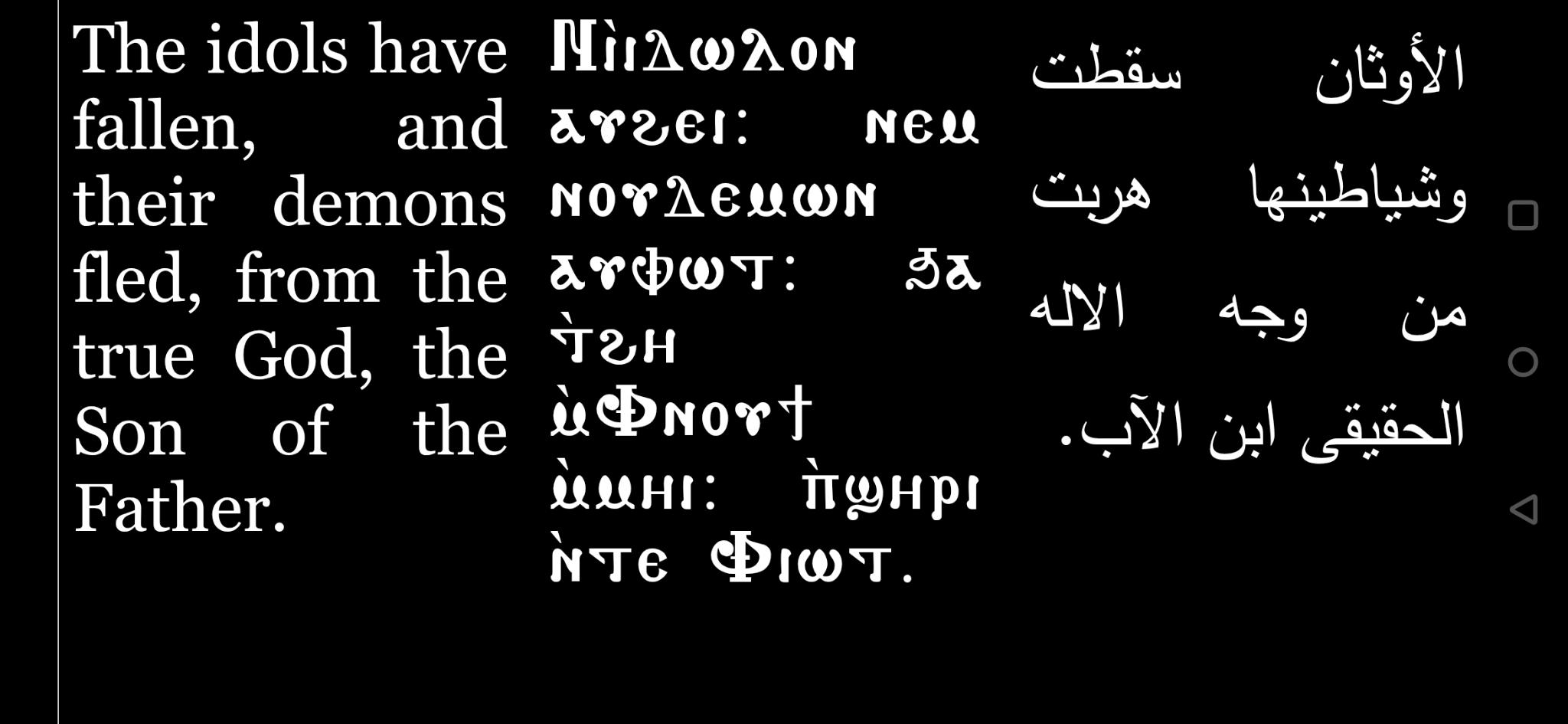
This was prophesied by Isaiah 700 years before it happened: “Behold, the Lord rides on a swift cloud, And will come into Egypt; The idols of Egypt will totter at His presence, And the heart of Egypt will melt in its midst.” (Isaiah 19:1)
Message
There is an important message that we can take from this
Egypt was filled with foreign idols - my heart can be too. Thoughts, Fears, Relationships, Desires or Lusts, Anger, Ambitions, Disputes, Sadness.
How can these be idols?
- They take away my focus
- They take from my time
- They use up all my energy
- I can lose my life worried about these things
- I can lose my future
- I can lose the effort that I have put in already
There is nothing more important than my relationship with God and my eternity - but if I am constantly focused on a relationship that God is not a part of, then I drive myself further from Him. That relationship becomes my idol - taking me from my spiritual life, taking me from Liturgy and Vespers and Praises, causing me to sin, causing me to be a stumbling block.
If I am so driven in my ambition - my career and my education - that I neglect my spiritual life: no time for prayer, no time for Bible, no time for Liturgy or Vespers or Praises, then my ambition has become my idol and has become my god.
Dispute - sometimes I am in a dispute or I disagree with someone or I have a different school of thought and it becomes my idol. My mind is completely focused on this dispute "I am right and they are all wrong" and everyone around me is at peace but I am not at peace and I won't even allow myself to be at peace. So now the dispute itself has become my idol! Or anger itself has become my idol. I would rather be angry than to be wrong.
Desires - someone may go with the wind in his life. Whatever he desires he has it. If he wants a certain kind of food, he goes to get it. Doesn't matter fasting or not fasting. Doesn't matter if his wife labored at home to make him a meal - I want what I want, I go get it. Then my desires have become my idol. God forbid when he wants something sinful.
Something physical - money or possessions (car, house, brand name clothes or shoes, jewelry). If my first thought in the morning is about money or checking on my possessions then they have become for me and idol.
When the Lord entered Egypt, the idols tottered and fell. Let us take this Feast as an opportunity to pray to the Lord that He enters our heart and totters the idols of our heart.
Paone
2026-06-28: 3rd Sunday of Paone - “By Your Words”
“For by your words you will be justified, and by your words you will be condemned.” (Matthew 12:37)
The words that we speak should not be taken lightly. By my words I will be justified and by my words I will be condemned...
- "Judge not, that you be not judged." (Matthew 7:1)
- "But whoever says, 'You fool!' shall be in danger of hell fire." (Matthew 5:22)
- "Not what goes into the mouth defiles a man; but what comes out of the mouth, this defiles a man." (Matthew 15:11)
- "If anyone does not stumble in word, he is a perfect man, able also to bridle the whole body." (James 3:2)
You see the great danger of my words? This is why many of the great saints and desert fathers preferred to live in silence.
This is why St Arsenius said: "I have often repented of having spoken, but never of having been silent."
Words of Condemnation
What are some of these Words of Condemnation:
- Filthy Language
- Lying
- Blasphemy
- Mockery
- Harsh or Angry words
- Bitterness
- Gossiping
- Envy
- Talk of pride or boasting
- Exaggeration
- Words of hypocrisy or deceit
- False witness and repudiating others
- Foolish disputes and prattle
- Talk that when it is poured into the ears of others, defiles their purity or their thoughts or their faith or their knowledge
- Talk that damages relationships or causes friction
- Talk that changes someone's mind about his friends
- Making excuses
- An excuse is a reason I try to find to cover up my sin in order not to be blamed, or to justify my failure in doing something good
- Fault that goes back to Adam and Eve... Adam blamed Eve for giving him the fruit and God for giving him Eve! Eve blamed the serpent who tempted her! But she didn't have to obey the serpent, and Adam didn't have to obey Eve! So they are unacceptable excuses!
- I may try to find an excuse for not completing my spiritual disciplines... "I don't have time" - but in reality I have time for various entertainment
- I may try to find an excuse for not offering my tithes to God... "I don't have enough" or "The Church has enough" - but in reality, the widow who gave two mites and the widow who gave the last of her flour and oil to Elijah... they gave out of their need and saw the blessing of the Lord.
- How about King David? How many excuses could he have come up with to avoid fighting Goliath?
- How about the right hand thief? How many excuses could he have come up with to avoid believing in Christ?
- How about Daniel and the Three Youth? How many excuses could they have come up with to eat the king's food, or to avoid the fire or the lions' den?
- Excuses are a result of laziness
- "The lazy man says, 'There is a lion in the road! A fierce lion is in the streets!'" (Proverbs 26:13)
- Complaining or Grumbling
- Many times you have someone who is a complainer... all of their talk is complaints. And they go into any situation trying to find the flaws. And sometimes it hides behind the veil of "giving feedback"
- Complaining is very different from giving feedback
- Complaining is emotionally-driven and comes from dissatisfaction
- Feedback wants to arrive at a solution together
- Idle words
- Useless Words - no benefit, no edification, nothing
- Careless Words - lazy, thoughtless, unnecessary
"So then, my beloved brethren, let every man be swift to hear, slow to speak, slow to wrath." (James 1:19)
The one who is quick to talk and rushes into speaking is bound to err. And once we have said a word, we cannot get it back.
Words of Justification
There is such a thing as useful talk!
The saints used to travel from the farthest ends of the world, just to hear a "word of benefit" from the mouth of one of the fathers.
- "It is not you who speak, but the Spirit of your Father who speaks in you." (Matthew 10:20)
- "O Lord, open my lips and my mouth shall show forth your praise." (Psalm 51:15)
Words of Justification:
- A word of blessing
- A word of comfort
- A word of encouragement
- A word of solution
- A word of guidance
- A word of teaching
- A word of rebuke if it is said with love
Gentleness
- A spiritual person never uses harsh words, but gentle ones because gentleness is one of the Fruit of the Holy Spirit
- The Lord Jesus when He talked to the Samaritan Woman
- Although she is very sinful, the Lord says to her: "You have well said, 'I have no husband', for you have had five husbands and the one whom you now have is not your husband.'"
- See His gentleness even in using the word husband... none of those five were technically a "husband" but He did not choose to use a harsh word.
- Instead of hurting people, try to win them
- St Paul, when he went to Athens, he saw the city is full of idols... how did he address them?
- "Men of Athens, I perceive that in all things you are very religious..."
Timing
"Do not answer a fool according to his folly,
Lest you also be like him.
Answer a fool according to his folly,
Lest he be wise in his own eyes." (Proverbs 26:4-5)
See these two verses... they seem to be exact opposites of each other! Do not answer a fool according to his folly... answer a fool according to his folly. What does it mean? It means that sometimes I will answer, and sometimes I will not!
"To everything there is a season, a time for every purpose under heaven: ... A time to keep silence, and a time to speak" (Ecclesiastes 3:1, 7)
Advices for Talking
Here I want to give some points for effective communication... advices for talking. These advices are for a husband talking to his wife, or a wife talking to her husband, or a parent talking to their teenager, or a teenager talking to their parent, or for two friends talking to each other, or for when you talk to Abouna...
- I don't talk for the sake of talking (e.g. to hear myself speak), but I talk to achieve something
- Talk when there is an ear ready to listen to you
- My high schooler wakes up at 6am and goes to school and after school, he goes to an extracurricular, or he goes to work, and then maybe he comes to Sunday School in the evening because it's Friday... and as soon as he walks into the door, I start yelling at him because he left the light on this morning... or because his room is not clean. What kind of result am I expecting from this conversation?
- On the other hand... my dad just came home from a long day at work. And as is usual, there was some stress at work and with the boss and things didn't really go his way, etc. And I go to him ready to deliver bad news... This is not the best time to approach with a difficult discussion! What kind of result am I expecting from that conversation?
- Don't talk to someone exhausted or tired, physically or otherwise, someone who is under pressure, etc.
- Don't talk to someone who is busy and has no time to listen to you, or does not have time to understand and discuss your point of view
- Many youth say "my parents never see my point" and many parents say "my children don't listen to me" - most of the time it's because we are not choosing the right time to talk. We are trying to talk in the middle of a heated argument, after a long day at work or school, with emotions flying through the air.
- Before you talk to someone, choose the right time - when they are feeling the best, when they are not preoccupied, when they are focused
- Listening Ear... Don't interrupt
- If you interrupt the one speaking to you without giving him a chance to talk, and you answer back before he is finished - so you are acting like an opponent. It makes the conversation into an argument instead of a discussion.
- You will lose the ability to convince, no matter how logical your opinion
- "So then, my beloved brethren, let every man be swift to hear, slow to speak, slow to wrath." (James 1:19)
- Talk privately
- Trying to talk in the middle of a big group, and have a discussion or a debate or an argument... if you win the argument in front of this big group, and you feel you have defeated! Then you will lose the person
- Your goal is not to win arguments or debates, but to win someone to your side
- Also after your private discussion... it was private. Keep it private. There is no reason to share the details or the result with anyone else
- “Moreover if your brother sins against you, go and tell him his fault between you and him alone. If he hears you, you have gained your brother.“ (Matthew 18:15)
- Respect the Person
- Don't mock the ideas of another
- Even if the ideas are weak or trivial or impractical or illogical... what result does mocking get? Respect the opinion of the one you are talking to.
- “Let your speech always be with grace, seasoned with salt, that you may know how you ought to answer each one.” (Colossians 4:6)
- Control Your Emotions
- My high schoolers comes to me and says "I want to go hang out with my friends next week. Can you take me?" And immediately I get in a fit of rage and I start yelling and cursing and accusing: "You always go out with them" and "You never listen to me..." What kind of a result am I expecting? The result here is that my high schooler will not share with me or ask permission again. I will lose them.
- There is someone who whenever a difficult conversation starts, they become emotional and resort to tears and yelling and being overcome by emotion... so this gives the message that I cannot be reasoned with or you cannot have a conversation with me!
Conclusion
"A word fitly spoken is like apples of gold In settings of silver. Like an earring of gold and an ornament of fine gold Is a wise rebuker to an obedient ear." (Proverbs 25:11-12)
I hope that we can apply some of these practices when we talk to our spouses, or to our children, or to our parents, or even our friends, or even when we talk with Abouna.
“For by your words you will be justified, and by your words you will be condemned.” (Matthew 12:37)
2026-07-05: 4th Sunday of Paone - “Love your enemies”
“But I say to you who hear: Love your enemies, do good to those who hate you, bless those who curse you, and pray for those who spitefully use you.” (Luke 6:27-28)
Love your Enemies
- The Lord recognizes that we will have enemies... but enemies are those who hate us, not those who we hate. We respond to them in love, trusting that God will protect our cause.
- Many times we are concerned lest when we show love, people will take advantage of us... but if we trust in God, He will protect our cause
- Love your enemies
- This is a radical new teaching
- In the Old Testament it was said "love your neighbor and hate your enemy" - we never heard before the Lord Jesus Christ that anyone said "love your enemies"
- It is a very simple command to understand, but very difficult to obey - unless you receive grace from the Holy Spirit
- Love is not emotion (warm fuzzy feeling) but a decision
- If we wait for our emotions or feelings, we may never love them
- I need to make the decision that I will love my enemy and do good for them
- The Lord is speaking about acts of love.
- "If your enemy is hungry, feed him; If he is thirsty, give him a drink" (Romans 12:20)
- When God sees me doing this, then this love will be processed by the Holy Spirit from the mind and will and intellect to the heart and emotions
- How to love enemies:
- Do good to those who hate you
- If someone hates me, what is my gut feeling? Maybe my gut feeling is to hate him back.
- Maybe by self-control, I am able to ignore and avoid him and do nothing - be neutral.
- But the commandment of God is even one level higher… to actively go out of my way to do good for him
- Bless those who curse you
- If I am cursed at, what is my gut feeling? Maybe my gut feeling is to curse back.
- Maybe by self-control, I am able not to respond and to ignore and to walk away.
- But the commandment of God is even one level higher… to bless him.
- Pray for those who spitefully use you
- Do good to those who hate you
- The Lord gives some examples
How?
To him who strikes you on the one cheek, offer the other also. And from him who takes away your cloak, do not withhold your tunic either. Give to everyone who asks of you. And from him who takes away your goods do not ask them back. And just as you want men to do to you, you also do to them likewise.
- For us, this commandment is so foreign - how can I just let someone strike me? How can I just take it or accept it? I will appear weak! I will be enabling him! I will be taken advantage. Actually, if I just let him abuse me, then he won’t learn and maybe he’ll do it again to someone else… no, I need to teach him a lesson! It is good for him, God would want someone to teach him a lesson. Actually, God sent me to teach him a lesson…
- This is the conversation I’d probably have in my head within a moment of being struck…
- But the commandment of God is clear. Offer the other also.
- There was a man who was demon possessed and they took him to see an elder hermit that God had graced with the power to cast out demons. The demon caused the man to slap the hermit... the hermit turned the other cheek and the demon immediately left the man. The demon cried out "I must leave - I cannot stay any longer. The commandment of Christ is casting me out." Nothing puts down the pride of the devil as humility and obedience to the commandment of God.
- Practical Examples:
- Someone cuts you off in traffic - so I start honking and getting mad and tailgating him, etc. That’s retaliation… turning the other cheek is that I tap my brakes, and let him go. And maybe later on when he wants to come in, I let him come in the lane.
- Someone posts about you on social media in a sarcastic or mean way - so I start posting about them and making fun of them, etc. That’s retaliation… turning the other cheek is ignoring it, and speaking about that person graciously.
- Your spouse comes home from a long day, irritated… so you start bringing up what he did 5 years ago and how he doesn’t contribute around the house, etc. That’s retaliation… turning the other cheek is pausing, giving him some space, and going to serve him.
- Someone at work takes credit for your work… so I start publicly embarrassing them, sabotaging their work, etc. That’s retaliation… turning the other cheek is that I clarify my contribution if needed and I am calm and without bitterness.
- Someone gossips about me… so I gossip about them. That’s retaliation! Turning the other cheek is that I speak the truth about myself, speak generously of the person, and go about my day
- Let me always consider whether or not my response is for retaliation, or given out of anger… or if it is graciousness and to be a peacemaker.
- This commandment doesn’t mean I should allow myself to be abused or taken advantage of, but it means that I am a peacemaker. It means that I let the small things go. It means that I am gracious. It means that I don’t allow my spirit to be disturbed.
- Christianity demands a standard that surpasses what is normally expected
- We have the grace of the Holy Spirit - so we are expected to behave in a behavior which surpasses the normal
- The Lord urges us to pursue a lifestyle that demonstrates God's mercy to everyone
- If we are grounded in God's love, trusting fully in the Holy Spirit, it will be easy for us to live in this way
No Credit Otherwise
“But if you love those who love you, what credit is that to you? For even sinners love those who love them. And if you do good to those who do good to you, what credit is that to you? For even sinners do the same. And if you lend to those from whom you hope to receive back, what credit is that to you? For even sinners lend to sinners to receive as much back. But love your enemies, do good, and lend, hoping for nothing in return; and your reward will be great, and you will be sons of the Most High. For He is kind to the unthankful and evil. Therefore be merciful, just as your Father also is merciful.
- I was talking to someone once who had gotten upset from one of his brothers. And he said to me “I am very humble usually, but when someone goes against me I can’t hold myself.”
- So I told him, Okay… that means you are not humble! Humility is not proven until it has been tested… Unless I can be humble in the face of a decision I disagree with, and in the face of tribulation, then I am not humble!
- The same with love!
- If I only love those who love me, it doesn’t count! It’s not love! “What credit is that to you?”
- If I only do good to those who do good to me, it doesn’t count! It’s not doing good! “What credit is that to you?”
The Reward
“Give, and it will be given to you: good measure, pressed down, shaken together, and running over will be put into your bosom. For with the same measure that you use, it will be measured back to you.”
- Measure of grain so pressed and shaken that it could hold no more and has started to run over
- With the same measure that you use, it will be measured back to you
- It is a powerful motivation for us - if we want more from the Love of God and forgiveness and goodness, then give more to the others and you will receive
Abib
2025-07-13: 3rd Sunday of Abib - Characteristics of Successful Ministry
Visual Aid
Background
Today is the 3rd Sunday of the Blessed Month of Abib. The Church arranges for us the readings of the Coptic Month of Abib to be about our fathers the apostles and their ministry. At the beginning of the month, we are fasting the Fast of the Apostles and on the 5th day the Feast of the martyrdom of St Peter and St Paul. So the focus of the readings for the whole month, takes from this and we see how the Lord supports the Apostles in their ministry.
- In the 1st Sunday, we read the gospel of the commission of the 70 Apostles when the Lord Jesus sent them and gave them instructions about the ministry.
- In the 2nd Sunday, we read the gospel of the Lord warning the Apostles against becoming a stumbling block and the message was about the offenses of the ministry.
- Today, in the 3rd Sunday, we read the gospel of the feeding of the multitude and we see the administration of the ministry.
- Next week, in the 4th Sunday, we will read about the raising of Lazarus, and God willing, we will see the the gifts of the ministry.
Introduction
The Gospel reading today is from Luke 9:10-17 - it is the same Gospel Reading that we pray in the 9th hour of the Agpeya. And there are many messages that we can take from it related to ministry and service. Before we look at today's Gospel, let's ask ourselves the question of "who are the ministers?" Lest anyone think "well I'm not a servant so this message is not relevant to me"
Does service only apply to those who are serving in an official capacity? What if I am not serving in Sunday School or Youth Meetings or Bible Studies or Hymns Classes? What if I am not a deacon? What if I don't serve in the kitchen service or the cleaning service or the orban service? Does that mean these gospel readings are not relevant to me?
Definitely not. As Christians, we are ALL called to be servants.
Minister to One Another
"For you, brethren, have been called to liberty; only do not use liberty as an opportunity for the flesh, but through love serve one another." (Galatians 5:13).
- Liberty means freedom; free from the bondage of the sin - don't use your freedom as an opportunity to serve yourself, to entertain yourself, to give in to your passions, to satisfy the lusts of the flesh... but use your freedom to serve one another through love. True Christian freedom is to make myself a servant and to give to others
"As each one has received a gift, minister it to one another, as good stewards of the manifold grace of God." (1 Peter 4:10)
- When I use my talents to serve others, I am acting as a good steward of God's grace
We are all called to serve one another, and to be ministers to one another. To use our talents to support our brothers and sisters. And to be good stewards of God's grace. To love one another.
Minister in My Responsibilities
In addition to that, I may have other roles or responsibility that require me to minister to others.
- A husband is responsible for serving his wife.
- A wife is responsible for serving her husband
- A mother and father are responsible for serving their children
- A son or daughter is responsible for serving his or her parents - especially as they get older
- In my workplace, I can serve my co-workers
- In my classroom, I can serve my peers
Minister to My Own Soul
On top of that, I need to minister to my own soul - as St Paul writes to the Philippians:
"work out your own salvation with fear and trembling" (Philippians 2:12)
So we will look at several characteristics of the Lord's Ministry that I can apply to myself as ministering to others, as ministering in my responsibility as a parent, spouse, son, daughter, etc. and ministering to my own soul.
The Impartial Ministry
The first important lesson from the Lord's Ministry in this chapter is that it is an Impartial Ministry. The Lord did not turn the people away.
First of all, the people followed Him without invitation in the first place - we read that the Lord took the disciples and "went aside privately into a deserted place belonging to the city called Bethsaida" - He is going to take private retreat with His disciples in a deserted place. "But when the multitudes knew it, they followed Him."
How did the Lord react to this? We read in the Gospel "and He received them and spoke to them about the kingdom of God, and healed those who had need of healing."
He received them, and gave them sermons, and did good works for them. And then when the disciples wanted to turn them away to go and find food, the Lord again accepted them and said "you give them to eat."
The Impartial Ministry or the Welcoming Ministry.
- Sometimes, I don't want to serve others because it is inconvenient for me. The time is not convenient. I don't feel like it.
- Sometimes, I only serve those who can serve me back - who can repay me, or who did something for me in the past
- Sometimes, I only serve those who are nice to me and love me and do good for me and make me happy
- Sometimes, I only serve those who have good reputations or are popular
- Sometimes, I only serve those who I know them very well and I spent a lot of time with them and I know their family
The Gospel in Vespers last night had this message for us. The Lord was invited to the house of one of the rulers of the Pharisees and said to him: "When you give a dinner or a supper, do not ask your friends, your brothers, your relatives, nor rich neighbors, lest they also invite you back, and you be repaid. But when you give a feast, invite the poor, the maimed, the lame, the blind. And you will be blessed, because they cannot repay you; for you shall be repaid at the resurrection of the just." (Luke 14:12-14)
St Paul in the Pauline Epistle today, writes to St Timothy "Now godliness with contentment is great gain." - Serve without expecting a reward. Serve with contentment. Content with the food on your plate and the clothes on your back - "For we brought nothing into this world, and it is certain we can carry nothing out."
The Lord did not turn them away. He didn't say "well you aren't from My 70 Apostles." He didn't say "the time is not convenient, I am here in a private gathering." He didn't say sorry, the time is inconvenient. But instead He accepted them, welcomed them, and ministered to them.
Let me do the same when I minister to others.
- When I ask about someone - how is he doing, how is his health, how is his family, how is his work, where has he been
- When I give a smile
- When I encourage someone
- When I show appreciation
- When I comfort someone who is mourning
- When I visit someone who is lonely or someone who is sick
- When I give a compliment
- When I honor or respect someone
- When I helping someone with their needs financially or with clothes or furniture or medicine
- When I am offering up my talents - maybe I am good with computers, or I am able to cook, or I know how to sew and to tailor clothes, or I am good with plumbing or electricity or HVAC, or I can help diagnose an issue with the car, or help with a medical issue, or I can tutor someone in a specific subject, or accompany someone to an appointment.
Whether it's someone I know, or my friends, or a stranger, or even my enemy - the Lord says: "Do good to those who hate you" (Matthew 5:44)
So our first characteristic of successful ministry is Impartial Ministry.
The Holistic Ministry
The Lord did not turn anyone away, and He gave them the spiritual food, and even healed them from their sicknesses. But why did the Lord feed the multitude? The disciples recommended sending them away to find supplies elsewhere. Isn't it enough that the Lord gave them the spiritual food, and even healed them from their infirmities and sicknesses?
The second lesson we can take from the Lord's Ministry is that it is a Holistic Ministry
- Everyone of us has a body, has a spirit, has an intellect, has emotions, has relationships.
- St Paul writes at the end of 1 Thessalonians: "May the God of peace Himself sanctify you completely; and may your whole spirit, soul and body be preserved blameless at the coming of our Lord Jesus Christ." - spirit soul and body
- The Lord didn't just minister to the spirit, but also to the intellect, to the emotions, to the body
- For example when He healed a leper, He didn't just heal his physical infirmity, but He touched him. A man that had not been touched by another person in so long, the Lord touches him to show him that he is loved, that he is human, that he is not alone. And then he told him to show himself to the priest and offer a sacrifice and to do the spiritual part. The Lord in His Ministry was always holistic, looking at the whole individual.
- The Church also serves Her congregation holistically as well.
- For example in Sunday School, our children enjoy a lesson and activities which is an intellectual and spiritual meal
- Then, they are given time to play sports and play outside and breathe fresh air - physical activity and physical health
- They are encouraged to play together and to build and strengthen godly friendships
I also need to minister holistically to those whom I am called to serve
- For example, as a parent, I am responsible for the well-being of my children in all aspects of their lives...
- I need to provide for them physically - to give them good and healthy food, to encourage them to breathe the fresh air outside, to play sports or exercise, to bathe and brush their teeth and take care of their hygiene
- I need to provide them with adequate schooling and education; I need to encourage them to study, help them with their homework, follow-up with their grades and their exams, give them opportunities for learning especially during the breaks like summer vacation
- I need to encourage them to build relationships with others, to cultivate healthy friendships, to love and respect the stranger
- And the foundation for all of these things is that I teach them the way of the spiritual life - I follow-up with their prayers, with their Bible Readings, I encourage them in the sacramental life - repentance & confession and the Eucharist, I ensure they are attending Vespers and Praises and Liturgy on a weekly basis, I make food that will encourage them to fast on Wednesdays and Fridays and the fasts of the Church. Of course, the Church will support me in the spiritual upbringing of my children, but the Church is not a replacement for my role. I cannot depend on the 2 hours a week of Sunday School, but rather I have to work WITH the Church.
- Yesterday night, Abouna Reweis told us the story of St Julitta and her son St Kyriakos, and how she taught him from a young age to say "I am Christian" and when it came to his martyrdom, at three years old he proclaimed his faith in the Lord Christ. This is the result of his spiritual upbringing by his mother.
- Many parents focus so much on the intellectual and education and studying and obtaining degrees and having a good career, but what's the point of a career if he loses his salvation? What's the point of degrees if she doesn't know how to socialize with others or form relationships with others?
- I have to minister to my child holistically, I am responsible for his or her well being in ALL aspects of their lives
- Even as an individual, I need to see myself holistically and to examine myself in all aspects of my life
- Let me strive to glorify God in my intellect - education, career
- Let me strive to glorify God in my body - to keep good hygiene, to stay in shape, to eat healthy, to exercise
- Let me strive to glorify God in my relationships - to turn away from evil relations, to distance from friends that bring me down, and to get closer to those who raise me up
- And let me strive in my Spiritual Life - in my fasting, prayers, prostrations, readings, in repentance and confession, in the liturgical life
"For what will it profit a man if he gains the whole world, and loses his own soul? Or what will a man give in exchange for his soul?" (Mark 8:36-37)
The Organized Ministry
We might say - it's difficult to do all of that. How can I, as a parent, focus on all of these things and also I have my work 40 hours a week. It's impossible!
We can take another lesson from the Lord's Ministry here - It is very organized. Our God is a God of order and not of chaos.
We start by reading that the Apostles returned from their mission and told Him all that they had done. They reported to them the details of the service He had sent them to do. And then, after the Lord had taught the multitude and healed many, the disciples reported to Him - the people don't have food. Send them away to go and rest and get food. But the Lord said to them "You give them to eat." And He told them to organize them into groups of 50 - and that's how we know the multitude was 5000 men, because they were separated into groups and organized. Then He told them to distribute among them the fish and the loaves. Then He told them to collect the remainder in baskets. The Lord is always organized in His Ministry.
That's why, also we see that the Church services are organized. There are services and people responsible for those services. And there are schedules and timetables. And there are group chats and announcements and emails and systems and websites pickup and drop-off lines. When we are organized in our ministry, taking the example of the Lord, then the ministry can be successful.
Organization is not something that is just administrative or social, but it is something that is spiritual.
The Spiritual Person will be organized in his life. When my time is organized, I will find that I have time for prayer, time for work, time for rest, time for my family, time for myself, time for social life, etc. But if my time is not organized, I will find that I am not successful in my spiritual life. If I am waking up in the morning and it takes me 10 or 15min just to figure out what I'm going to wear - so when will I pray?
I need to be organized, to minister to my soul:
- I wake up at this time, I stand in my room for prayer, I take care of my hygiene, I go to school or work, I have a time for eating, I have a time for rest, I have time for my spiritual canon, I have time for sleeping. If I am organized, I will find time for all of those things - but if I am not, then the first thing that will suffer will be my spiritual life. We have all experienced it, and we have all said it: "I didn't have time" - "I was too busy" - "I was too tired."
- Same thing if I am a parent - I should model the organized life for my children. I should help them to have a daily routine. Wake them up at a certain time, stand and pray WITH them, eat with them, give them chores and things to help around the house.
- Same thing if I am a spouse - I need to be organized so I'm able to spend time with my spouse
"See then that you walk circumspectly, not as fools but as wise, redeeming the time, because the days are evil." (Ephesians 5:15-16)
The Cooperative Ministry
The fourth lesson that we can take from the Lord's Ministry here is that it is a Cooperative Ministry. The successful ministry is the one that is Cooperative between God and Man. There is a human element and a Divine element.
- The human element is what I need to do - what I CAN do.
- The Divine element is what I CANNOT do, and God will do it.
The disciples brought the five loaves and the two fish - this was all they could do. But the Lord took what they had and blessed it and multiplied it and fed a multitude with it. In the reading next week, the disciples will move the stone of Lazarus' tomb, and the Lord will raise him from the dead. The disciples cast the net, and the Lord multiples the fish.
The same in my own life and ministry:
- I visit someone who is in need - maybe in the visit, I don't do anything or I don't say anything. But the Lord will give them comfort by my presence.
- I encourage someone with my words - the Lord energizes him to keep going
- I teach my children - the Lord will remind them of those lessons at the time when they need it the most
- I set aside time for my spiritual canon - the Lord will multiply my time throughout the day.
- Small gestures of appreciation for my husband or wife - the Lord will multiply peace in my marriage
St Paul says to the Corinthians: "I planted, Apollos watered, but God gave the increase" - we do the easy part, and God does the hard part.
The Lord said to St Paul: "My strength is made perfect in weakness." - we do the weak part, and God does the strong part.
God will never do our part - that would encourage and enable laziness. No! I need to do the parts that I CAN do and the Lord will take care of the rest. I give the 5 loaves and 2 fish, He feeds 5000 men + women and children.
The Abounding Ministry
Finally, what is the result of this ministry? This Ministry that is Impartial, that is Holistic, that is Organized and that is Cooperative with God - the result is an Abounding Ministry. A Ministry that is abundant.
The Gospel ends with the words: "So they all ate and were filled, and twelve baskets of the leftover fragments were taken up by them"
At the beginning of the day, they were hungry and had only 5 loaves and 2 fish. At the end of the day, they are filled and have 12 baskets of remaining fragments. This is abundance.
The result of a successful ministry is abundance:
- When I minister to others, I find myself in an abundance of joy, kindness, goodness, and the other fruit of the Spirit.
- When I minister to the spouse and my children, I will find that my family is abounding in love; my home is abounding in peace
- When I minister to my own soul, I will find that I am abounding in God's grace. That I am growing in virtue. That I am acquiring and living the fruit of the Spirit
- And of course, the abundance is not only here on earth but the Lord promised us treasures in heaven.
King David writes in Psalm 23: "My cup runs over" - abundance. More than I can hold.
Conclusion
May the Lord grant us to examine ourselves and learn from His example in Ministry, to Minister to one another in love, to Minister to our spouse, children, parents, and to Minister to our own soul that He may take our small offering, our weak offering, our easy part - and multiply it for His glory, for the salvation of all.
Glory be to our God. Amen.
2025-07-20: 4th Sunday of Abib - Raising of Lazarus
Introduction
Why did the Lord weep?
In the beginning of the gospel, the Lord said:
"This sickness is not unto death, but for the glory of God, that the Son of God may be glorified through it.”
And later he explained it to the disciples:
"Our friend Lazarus sleeps, but I go that I might wake him up."
So if the Lord knows that He will perform a miracle, and He knows that Lazarus will live and walk again, then why did the Lord weep?
Of course, the Lord loved Lazarus - but His tears were not simply for His friend's death, but for death itself.
St Cyril of Alexandria says: “The Jews thought that Jesus wept on account of the death of Lazarus, but in fact He wept out of compassion for all humanity, not mourning Lazarus alone but all of humanity, which is subject to death, having justly fallen under so great a penalty.”
In the Liturgy, we will hear Abouna say: "And death which entered into the world through the envy of the devil, You have destroyed"
Death entered into the world, through the envy of the devil... What is death? Sin is death.
The Lord is weeping not for his friend's death, but for death itself. For sin. For humanity's fallen nature.
When I am in sin, I am dead. If sin is separation from God, and God is Life, then when I separate myself from Life, I am dead. When I am far from God, I am dead. When I am far from Light, I am in darkness and the shadow of death. But when I repent from the sin, I am raised again to life.
The Lord wept for death and He told His disciples - "Lazarus is dead." God forbid that I hear these words from the mouth of the Lord about myself "Morcous is dead" - God forbid.
Three Resurrections
In the four gospels, the Lord raised three people from the dead. Three miracles of raising the dead performed by the Lord in the gospels:
- The raising of Jairus' daughter
- The raising of the son of the Widow of Nain
- The raising of Lazarus
The Fathers see these three Resurrections as symbolizing our Resurrection from Sin at its various stages.
The Resurrection of Jairus' daughter happened when she had just fallen asleep. She was not even removed from her house yet. It's right after she died, that the Lord came and raised her. This represents the beginning stage of sin.
The Resurrection of the Son of the Widow of Nain happened after he had died, and was taken out of his home and carried in a coffin, but not yet buried. At this time, the Lord came and raised him. This represents the next stage of sin. I am dead, I am on the way to be buried. Sin is growing and it is hiding, as the young man was hidden in the coffin.
The Resurrection of Lazarus happened after he had died, was taken out of his home, carried to a tomb and buried in it, and then left for four days. The Gospel tell us - "there was a stench." At that time, the Lord came and raised him. This represents the last stage of sin - I am dead, buried, and am corrupted to the point that "there is a stench" that everyone around me can smell.
St James also tells us about various stages of sin: "But each one is tempted when he is drawn away by his own desires and enticed. Then, when desire has conceived, it gives birth to sin; and sin, when it is full-grown, brings forth death." (James 1:14-15)
Maybe I am in the beginning stage of sin - I heard about a sin, I am considering doing it, I tried it once. I did it on accident. I was pressured into doing it. I am like Jairus' daughter who was JUST pronounced dead a few minutes ago.
Maybe I am at a further stage - I have repeated the sin more than once, I am hiding it from my Father of Confession. I am like the son of the widow - dead and on the way to be buried.
Maybe I am at an even further stage - I am living the sin, I am not ashamed or embarrassed of it, I am encouraging others to do it or teaching them how. I am like Lazarus - I am dead, buried in the tomb, and there is a stench.
At all three stages, I am dead... I need repentance. And the later the stage, the deeper I am in sin, the more difficult it will be for me to come out of it.
Let's Take some Examples:
Gambling
- My friend told me about an app and I used it and then I found out it's gambling and it's a sin. This is still early stages. Jairus' Daughter
- Well even after I found out that it is gambling and it's a sin, I continued to do it. I made some money, I'm happy with the money! Everyone else is doing it, why not? It's not gambling if you do research, right?! Now sin is at the next level. The son of the widow of Nain.
- Now I'm teaching others how to play. I don't think what I'm doing is wrong... whoever said it was a sin didn't know about it. Now sin is at the last level - Lazarus.
The same can be said of any sin - lying, cheating, lust, anger, jealousy.
These are stages of sin that the Fathers see in these three dead people - but what unites these three stories, and what makes them miracles, is that the Lord RAISED all of them. He is the Resurrection and the Life, as He told Martha today.
See this icon how we see the Lord trampling on the serpent. The serpent here represents death. As we pray in the Thanksgiving Prayer - “It is You who have given us the authority to trample on serpents, scorpions, and upon all the power of the enemy.” So we see who else trampling on the serpent and on death? Jairus’ daughter.
No matter what I am struggling with, the Lord is able to raise me out of it. No matter how new it is, how old it is, how deep I am, how much I stand to lose, how much people know or don't know, the Lord can bring me out of it. He can raise me from the death of sin.
Let me ask myself - what is it that I am struggling with? What is it that I am keeping from my Father of Confession? What is it that I can't seem to shake, or that I've become addicted to? The Lord can bring me out of it.
How?
The Lord Seeks Our Repentance
Lazarus was dead in Bethany, but the Lord at the time was beyond the Jordan. But the Scripture tells us that He said to the disciples "Let us go to Judea again." Even though at this point in His Ministry, it was dangerous to go to Judea, the Lord tells them "Let us go to Judea again." He is seeking out Lazarus. He is seeking to raise him from the dead and into life.
Throughout the Holy Scripture, we see the Lord seeking the repentance of those who fall.
- Adam
- Starting even from Adam... After Adam and Eve had eaten from the tree, the Lord God called to Adam and said to him, 'Where are you?'
- Does the Lord not know where Adam is? Of course He does, He is All-Knowing... so why is He asking? He gives Adam a chance to confess. A chance to say "Lord, I made a mistake." - "Lord you gave me one commandment." - "Lord I was weak and I fell and I need You to pick me up."
- But Adam responds: "I heard Your voice in the garden, and I was afraid because I was naked; and I hid myself."
- Does the Lord leave him at that? No, he asks him again - "Who told you that you were naked?" - Confess! - "Have you eaten from the tree of which I commanded you that you should not eat?" Confess!
- See how the Lord continues to seek his repentance.
- And so Adam confesses - The woman whom You gave to be with me, she gave me of the tree, and I ate. He blames Eve, he blames God, but it's a confession.
- So the Lord moves on to Eve - "What is this you have done?" And Eve confesses right away - "The serpent deceived me, and I ate."
- The Lord Seeks our Repentance.
- St Gregory the Theologian in the Divine Liturgy, puts himself in the place of Adam and prays to the Lord, You have created me. You formed me. You laid Your hand upon me. You inscribed in me the Image of Your Authority. You gave me the gift of speech. You opened for me Paradise to enjoy.
- And then "of one plant have You forbidden me to eat, that of which You have said to me, 'of it only do not eat.'"
- And St Gregory gives us the confession: "But according to my will, I did eat. I put Your law behind me by my own counsel, and became slothful toward Your commandments. I plucked for myself the sentence of death."
- There's that word again - death. Sin is death. But the Lord seeks our repentance
- Cain
- And He didn't just do this with Adam, but in the next chapter with Cain when He asked him "Where is your brother?" and Cain responds "Am I my brother's keeper?"
- And He didn't just do this with Adam, but in the next chapter with Cain when He asked him "Where is your brother?" and Cain responds "Am I my brother's keeper?"
- King David
- With King David when He sent to him Nathan the Prophet
- Nathan told him a story about a rich man and a poor man, and when a traveler came, the rich man took all that the poor man had and gave it to the traveler
- So King David was enraged! He said that man shall surely die!
- Nathan told him "You are the man!" - It's you that is in this story because you took all that Uriah the Hittite had
- And David's response was "I have sinned against the Lord" - and King David in his repentance prayed and chanted and wrote many psalms.
- This is the answer the Lord is looking for from us - and we can take and use those psalms that King David wrote, like Psalm 50 the Psalm of Repentance.
- Nineveh
- When the Lord sent Jonah to Nineveh - He was seeking their repentance.
- When the Lord sent Jonah to Nineveh - He was seeking their repentance.
- St Peter
- With St Peter when He asked him "Simon Bar Jonah, do you love Me more than these?"
The Lord seeks my repentance. Every day that I wake up is a new chance the Lord is giving me for repentance.
The Lord Calls For Me
"Lazarus, come forth!"
Let me put my name in this verse and take it as a message to myself. The Lord is calling for me by name. Am I listening?
The Lord calls for me through the Church:
- Through my Father of Confession - when my Father of Confession gives me advice, or gives me a spiritual canon, or gives me guidance... this is the Lord speaking through him.
- Through my servants - my Sunday School Servants or my Youth Meeting servants. When my servant comes to me and says what you're doing is wrong - it is not pleasing to the Lord, it is not fitting for you as a Christian, you are putting yourself at risk - I take the message as coming from the mouth of God.
- The Lord calls for me through the lessons I hear in Sunday School, or the topics I hear in Youth Meeting. If I am not attending the Youth Meeting, how will I hear His voice and His call for me as a youth?
- The Lord calls for me through the sermons of our fathers the priests in Vespers and in the Liturgy. If I am busy on my phone while Abouna is talking, then I will not hear the Lord's call for me.
The Lord calls for me through His Scriptures:
- The Lord calls for me through my personal readings - when I read the Scripture, and I see myself in place of the Bible Characters, and I see my situations in the Bible stories, and I pray the Lord gives me a personal message, then I will hear Him calling for me.
- The Lord may call for me through the Liturgical Readings - when we read the Pauline, Catholic, Acts, and the Gospel
The Lord may also call out for me through my daily life
- I have the Bible app on my phone and every day it sends a notification to my phone "Daily Bible Verse." I take my finger and swipe right so it can go away - I don't read it, I don't look at it, I just naturally swipe it away. Maybe the Lord is sending me this verse?
- I am scrolling through my Facebook and Instagram - hopefully, if I have social media, then I am following good pages. There are pages that post lives of the saints, that post hymns and liturgies, that post icons, that post verses from the Scripture. And when I see those posts do I keep scrolling? Or do I think to myself - maybe the Lord is sending me a message.
The Lord is calling out for me
The Lord Frees Us
"Loose him and let him go"
Lazarus came out, but he was still in his graveclothes. So the Lord told the people "Loose him and let him go."
It reminds us of when the Lord instituted the sacrament of Confession with the Disciples. He said to them "Whatever you bind on earth will be bound in heaven, and whatever you loose on earth will be loosed in heaven." (Matthew 18:18)
What is binding me? What is preventing me from going to confession? The devil tries to trick us with the Sacrament of Confession. We will hear lies like:
- Abouna is too busy
- Abouna might judge me
- I don't have time
- I haven't confessed in a long time, it's too late
- God can't forgive this
- I'm too embarrased
- I don't need to confess
- I'm ashamed
- I'm afraid
- I can't stop my bad habits
These are graveclothes that we have to remove so that we can be loosed in the Sacrament of Confession.
If I don't receive the sacrament of Repentance and Confession in its completion, and sit with my Father of Confession, then I will continue to be dead.
And this is why the Church arranges for these readings on the 4th Sunday of Epep. We mentioned last week that this month focuses on the ministry of the Apostles and the Lords support for them. One of the gifts of this ministry is the raising of the dead - the raising of the spiritually dead by the Sacraments.
Today, by Gods grace we celebrated the baptism of a blessed family. This baptism is a participation in the Resurrection of Christ. The removal of the old man and the putting on of Christ. But I cannot go and be baptized every week or after every sin. I have the Sacrament of Repentance of Confession and the Eucharist.
As the Lord said about Lazarus, “Loose him” so He also said to the apostles about us - whatever you loose on earth will be loosed in heaven
Action
So we had three points today in how the Lord raises us from the death of sin:
- The Lord Seeks our Repentance
- The Lord Calls for Us
- The Lord Frees Us
So now let me ask myself - what is it that I am struggling with? What is it that I am keeping from my Father of Confession? What is it that I can't seem to shake, or that I've become addicted to? What is the new sin that I want to make sure it doesn't get worse? What am I holding on to? Let me ask myself these questions, and having faith that the Lord can bring me out of it, let me set an appointment with my Father of Confession.
Maybe it has been a very long time since my last confession. That's okay - the Lord seeks my repentance. The Lord rejoices in my repentance. The Lord is calling for me - all of those messages I've been ignoring, the Gospel Readings, Abouna's sermons, the Sunday School Lessons, the Youth Meeting topics, the Bible verses that come as notifications or come across my feed, - let me take them as messages to repent and confess and receive the Eucharist. And the Lord will set me free.
May the Lord raise us up from the death of sin as He raised Lazarus, and grant us to hear His voice and come forth to the Resurrection of Life.
Glory be to God, forever. Amen.
2026-07-19: 2nd Sunday of Abib - Become As Little Children
Background
The disciples came and asked the Lord "who is the greatest in the kingdom of heaven?" and the Lord brought a little child and said "Assuredly, I say to you, unless you are converted and become as little children, you will by no means enter the kingdom of heaven. Therefore whoever humbles himself as this little child is the greatest in the kingdom of heaven."
It is a BOLD statement! "UNLESS you are converted and become as little children, you will BY NO MEANS enter the kingdom of heaven."
What can this mean?
Actually, it's ironic that we do the opposite! When we are little children, we want to grow up! We don't want to be children anymore! And then when we grow up a little we are upset if someone "treats me like a child!" And then when we have children, we try and hand them off to the grandparents every chance we get! Or we want to go on a trip without the children! And all this time, they have the keys to the kingdom of heaven
So what does the Lord mean to be converted and become as little children? What characteristics of children is He talking about?
"We must recall into the simplicity of children the vices of the body and mind. He has called children all who believe through the faith of listening. For children follow their father, love their mother, do not know how to wish ill on their neighbor, show no concern for wealth, are not proud, do not hate, do not lie, believe what has been said, and hold what they hear as truth. And when we assume this habit and will in all the emotions, we are shown the passageway to the heavens. We must therefore return to the simplicity of children, because with it we shall embrace the beauty of the Lord's humility." (St Hilary of Poitiers)
"Just as this child whose example I show you does not persist in anger, does not long remember injury suffered, is not enamored inordinately by the sight of a beautiful woman, does not think one thing and say another, so you too, unless you have similar innocence and purity of mind, will not be able to enter the kingdom of heaven." (St Jerome)
1 - Purity & Innocence
"Blessed are the pure in heart, for they shall see God.“ (Matthew 5:8)
“Who may ascend into the hill of the Lord? Or who may stand in His holy place? He who has clean hands and a pure heart” (Psalm 24:3-4)
- Children are pure - they are shocked by sin.
- They have not normalized evil
- If they hear a bad word, they are shocked and say "that's a bad word"
- They, themselves, would NEVER say a bad word
- We have become used to it in our workplace, our schools, the entertainment we watch, etc.
- They are honest, would never tell a lie
- Free from vices
- Pride, jealousy, rivalry, self-glory
- Don't compare themselves with others
- The Lord is calling us to obtain the purity of children
- Purity of thoughts
- Purity of words
- Purity of heart
2 - Humility
“I am the vine, you are the branches. He who abides in Me, and I in him, bears much fruit; for without Me you can do nothing.” (John 15:5)
“If you love Me, keep My commandments.” (John 14:15)
“Trust in the Lord with all your heart, and lean not on your own understanding.” (Proverbs 3:5)
- A child knows that he needs help
- He reaches for his father's hand
- He asks questions
- He depends on others
- An adult thinks he can do everything by himself
- Follows his father and mother
- Believes what has been said to him
- Holds what he has been taught as truth
- Faith begins this way - by trusting our Heavenly Father and obeying Him. After obedience comes faith.
- Sometimes we think that obedience comes after faith. Not so with a child.
- The Lord is calling us to obtain the humility of children and to realize that we can do NOTHING without Him
3 - Simplicity
“If your eye is good, your whole body will be full of light.” (Matthew 6:22)
- A child is simple
- if you give a child a cardboard box, he can play for hours
- If you give an adult a cardboard box, he will spend 8 hours trying to figure out why you gave it to him
- NOTE: Here I want to take a sidenote and caution you, because you might be saying "my kids are not innocent, humble or simple!" Unfortunately, in our modern day, our children are losing themselves in devices and screens... Videos that can take away their innocence; access to information that takes away their humility, and imbalances in the brain that take away their simplicity. Take away screens from your children (phones, tablets, computers, TVs) and replace them with playing outside, family time, board games, thinking games and pretend-play. You will be amazed how quickly they rediscover their imagination, creativity and happiness
- if you give a child a cardboard box, he can play for hours
- For example, if someone who is needy asks for alms, you will find the mom and dad overanalyzing "well what will he use it for? What can we do? I have a $20 bill I can't break it?" but the child is so simple - "Mommy, Daddy, can we give him something?"
- The Simplicity of children
- They just rejoice! They just enjoy their time! They make the best of it! They smile a lot
- I was talking with some parents recently and they were sharing something their young children were doing. Every night when it's bed time, the children don't want to go to sleep. So what do they do? They say "we have to pray" and then spend one hour praying! Thank you God for the couch, thank you God for the door, thank you God for the chair and the four legs of the chair and the cushion that's on it... and they are looking around the room trying to find anything else to say thank you God for. And finally when they can't, they start in all the details of their day. Thank you God for my teacher and when she said to me this and that, and when mommy picked me up from school, and when daddy came home... and when they can't find anything else, they conclude... Through the Intercessions of St Mary... Archangel Michael... Archangel Gabriel... Archangel Raphael... Archangel Suriel, .... and they name every angel and every martyr and every saint they can think of. Simple! Simplicity! Just so they don't go to bed!
- How many of us would rather go to bed than to pray 5 minutes?
- We lost our simplicity
- Instead, we might spend one hour gossiping with a friend. Or one hour replaying an argument in my head and thinking of all the things I SHOULD have said. Or one hour trying to figure out why someone texted me and the text ended with a period.
- The Lord wants us to obtain the simplicity of a child
4 - Courage
“For God has not given us a spirit of fear, but of power and of love and of a sound mind.” (2 Timothy 1:7)
“Whoever confesses Me before men, him I will also confess before My Father who is in heaven.” (Matthew 10:32)
- A child is courageous and fearless
- To go pick up a lizard or a snake...
- Climbing a tree
- Even in their speech, they are courageous to speak the truth. A child doesn't care who he's talking to - if it's his friend, or his parents, or Abouna or the President - they will speak the truth
- Children are not afraid to spread and preach their faith
- Many of our elementary children have taught their friends at school about Christ dying on the Cross, about Fasting, about praying, about being a deacon, etc.
- Adults are afraid of "political correctness" and "ramifications"
- The Lord wants us to obtain the courage of a child
Conclusion
When we grew up, we lost something. And we aren't the first ones! Even in the time of Christ, 2000 years ago, growing up meant we lost something. The Lord is calling us to regain it. To become like children again, in every aspect of my life.
- Purity – Relationship with Myself (my senses and my thoughts)
- Humility – Relationship with God
- Simplicity – Relationship with Others
- Courage – Relationship with the World
May the Lord grant to us to be like little children, that we may enter with them into the Kingdom of Heaven.
Mesore
2021-08-29: 4th Sunday of Mesore - Watch
Introduction
End of Calendar Year
- We are coming up on the end of the Coptic Calendar Year now
- For those who don't know, the Coptic Calendar is 12 months that are 30 days each starting with Thout and ending with Mesra. And then there is a small month that is 5-6 days (depending on leap year).
- So the last full month is Mesra which is the month we are in now.
- And the Sunday Lectionary is based around these months. So every Sunday, the readings are all pointing to a theme... And the four Sundays of every month come together to give us the theme of the month.
Theme of Mesra - Be Ready
- As you heard in the gospel reading today and last night, the Church arranged for us to read about the end times as we approach the end of the year. And next week, God willing, will be the Sunday of Little Month and we'll read about the Second Coming of Christ.
- So the Church is giving us a theme during these last days which is to BE READY. The theme of the month of Mesra is to BE READY.
- Be ready for what? We heard it today in the gospel...
- Wars
- Nation will rise against nation
- Kingdom against kingdom
- Earthquakes
- Famines
- Troubles
- Etc.
- Sometimes we read these passages and other similar passages and we want to know the details:
- When will this happen?
- Will it be during my lifetime?
- I see a plague or a pandemic... Is this what Christ was talking about?
- I see a war... Are we in the end times?
- And we're so curious about these things, pouring through the Book of Revelation and Daniel and Thessalonians and trying to figure it out.
- But the Lord was very clear... That's not what he wants from us. When the Pharisees asked him last night in the Vespers Gospel "when will the Kingdom of God come?" He told them "The Kingdom of God does not come with observation" but "the Kingdom of God is within you."
Theme of 4th Sunday Mesra
- So what is He saying? Don't worry about the end of the world! Worry about yourself. Worry about the end of your life which could come at any moment! We come to the end of the year and the Church is reminding us "don't forget the end of your life"
- St Athanasius: "In the end of all is the end of each, and in the end of each is the end of all... For who, if they knew the day of the end would not disregard the interval? But if ignorant, would they not he ready day by day?"
- The message from today's Gospel is not about the signs buy rather it comes to us from the very important passage at the end of today's Gospel reading:
- "it is like a man going to a far country... Watch!"
- Today's message is to WATCH
- You don't need to know when He is coming, you just have to know THAT He is coming. And since He is coming... Watch. Watch.
- What does it mean to watch? How do I watch? What do I watch?
- We'll discuss three points
1 - Spiritual Growth
Watch Lest You Become Stagnant
- In the Spiritual Life there is no concept of idleness or stagnation. There is only growing or falling. And if you're not growing, you're falling!
- Am I better today than I was yesterday? For example maybe yesterday I did not pray but today I prayed.
- Am I better this year than I was last year? Maybe this year I started to fast on Wednesdays and Fridays.
- Am I better this week than I was last week? This week I decided I would start attending the Midnight Praises, and I attended!
- The Church gives us many resources for spiritual growth:
- Prayer via the Agpeya
- Praises and the Psalmody
- Reading the Scripture
- Learning and chanting the hymns of the Church
- Fasting on Wednesday, Friday and all the fasts of the church
- Attend Spiritual Meetings (Youth Meeting, Graduates Meeting, Servants Meeting, Elders Meeting, Sunday School)
- Reading Spiritual Books
- Reading the Lives of the Saints
- Etc.
- This is the beginning of Spiritual Growth. Doing.
Watch Lest Your Growth not be Spiritual
- Of course, it's not enough to just DO with the body, but I must also do with the Spirit - that's why it's called Spiritual Growth
- I might open the Agpeya every day and read through it but my mind is somewhere else... My spirit is not present with me.
- I might read the Scripture every day, but my attitude towards it is Lukewarm. In one ear and out the other. I don't let it penetrate my spirit. I don't let it change me.
- I might fast and eat vegan food, but I am treating others poorly - my wife or kids or coworkers or even strangers.
- I could be in Liturgy every single week, but I am not participating at all. Or I am participating but my spirit is absent.
- Watch Lest your Growth be not spiritual. Remember that the Kingdom of God is within you.
- See what St Paul wrote to the Thessalonians in today's Pauline Epistle reading:
- "For this reason we also thank God... Christ Jesus."
- The Thessalonians were so concerned about the end times and why hasn't Christ come back yet, and what about our friends who died before Christ returned, and other sorts of panicking and questions. But St Paul wrote to them, thankful to God that they accepted the Gospel he handed to them as the word of God, and that it works in them effectively and that they imitated the Church. And he exhorts them to continue in Spiritual growth.
2 - Spiritual Warfare
Watch Lest you fall into Temptation
- Satan is crafty. He can come at you in many different ways and with many different methods.
- The good news is... We are not ignorant of his devices. We are not unaware. We know his tricks.
- He might come at me with pride. Convince me that I am better than those around me - I fast more, I pray more, I know more, I read the Bible more, etc.
- He might come at me with old sins - elementary or beginner sins. Sins that I repented of many years ago. And tempt me to fall into sin.
- He may attack me with laziness or complacency. I may forget that sometimes doing nothing is sin too.
- I have to be watchful of Spiritual Warfare and the tricks of Satan.
- Of course, the Spiritual Growth we just finished talking about gives us weapons and defenses against the temptation of the devil - fasting, prayer, Bible, etc.
Watch Your Participation in the Sacraments
- But what if I fall? I must repent of course.
- Watch that you repent with an open heart, confess with honesty, and receive the Eucharist worthily.
- This is what St James teaches us in the Catholic Epistle today:
- "Therefore submit... Lift you up."
- Repentance is the remedy to Spiritual Warfare.
3 - Talents
All have talents
- One of my favorite things about Nashville and coming to visit here is all of the talents. The people of Nashville are a wonderful congregation with so many talents
- Cooking and Baking
- Speaking
- Singing
- Art and Poetry and composition of songs
- Learning and memorizing
- Construction and Building
- Designing
- Fixing cars
- Doing hair styles
- Repairing appliances
- Administrative work
- Every single one of us has talents given by God without exception.
Watch Lest You Use the Talents for Your Own Glory
- Am I using my talents for the glory of God?
- Am I using my talents to serve God, to serve the Church, to serve others - my neighbors and my friends, strangers, even those who hate me?
- God gave us our talents to serve one another
- "As each one has received a gift, minister it to one another" (1 Peter 4:10)
Watch Lest You Ignore or Reject your Talent
- Sometimes the devil might convince me that my talent is not good. Or it's not as good as another talent. I might envy someone else's talent. I may completely reject my own talent or ignore it.
- Watch Lest you Ignore or Reject your Talent
- Watch Lest you hate or disdain your talent out of jealousy
Conclusion
Review
- We said today that the theme of the month of Mesra is BE READY
- And the focus during the fourth week (today) is WATCH
- And we took three examples of what to WATCH for:
- Watch for Your Spiritual Growth Lest you become stagnant, lest your growth be not spiritual
- Watch for Spiritual Warfare lest you fall into Temptation, lest you ignore the Sacrament of Repentance and Confession
- Watch for your talents lest you use them for your own glory, lest you reject or ignore them, lest you hate or disdain them
Application
- I hope that we can go home today and WATCH! Not watch TV or Netflix but WATCH myself. Examine myself in these areas.
- Let us enter the new year having a plan for spiritual growth, a plan for repentance and confession, and a plan for how we will use our talents for God's glory to serve one another.
Concluding Prayer
- May the Lord grant clarity to our Spiritual Eyes to examine ourselves and to WATCH so that we can BE READY for Christ who was and who is and who is to come.
Glory be to God forever. Amen.
2025-08-10: 1st Sunday of Mesore - Stewardship
Visual Aid
Background
Today is the 1st Sunday of the Coptic Month of Mesore and the Church arranges the readings of the first three Sundays of this month to speak about how the Lord cares for His Church.
Introduction
Today the Gospel Reading according to St Luke showed us one of the very important parables that the Lord preached: The Parable of the Wicked Vinedressers. The Lord said this parable near the end of His ministry in Jerusalem and its meaning was very clear to the Pharisees and Chief Priests and Scribes - so much so that they sought to lay hands on Him after hearing it.
A vinedresser planted a vineyard. Then he leased it to some vinedressers, and went away for a long time.
When it was vintage-time, when it was time for the vineyard to produce fruits, the man sent his servant to go and get some of that fruit. The vinedressers beat the servant and sent him away. So he sent another servant... again, they beat him and sent him away empty. Then he sent a third... again, they wounded him and cast him out.
So the man sends his son, and the gospel says specifically: "his beloved son" - but when the vinedressers saw him, they cast him out of the vineyard and killed him. And the Lord tells them "Therefore what will the owner of the vineyard do to them? He will come and destroy those vinedressers and give the vineyard to others."
And the chief priests and scribes UNDERSTOOD the Parable, so they said "Certainly not!"
They understood that:
- The man refers to God
- The vineyard refers to Israel
- The vinedressers refer to them, the keepers of Israel in that day
- The servants refer to the prophets
- The son refers to the Lord Jesus Christ
The message of the parable was that God had entrusted them with a vineyard, a promised land, a nation, a people. And when God sent His servants, the prophets, they persecuted them and cast them out and rejected them. And that now God sends His Son - His beloved Son - and He is rejected, and He will be killed. And God will destroy them and give the vineyard to someone else.
And the Lord drives home the idea by referring to the prophecy of Psalm 118 - "The stone which the builders rejected has become the chief cornerstone."
This is the prophetic meaning of this parable. The Lord prophesies His death at the hands of the Jewish people, and the giving of the Heavenly Kingdom to others; to Gentiles. We, the Christian people. The New Israel.
There is also a spiritual meaning. These wicked vinedressers were evil stewards. The owner of the vineyard leased it to them - he made them stewards. He entrusted them the care of his vineyard, the responsibility of it, and they were evil in their stewardship. What about us? Are we good stewards? What does it mean to be a steward? What are we stewards of?
The Concept of Stewardship
A steward is someone who is entrusted with responsibility over something... a business, a piece of land, a vineyard. The steward is not the owner, but the owner entrusts him with the stewardship.
St John Chrysostom says: “A steward’s part is to administer well the things committed to his charge: not to say that his master’s things are his own; but, on the contrary, that his own are his master’s.”
So the key word in stewardship is "I am not the owner"
We are not the owners of:
- Our life
- Our money
- Our health
- Our intellect
- Our children - "behold children are the inheritance of the Lord"
Sometimes we conduct our lives as if we are the owners, not as stewards. We are stewards for God. God is the owner. We are born with nothing on our backs, nothing in our hands... and when we leave this world, we will take nothing with us... whatever we have here is given to us from God as a stewardship.
Today we will discuss three principles of stewardship.
1 - What God Gave Us is Good
The vineyard that the Lord planted was not just a basic vineyard.
"There was a certain landowner who planted a vineyard and set a hedge around it, dug a winepress in it and built a tower. And he leased it to vinedressers and went into a far country" (Matthew 21:33)
The Lord gave these stewards something that is good and something that can bear fruit. If the man hadn't set a hedge around it, it would be exposed to thieves or wild animals. If he hadn't dug a winepress, there wouldn't be anywhere to gather the harvest. If he hadn't built a tower, there wouldn't be a place for watchmen to guard against danger. The man prepared everything perfectly so that the vineyard could flourish. And THEN he gave it in a stewardship.
The Lord has made me steward over many things, and equipped me with much to be fruitful. But my job is to bring those fruits for God's glory.
The Lord when He created the heavens and the earth, at the end of each of the six days, He looked and "saw that it was good" (Genesis 1)
"Every good gift and every perfect gift is from above, and comes down from the Father of lights" (James 1:17)
What am I a steward of?
- My body
- "Do you not know that your body is the temple of the Holy Spirit who is in you, whom you have from God, and you are not your own? Therefore glorify God in your body and in your spirit, which are God's." (1 Cor 6:19-20)
- The Lord gave me a body and I am leasing it for my time on earth, for my sojourn.
- Money
- "Honor the Lord with your possessions, and with the firstfruits of all your increase" (Proverbs 3:9)
- The money in my account and the possessions in my house are not mine. I'm not the owner of them. They belong to the Lord and he gave me stewardship.
- You might say - what do you mean it's not mine? I worked hard for it... who gave you energy to work hard? Who gave you the job in the first place? Who gave you the mental capacity to work and to make decisions? Who gave you the breath of life and woke you up in the morning for work?
- It's not mine. I'm not the owner. But I'm entrusted with it to use for God's glory.
- Talents
- "As each one has received a gift, minister it to one another, as good stewards of the manifold grace of God." (1 Peter 4:10)
- "As each one has received a gift, minister it to one another, as good stewards of the manifold grace of God." (1 Peter 4:10)
- Intellect
- "For the Lord gives wisdom; from His mouth come knowledge and understanding" (Proverbs 2:6)
- Time
- "See then that you walk circumspectly, not as fools but as wise, redeeming the time, because the days are evil" (Ephesians 5:15-16)
- Every moment I have, every second I am alive, every day that I wake up - is another opportunity the Lord is giving me.
- If I am a parent, I am a steward of my children
- "Behold, children are the inheritance of the Lord, the reward of the fruit of the womb" (Psalm 126)
- If I am a servant in Sunday School, I am also a steward of the children in my class
- St Paul today talks about his ministry of preaching the gospel as a stewardship. He says…
- If I am a manager at work, I am also a steward of the employees that are under me
- If I am a leader in a club at school or on a sports team, this is a stewardship
The Lord has given me a good vineyard. He entrusted me with many things to be steward of them.
2 - Faithful and Wise Stewards
What does the Lord expect me to do with my stewardship? "Who then is that faithful and wise steward" (Luke 12:42)
Faithfulness and Wisdom
“It is required in stewards that one be found faithful.” (1 Corinthians 4:2)
An owner of a business who wants to hire a manager will look for someone who is faithful and wise.
- Wise means he will make good decisions and turn a profit.
- Faithful means he won't steal that profit.
If he is wise but unfaithful, then he will make good profits and then steal it for himself. If he is faithful but not wise, then he will honor you and support you and be loyal, but he will not make a profit. He won't bring fruit. But you want someone who is faithful and wise.
The faithful and wise steward of God will use his gifts to make a profit and render that profit to the Lord - to give glory to God.
- A steward that is not wise will not know how to use his gifts.
- A steward that is not faithful will use his gifts for his own interests, and not for God's glory.
"Therefore, whether you eat or drink, or whatever you do, do all to the glory of God." (1 Corinthians 10:31)
This is what the Lord expects from us. We are stewards of our body, our time, our money, our talents, our intellect, our health, our jobs, our educations, our children - but we must be faithful and wise.
- Money
- Someone is entrusted with money.
- If he isn't wise wise with money, he will throw it all away. Maybe he will gamble it all away. Maybe he will spend every dollar that he earns without saving anything. Maybe he buys things he doesn't need. He uses money based on his desires or how he feels in the moment... without any thought or planning. So his money is fruitless. Lacking wisdom.
- On the other hand, someone who is wise with money but is not faithful - he will use that wisdom to multiply his wealth for selfish gain. He ignores the needs of others. He ignores the purposes of God. He seeks only to build up his own wealth and possessions and a bigger house and a nicer car and a fancy watch and the newest phone. Not faithful.
- The faithful and wise steward realizes that money is a tool entrusted to his stewardship by God. It is not the end, but it is a means. He spends it carefully. He saves it. He gives generously. He invests it in things that further God's kingdom, and not in businesses that promote evil. The faithful and wise steward honors the Lord with his possessions and with his money.
- Intellect
- Someone is entrusted with intellect.
- If he is not wise, then he will be misled. There are people who in High School or College started to learn Philosophy, and were misled. Or who got deep into the sciences and Evolution and Cosmology - but because they lacked wisdom and discernment, they were misled. Or as St Peter says, they follow after cunningly devised fables... they heard a video on TikTok or Instagram about some strange doctrine... but it sounds legit. Maybe it is supported by Bible verses (as all heresies are)... So they follow it. And they are not able to bring fruit from their intellect. Lacking wisdom.
- If he is not faithful, then his intellect becomes self-serving. To put many degrees and certificates on the wall. To have many books and academic papers in my name. To make a name for myself. The intellect and the education becomes the end, not the means. Not faithful.
- The faithful and wise steward realizes that intellect is a tool entrusted to his stewardship by God. It is not the end, but a means by which to glorify God. It's a way to learn more about the Lord and to engulf myself in His word. To learn apologetics and how to defend the faith. To serve those who have intellectual blocks to the faith - lost sheep who are struggling with atheism and they need someone who can give them intellectual arguments. To evangelize and bring people to the knowledge of the Truth. To start businesses that support the community. To invent new products and ideas that can help the needy. The faithful and wise steward will use his intellect for God's glory.
- Health
- Someone is entrusted with health.
- If he is not wise, he will neglect his health and his body. Overworking himself, ignoring rest, eating and drinking unhealthy. He will not see fruits.
- If he is not faithful, then the health becomes self-serving. Again, it becomes an end. Take care of my body, exercise, eat well, rest - but it is vanity. It's so I can take pictures for instagram. So I can glory in my own appearance. Or it takes over my life - I can't make time for God, but I can make time for the gym.
- The faithful and wise steward realizes that his health and his body are entrusted to his stewardship by God. They are not an end, but they are a means to glorify God. They use their health to serve others - to ask about people, to visit the brethren, to serve the sick, the perform acts of mercy in the community.
- Time
- We are all entrusted with time.
- If we are not wise, we procrastinate. Or we overcommit. Or we waste hours on distractions - scrolling through reels/shorts. Hours and hours on video games. Hours on watching movies and TV Shows. Hours and hours on watching sports. Excessively sleeping. Lacking wisdom.
- If we are not faithful, then we will use our time for personal ambition. I am extremely productive in planning, scheduling, accomplishing many things... I don't stop and I don't waste a second... but it's all for my own ambition. Or for my own comfort. Or for worldly gain.
- The faithful and wise steward understands that "the days are evil" and "redeeming the time." He invests his time in spiritual matters. He has a time for work and a time for rest. He has a time for his spiritual canon. He has time for his family. He has time for his friends. He has time for God. The faithful and wise steward redeems the time.
- The same goes for my talents, my job, my education, my children. All of these gifts that I am entrusted with, I must be faithful and wise.
Why? What is the result?
3 - Stewards Are Accountable
Stewards are accountable. "Give an account of your stewardship"
If we know that God will ask us "How did you spend your time?" we will be careful to spend our time in a way that glorifies God.
If we know that God will ask us "What did you do with your money?" we will be careful to use our money to glorify God.
If we know that God will ask us "What did you do with your children?" we will be careful in raising our children to be well-balanced in their spiritual life, in their education, in their social life.
If we know that God will ask us "How did you deal with your employees?" we will careful to treat our employees with respect and honor them and give them a fair wage and serve them.
The Lord will ask us - "I gave you money, children, family, intelligence, health, career, talents, time... what did you do with these gifts? Did you waste them? Did you bury them? Or did you produce fruits glorifying God? Give an account of your stewardship."
If the Lord asked me right now, "how did you use your time last week?" - What would I say?
If the Lord asked me right now, "what did you do with your children this summer?" - How would I respond?
Let me put these questions at the front of my mind, knowing that I am a steward and that stewards are accountable. It's a good exercise at the end of each day, and at the end of each week, and at the end of each quarter and year to give account of my stewardship. To look at all that the Lord has entrusted to me and ask myself these questions.
Conclusion
In today's parable, the Lord warned the wicked vinedressers because they failed in their stewardship. They received a good vineyard that was protected and provisioned and able to produce fruits. But they were not faithful. They were not wise. And instead of rendering fruit for the owner, they kept it for themselves.
We also are entrusted with a vineyard - a good vineyard that is prepared for us. Our life, our time, our money, our talents, our intellect, our health, our relationships, our children, our jobs, our employees. These are not our own - they are God's, and He gave them to us for stewardship... to tend them and to return the fruit.
One day, the Lord will ask each one of us: "Give an account of your stewardship." God forbid that we show up before Him empty-handed. But if we are faithful and wise in our stewardship, we will hear those fateful words, the reward of faithful stewardship: "Well done good and faithful servant, you were faithful over a few things, I will make you ruler over many things. Enter into the joy of your lord."
May the Lord grant all of us to hear those words, and may He give us faithfulness and wisdom in dealing with our stewardship, lest we become like those evil vinedressers.
2025-08-17: 2nd Sunday of Mesore - Follow Me
Visual Aid
Background
*Good morning, dear beloved*
We are coming to the end of the Coptic year now - today is the 2nd Sunday of the Blessed Month of Mesore.
And the Church arranged for us today the Gospel Reading of the Calling of Matthew the Apostle. Matthew was a tax-collector named Levi working in a tax office and the Lord passed by him and said two words: "Follow Me." The Gospels don't mention to us that they had any interaction before that. They don't mention that Levi saw a miracle or heard a teaching. It was two words - Follow Me.
I think to better understand this story, we have to understand a little bit of the culture in the time of the Lord Jesus Christ - 1st Century Judaism.
Follow Me
In those days, education was very structured for Jewish males.
A boy, from age 5-10 would go to the Synagogue and learn Torah, Hebrew Language, memorization, chanting, etc. Sort of like Elementary School. Then from age 10-14, those who excelled would go to school to learn the Oral Law and the Prophetic books. And this is like Middle School.
At 13 or 14 years old, there would be a split. Those students that were not the top of their class or were not so exceptional in their schooling, would go back to their family business or find a different trade to work in. They were respectable, but they were ordinary. What about the exceptional ones?
They would seek out Rabbis and ask to become their disciple. The Rabbi would examine him - quiz him on his knowledge of the Torah, test his memory, see how he applies Scripture to situations, assess his reputation. And if he doesn't pass the exam, the Rabbi would reject him. He might tell him to go back to his family and their trade, or tell him you don't have what it takes, or just you cannot be my disciple.
So if he passes the Rabbi's test - if he is the best of the best, top of the class in his village or town, memorizing the whole Torah, having a good reputation, then the Rabbi would look at him and say: "Follow me." And he would follow him.
The Lord Jesus comes to Levi today and says "Follow Me." No test, no memorization, no reputation... even though Levi had a terrible reputation. He's a tax collector - he's taking money from Jews and giving it to Romans, he's supporting the enemy! That didn't matter - "Follow Me." So it's no wonder that Levi left all, rose up, and followed Him. And the same goes for all of the disciples. The Lord chose His disciples from the rejected - those who were filtered out by the system already. Those who weren't the most knowledgeable in Torah. Those who didn't have advanced training in the Oral Law. Those who weren't experts in the prophets. Those who didn't have the best reputations. So the Lord, goes to THEM and says the words that they all wished to hear in their youth - "Follow Me."
What does it mean to "Follow Him?"
St Matthew - again, Levi is St Matthew - he did five things today. And we'll take them as five points for our benefit.
"And He said to him, 'Follow Me.' So he left all, rose up, and followed Him. Then Levi gave Him a great feast in his own house." (Luke 5:28-29)
1 - Hear His Voice
The first thing Levi did is he heard the voice of the Lord Jesus. And he wasn't in a private conversation, he wasn't in the Synagogue, he was sitting at the tax office. In the hustle and bustle of people paying their taxes and bartering and arguing, he heard the voice of the Lord.
Are we listening to the voice of the Lord?
The Lord is telling us to Follow Him... but can we hear Him?
There are other voices:
- The biggest commodity in today's digital world is my attention. Everyone wants my attention. Everyone wants me to hear their message. Every game on my phone gives me notifications "hey you earned coins, come back and play!" Every news site sends me notifications. YouTube videos are paid by retention - the longer I have you hooked on my video, the more money I make. How many ads can I put in this video or on this page. These are voices! And they are distracting!
- The voice of others around me, my friends and family, peer pressure. The friend who tells me "come ride the car with me, let's skip Sunday School." The friend who offers me drugs, vapes, alcohol, gambling. The coworker who wants me to lie or cheat to get ahead. These are voices. And they are distracting.
- Also, the voice of the devil, trying to tempt us and deceive us. The devil who deceives you with sin "just do it, you can confess after." The devil who deceives you "Don't confess, Abouna will judge you." This is the voice of the devil. And it is distracting.
But can we set those aside and hear the voice of the Lord?
The Lord Jesus didn't call Levi in silence, but in the middle of all these distractions.
If my ears are not tuned to the frequency of His voice, then I won't hear Him. If I can't hear Him, then I can't Follow Him.
"My sheep hear My voice, and I know them, and they follow Me." (John 10:27)
How do I tune my ears to His voice?
- By engulfing myself in the Scripture
- By listening to the Sunday School lessons, Youth Meeting topics and the Sermons
- By reading spiritual books - the books of HH Pope Shenouda, books about the saints, books about virtues, books about the Fathers, books about the liturgy and the rituals.
- Prayer - like Samuel who prayed: "Speak, Lord, for Your servant hears." and then was able to discern the Lord's voice
- Spiritual guidance - from my Father of Confession or Spiritual Father, from my servants, from someone older who I know is faithful and filled with God's wisdom
The more I engulf myself in God's voice, the more I will be able to hear Him.
Let me ask myself at the end of every day - whose voice filled most of my day? Was it God's voice or was it something else?
2 - He Left All
When the Lord Jesus said to Levi: "Follow Me," Levi left all. No excuses. No hesitation. No looking back.
Let me leave behind the evil things, the things that are causing me to sin, the people that are causing me to sin.
Today in the Catholic Epistle, we read from 1 John: "Do not love the world or the things in the world. If anyone loves the world, the love of the Father is not in him. For all that is in the world - the lust of the flesh, the lust of the eyes, and the pride of life - is not of the Father but is of the world."
All that is in the world. Any evil thing or any sin can be categorized under these three categories: the lust of the flesh, the lust of the eyes, the pride of life.
The gospel tells us that St Matthew "Left all." He didn't say "okay I'll follow you and I'll work as a tax-collector part-time." Or "I'll follow you on Saturday and Sunday but I have work during the week." No, he left all.
"Whoever of you does not forsake all that he has cannot be My disciple." (Luke 14:33)
We can't have the old life and the new life at the same time.
It seems radical to leave all... and it is! The Gospel is radical. Being a disciple is radical. If your eye causes you to sin, pluck it out. Radical. Leave all - even my eye? Yes, even your eye. How?
"For what profit is it to a man if he gains the whole world, and loses his own soul? Or what will a man give in exchange for his soul?" (Matthew 16:26)
Following the Lord requires us to leave all.
Let me ask myself: What is one thing I am clinging to that is preventing me from following Him?
3 - Rose Up
Levi left all and then he rose up. He took action. Imagine if he said "Okay I'm following you, Jesus" but he doesn't get up from his chair... we do that sometimes.
- Okay Lord, today I'm going to pray as soon as I wake up! And then I set my alarm for 10 minutes before work.
- Okay Lord, today I'm going to read the Bible before I sleep! And then I turn on a movie.
- Okay Lord, this year I'm going to fast the whole Great Lent! And then I book a cruise for the first week of it.
Saying it is easy. Doing it is the hard part.
St James says: "Show me your faith without your works, and I will show you my faith by my works." (James 2:18)
Levi rose up - he took an action. He made a decision in the moment.
Following the Lord requires action. Levi rose up!
What actions can I take to follow Him? To become an active disciple?
- Set a time for prayer
- Read the Scripture
- Repent and Confess
- Receive the Eucharist
- Fasting
We all know the answers... we know what we need to do... we know what is good for us. But do we do it? The important part is taking action. Intentionality.
- Set a time for prayer
- There's a big difference between saying "I will pray in the morning" and setting an alarm clock for prayer.
- Read a passage from the Scripture and meditate on it
- Don't just say "I will read the Bible today." - but make a plan. Pick a passage, set a time and prepare an explanation to read
- Repent and sit for confession with Abouna
- The one who says "I will confess when Abouna is not busy" will never confess. Send Abouna a message and say "I need to set a time for confession." Arrange a time and then be there.
- Receive the Eucharist
- Be prepared. I know I have liturgy on Sunday, so I will make sure I am reconciled with my brother, and I have confessed what I need to confess, BEFORE then. Be intentional!
- Fasting
- Several days before the fast begins, prepare your refrigerator. Finish the non-fasting food - the meat, the dairy. Buy some fasting food. Be intentional about your fast. Take action!
Let me ask myself - what is an action that I will take today to rise up like Levi and follow the Lord?
4 - Followed Him
So he left all, rose up, and followed Him.
Following a Rabbi was not just "come walk behind me" - it meant to leave your home and your family and your village and your trade and travel with him full time. It mean to learn his teaching. It meant to imitate his life - his speech, his actions, his mannerisms.
This is exactly what Levi did with the Lord Jesus Christ. He spent time with Him, he heard His teachings, and He imitated His life.
St Paul teaches us: "Therefore be imitators of God as dear children. And walk in love, as Christ also loved us" (Ephesians 5:1)
Following the Lord is about imitating His virtues in every relationship, in every role, in every aspect of my life: DAILY.
- At home
- Speaking with love to my parents, my siblings, my children.
- Helping without complaining
- At school or work
- Being honest even if no one is watching
- Helping someone who is struggling, to overcome their struggle
- Shutting my ears to gossip and harmful speech
- With friends
- Offering encouragement instead of criticism
- Fostering good habits with each other
St Paul reminds us in today's epistle:
- Children, obey your parents in the Lord, for this is right.
- Fathers, do not provoke your children to wrath, but bring them up in the training and admonition of the Lord
- Bondservants [Employees], be obedient to those who are your masters according to the flesh, with fear and trembling
- Masters [Employers], do the same things to them, giving up threatening, knowing that your own Master also is in heaven
Following the Lord is about imitating His virtues and striving to become like Him in all aspects of my life.
What is one specific way that I can imitate Christ today? In my words, actions or relationships
5 - Great Feast in His Own House
Finally, Levi celebrated His discipleship by inviting the Lord to his house and making a gathering of all of those around him to share the Lord with them.
Following the Lord is not just something personal, but it means that we share His love and His mercy and His truth with others.
"Let your light so shine before men, that they may see your good works, and glorify your Father who is in heaven." (Matthew 5:16)
- When I show love to someone, they will see my good work and glorify my Father in heaven.
- When I show mercy to someone, they will see my good work and glorify my Father in heaven.
With my actions, I can share the faith. There's a saying: "Preach the gospel, and if necessary use words." I can spread the message of the gospel simply with my actions, my behaviors and my speech. That which I imitate in Christ.
At the end of the liturgy today, Abouna will say "Go in peace, the peace of the Lord be with you all." - This peace that we receive from the Liturgy is meant to go out with us into the world. Do we take into the world? Or even into our neighborhood? Or even into our own homes?
Is my house a house of prayer, a house of purity and a house of blessing? Is my house a house of peace? Is my house a house of forgiveness and compassion and love and mercy? Is the Lord invited to my house? Or is my house a place of arguing and complaining? Is it a place of gossip?
Am I a light to the world and salt of the earth?
This is what Levi did today - he invited all of the tax-collectors and sinners to his house to meet the Lord. This was his response to discipleship. This is how he followed the Lord.
Conclusion
The Lord said to Levi - Follow Me, and Levi became His disciple. We, too, are disciples of the Lord. The word Christian means "disciple of Christ." What does it mean to be a disciple? What does it mean to follow Him?
There's a flavor of Evangelical Protestantism in the world now that is "seeker-sensitive" or "seeker-friendly." They love to say "Come as you are." And "The Lord loves you just the way you are." In Orthodoxy, our message is a little different. Yes, come as you are... but be ready to follow Him. And following Him means radical change:
- Leaving behind the sins, distractions and attachments of the world. Maybe even how I dress, how I speak, or my lifestyle.
- Following Him means rising up and making a commitment to be active in my discipleship; intentional in my spiritual life
- Following Him means listening, learning and imitating the life of Christ
- Sharing His love, mercy and truth with those around us
May the Lord grant all of us to take the example of our beloved St Matthew - to hear the Lord's voice, to leave all, to rise up, to follow Him and to share Him with the world.
Glory be to God, forever. Amen.
2025-08-31: 4th Sunday of Mesore - Watch
Visual Aid
https://www.dropbox.com/scl/fi/ly0exceudvgqlen61qfnm/Watch.pptx?rlkey=lpbszfs8zplevdmae42kggz5e&dl=0
Background
*Good morning, dear beloved*
We are coming to the end of the Coptic year now - the Coptic Calendar has twelve full months. Each month is 30 days... so that gives us 360 days. So there are 5-6 days leftover which we call the Little Month.
So today we're in the fourth Sunday of Mesore. And next Sunday, God willing, will be the Sunday of the Epagomenal Days and this is called Sunday of the Little Month. After that, on September 11th, God willing, we will celebrate the Nayrouz which is the new Coptic Year.
So that means this Sunday and next Sunday are the last Sundays of the year. And the theme of these two Sundays is the same. Watch. Be Ready.
The Church reminds us at the end of the year with the end of life. Actually, the Church gives us this reminder at the end of each day, at the end of each week and at the end of the year.
Every evening in Vespers, no matter which day of the week, no matter if it is a Feast or a regular day, we pray the Litany of the Departed. End of day - end of life. Also on Saturday morning in Matins, which is the last day of the week, we pray the Litany of the Departed. End of the week - end of life.
Also in our Agpeya prayers. At the 12th hour, which is the end of the day, we pray "Behold, I am about to stand before the just judge, terrified and trembling because of my many sins." - it's a reminder about the end of life. And also "If life were everlasting and this world ever-existing, you would have an excuse O my soul" - if this world lasted forever, and there was no death and no judgment, then you would have an excuse to live according to your flesh,,, but there is a judgment day. There is death. "If your wicked deeds and ugly evils were exposed before the Just Judge what answer would you give?"
So the same thing with today's Gospel and next Sunday's Gospel
The theme is to be ready. We heard in the Gospel today about:
- Wars
- Nation will rise against nation
- Kingdom against kingdom
- Earthquakes
- Famines
- Troubles
- The Sun will be darkened
- The moon will not give its light
- The stars will fall from heaven
When we read these passages, our first instinct is we want to know "WHEN" will this happen? Will it be during my lifetime? If I see an earthquake or a pandemic like COVID or a plague.. is this what Christ was talking about? If I see a war, are we in the end times? Many people are so curious about these things, pouring through Revelation and Daniel and monitoring the news trying to figure it out.
Watch
But the Lord is very clear... that's NOT what he wants from us. Last night in the Vespers Gospel, the Pharisees asked Him: "When will the Kingdom of God come?" The Lord answered them and said "The Kingdom of God does not come with observation" but "The Kingdom of God is within you."
The Lord is telling them - don't worry about the end of the world. Don't worry about the signs. Worry about yourself. Worry about the end of your life which could come at any moment!
- St Athanasius: "In the end of all is the end of each, and in the end of each is the end of all... For who, if they knew the day of the end would not disregard the interval? But if ignorant, would they not he ready day by day?"
The message from today's Gospel is not about the signs but actually it comes to us from the very important passage at the end of today's Gospel reading:
"It is like a man going to a far country, who left his house and gave authority to his servants, and to each his work, and commanded the doorkeeper to watch. Watch therefore, for you do not know when the master of the house is coming - in the evening, at midnight, at the crowing of the rooster, or in the morning - lest, coming suddenly, he find you sleeping. And what I say to you, I say to all: Watch!"
What does it mean to watch? How do I watch? What do I watch?
We'll see the answer in three points
Spiritual Growth
"The righteous shall flourish like a palm tree, he shall grow like a cedar in Lebanon." (Psalm 92:12)
Watch Lest You Become Stagnant
In the Spiritual Life there is no concept of idleness or stagnation. There is only growing or falling. And if you're not growing, you're falling!
Watch lest you become stagnant and fall
Remember the Israelites. After God delivered them from Egypt, many of them still lived in fear. Many of them were disobedient to God's commandment. They even refused to enter the Promised Land! After everything God had showed them - the plagues of Egypt, the pillar of fire, the cloud, the Red Sea, the Manna from Heaven, the Water from a Rock... but because they were stagnant, and they had no desire to increase, they fell. And they wandered 40 years until they had all died and the next generation entered the Promised Land.
The Church gives us many resources for spiritual growth:
- Prayer via the Agpeya
- Praises and the Psalmody
- Reading the Scripture
- Learning and chanting the hymns of the Church
- Fasting on Wednesday, Friday and all the fasts of the church
- Reading Spiritual Books
- Reading the Lives of the Saints
- Attend Spiritual Meetings (Sunday School, Youth Meeting, BRAVE Men, Virtuous Women, St Joseph Meeting) - all of the ages are covered!
- Etc.
Let me ask myself...
- Am I better today than I was yesterday? Maybe yesterday, I did not pray... but today I prayed.
- Am I better this week than I was last week? This week I decided I would start attending the Midnight Praises, and I attended!
- Am I better this year than I was last year? Maybe this year I started to fast on Wednesdays and Fridays when I didn't before.
- Or did I go down? Maybe I didn't have a plan for spiritual growth, so I thought I would stay the same, but really I went down.
Watch lest you become stagnant and fall.
Watch Lest Your Growth not be Spiritual
There's also another danger in Spiritual Growth - that I think I am growing, but I am not.
Watch Lest your Growth be not spiritual
If we take the example of King Saul - King Saul calls himself a Benjamite of the smallest of the tribes of Israel, and from the least of all the families of the tribe of Benjamin... and then he became King of Israel! That is Growth! If we read Deuteronomy 17 we see that God laid down some principles for kings through Moses - the king is a spiritual leader. He is meant to write for himself a copy of God's Law, keep it with him, read it all the days of his life, fear the Lord, be careful of all the Lord's statutes. But this is not what King Saul did. Because King Saul's growth was not spiritual. His heart did not grow with God.
- The clearest example of this, I think, is in fasting. I eat vegan food, but I am treating others poorly - my wife or kids or coworkers or even strangers.
- I might open the Agpeya every day and read through it but my mind is somewhere else... My spirit is not present with me.
- I might read the Scripture every day, but my attitude towards it is Lukewarm. In one ear and out the other. I don't let it penetrate my spirit. I don't let it change me.
- I could be in Liturgy every single week, but I am not participating at all. Or I am participating with my mouth, but my spirit is absent.
Watch Lest your Growth be not spiritual
Spiritual Growth
In today's Pauline Epistle, St Paul writes to the Thessalonians and he thanks God for their spiritual growth.
- "For this reason we also thank God without ceasing, because when you received the word of God which you heard from us, you welcomed it not as the word of men, but as it is in truth, the word of God, which also effectively works in you who believe. For you, brethren, became imitators of the churches of God which are in Judea in Christ Jesus." (1 Thessalonians 2:13)
- So they received the word of God, they welcomed it as the word of God and not just words of men, they allowed the word of God to work in them, and they became imitators of the churches in Judea.
This is real spiritual growth. To let the word of God penetrate my heart, influence my thoughts and my actions, that I imitate the Lord.
Spiritual Warfare
Watch Lest You Fall into Temptation
Even if I am growing, the enemy is not idle. Satan is crafty. He can come at you in many different ways and with many different methods.
Think of King David - the man after God's own heart. And then he was tempted - and he committed adultery, and then murder to cover up his adultery.
The good news is... We are not ignorant of Satan's devices. We know his tricks.
- He might come at me with pride. Convince me that I am better than those around me - I fast more, I pray more, I know more, I read the Bible more, etc.
- He might come at me with old sins - elementary or beginner sins. Sins that I repented of many years ago. And tempt me to fall into sin.
- He may attack me with laziness or complacency. I may forget that sometimes doing nothing is sin too.
I have to be watchful of Spiritual Warfare and the tricks of Satan. Of course, the Spiritual Growth we just finished talking about gives us weapons and defenses against the temptation of the devil - fasting, prayer, Bible, etc.
Watch Lest You Do Not Repent
If I am tempted, and I fall, then what? I must repent of course.
Repentance is the remedy to Spiritual Warfare.
- Watch that you repent with an open heart, confess with honesty, and receive the Eucharist worthily.
- This is what St James teaches us in the Catholic Epistle today:
- "Therefore submit to God. Resist the devil and he will flee from you. Draw near to God and He will draw near to you. Cleanse your hands, you sinners; and purify your hearts, you double-minded. Lament and mourn and weep! Let your laughter be turned to mourning and your joy to gloom. Humble yourselves in the sight of the Lord, and He will lift you up." (James 4:7-8)
- "Therefore submit to God. Resist the devil and he will flee from you. Draw near to God and He will draw near to you. Cleanse your hands, you sinners; and purify your hearts, you double-minded. Lament and mourn and weep! Let your laughter be turned to mourning and your joy to gloom. Humble yourselves in the sight of the Lord, and He will lift you up." (James 4:7-8)
Let me ask myself...
- How many times this year did I confess?
- When I confessed, how many times did I hide one of my sins? Or is there a sin I have been hiding from my Father of Confession for a long time? What sins, or relationships, or habits am I keeping to myself, or trying to justify them, or trying to say they are not a sin?
- Cleanse your hands, purify your hearts, lament and mourn and weep. Humble yourself in the sight of the Lord and He will lift you up.
To overcome Spiritual Warfare, I must repent.
Talents
"As each one has received a gift, minister it to one another, as good stewards of the manifold grace of God" (1 Peter 4:10)
Watch Lest You Ignore or Reject Your Talent
- Sometimes the devil might convince me that my talent is not good. Or it's not as good as another talent. I might envy someone else's talent. I may completely reject my own talent or ignore it.
- Watch Lest you Ignore or Reject your Talent
Cain was jealous of Abel because God accepted Abel's offering but not his. Instead of improving his offering, or using his gifts correctly, he rejected them. He submitted to anger and killed his brother.
Every one of us has talents, given to us by God, without exception. Sometimes we reject our talents because we would rather have other talents. We have seen youth who are so talented in reading and writing and speaking and memorizing and learning... but those aren't the "cool talents." The cool talent is playing basketball... so they forsake all that they have - leave behind their talents and spend all of their energy pursuing some other talent.
- Watch Lest you hate or disdain your talent out of jealousy
Watch Lest You Use Your Talents for Your Own Glory
And if I am using my talents, let me ask myself - Am I using my talents for the glory of God? Or for my own glory?
- Am I using my talents to serve God, to serve the Church, to serve others - my neighbors and my friends, strangers, even those who hate me?
- God gave us our talents to serve one another
- "As each one has received a gift, minister it to one another" (1 Peter 4:10)
The Pharisees had a gift. They were knowledgeable in the Scripture and they could memorize the Oral Law, They knew the religious duties. But they did the religious acts to be seen and praised by men. They did not care about honoring God. They only cared for what people saw.
Using my talents for God's Glory
Acts:
- “They traveled as far as Pheonicia, Cyprus, and Antioch, preaching the word”
- “When Barnabas came and had seen the grace of God, he was glad, and encouraged them all that with purpose of heart they should continue with the Lord.”
- “Agabus stood up and showed by the Spirit that there was going to be a great famine throughout all the world, which also happened in the days of Claudius Caesar.”
- “Then the disciples, each according to his ability, determined to send relief to the brethren dwelling in Judea.”
Throughout the Book of Acts, we see how the apostles are using their talents for God's glory. In this passage we see that many disciples traveled to Phoenicia, Cyprus and Antioch, preaching the word. They have the gift of preaching, they use it. Then we see that Barnabas came down and encouraged them all. That's one of his talents, and he used it for God's glory. Then, Agabus prophesied about a famine in the world - this is a spiritual gift. And finally we sum it all up with the last verse of the chapter - "Then the disciples each according to his ability, determined to send relief" - each one according to his ability. According to his gift, his talent, his stewardship.
Watch lest you don't use your talents, or you use them for your own glory instead of God's glory
Conclusion
- Today is the fourth Sunday of the Blessed Month of Mesore and as we close the year, the Church is orienting our thoughts to the theme of WATCH.
- And we took several examples of what to WATCH for:
- Lest you become stagnant
- Lest your growth be not spiritual
- Lest you fall into Temptation
- Lest you ignore the Sacrament of Repentance and Confession
- Lest you ignore your talents
- Lest you use them for your own glory
May the Lord grant us to conclude this year with Him, to examine ourselves, to WATCH and to BE READY and to always remember that there is no guarantee for my life. At any time, I can find myself in Judgment Day.
Glory be to our God, forever. Amen.
2026-08-09: 1st Sunday of Mesore - The Stone Which the Builders Rejected
Visual Aid
Background
Today is the 1st Sunday of the Coptic Month of Mesore and the Church arranges the readings of the first three Sundays of this month to speak about how the Lord cares for His Church.
Introduction
Today the Gospel Reading according to St Luke showed us one of the very important parables that the Lord preached: The Parable of the Wicked Vinedressers. The Lord said this parable near the end of His ministry in Jerusalem and its meaning was very clear to the Pharisees and Chief Priests and Scribes - so much so that they sought to lay hands on Him after hearing it.
A vinedresser planted a vineyard. Then he leased it to some vinedressers, and went away for a long time.
When it was vintage-time, when it was time for the vineyard to produce fruits, the man sent his servant to go and get some of that fruit. The vinedressers beat the servant and sent him away. So he sent another servant... again, they beat him and sent him away empty. Then he sent a third... again, they wounded him and cast him out.
So the man sends his son, and the gospel says specifically: "his beloved son" - but when the vinedressers saw him, they cast him out of the vineyard and killed him. And the Lord tells them "Therefore what will the owner of the vineyard do to them? He will come and destroy those vinedressers and give the vineyard to others."
And the chief priests and scribes UNDERSTOOD the Parable, so they said "Certainly not!"
They understood that:
- The man refers to God
- The vineyard refers to Israel
- The vinedressers refer to them, the keepers of Israel in that day
- The servants refer to the prophets
- The son refers to the Lord Jesus Christ
The message of the parable was that God had entrusted them with a vineyard, a promised land, a nation, a people. And when God sent His servants, the prophets, they persecuted them and cast them out and rejected them. And they understood that now God sends His Son - His beloved Son - and He is rejected, and He will be killed. And God will destroy them and give the vineyard to someone else. The Gentiles... the Christians.
And the Lord drives home the idea by referring to the prophecy of Psalm 118 - "The stone which the builders rejected has become the chief cornerstone."
This is the prophetic meaning of this parable. The Lord prophesies His death at the hands of the Jewish people, and the giving of the Heavenly Kingdom to others; to Gentiles. We, the Christian people. The New Israel.
There is also a spiritual meaning. These wicked vinedressers were evil stewards. The owner of the vineyard leased it to them - he made them stewards. He entrusted them the care of his vineyard, the responsibility of it, and they were evil in their stewardship. They rejected the chief cornerstone... they rejected Christ.
Let me examine myself, as a steward of God's vineyard, do I reject Him? What does rejection of Christ look like? We will talk about three types of rejection.
1 - Reject Christ in Doctrine
It is like saying: "I will not believe what You teach"
- "He who abides in the doctrine of Christ has both the Father and the Son." (2 John 1:9)
- This was the first way that the Pharisees rejected Christ. They did not believe what He taught. They did not believe that He is God, the Son of God. They did not believe that He came to save them and the rest of the world. They did not believe that He would rise on the third day.
- Someone might ask - does it really matter if I don't have the right belief or the right theology, or if I get something wrong... Of course it does!
- The Doctrine given to us by Christ is so clear because He usually gives it in the positive AND the negative.
- "Unless you eat the flesh of the Son of Man and drink His blood, you have no life in you. Whoever eats My flesh and drinks My blood has eternal life, and I will raise him up at the last day. For My flesh is food indeed, and My blood is drink indeed." (John 6:53-55)
- "He who believes and is baptized will be saved; but he who does not believe will be condemned." (Mark 16:16)
- "Most assuredly, I say to you, unless one is born of water and the Spirit, he cannot enter the kingdom of God." (John 3:5)
- Just as the Jews rejected the Doctrine of Christ in His day, and the Lord quoted for them this verse, so also those in our day who reject the Doctrine of Christ - His Salvation, His Grace, His Church, His Sacraments - reject Him.
2 - Reject Christ in Morality
It is like saying: "I will not obey what You command"
- Another form of rejecting Christ is rejecting Him in morality. Being lukewarm in my moral behavior.
- The Pharisees did this too. Although they knew God's command very well, they were more interested in the outward appearance of God's command. And the Lord rebuked them for it - "You also outwardly appear righteous to men, but inside you are full of hypocrisy and lawlessness." (Matthew 23:28)
- I may think of myself as someone who understands the doctrine of the Church and even the commandment of God... but if I don't do it, then I understand nothing! Then I reject Him!
- "If you love Me, keep My commandments." (John 14:15)
- Moral behavior could be something I am doing - I am acting immorally. Read the end of Romans 1: "Unrighteousness, sexual immorality, wickedness, covetousness, maliciousness; full of envy, murder, strife, deceit, evil-mindedness; whisperers, backbiters, haters of God, violent, proud, boasters, inventors of evil things, disobedient to parents, undiscerning, untrustworthy, unloving, unforgiving, unmerciful." (Romans 1:29-31)
- Moral behavior could be something I am supporting or approving: "who, knowing the righteous judgment of God, that those who practice such things are deserving of death, not only do the same but also approve of those who practice them." (Romans 1:32)
- Moral behavior could be that I cause someone else to stumble - my brother is standing next to me, trying to hold himself from sin. And I sin in front of him. And God forbid I even tell him "just because you're weak that's not my problem." You reject Christ. You reject the Chief Cornerstone.
- We heard from Fr Reweis last night about St Paesa and the impact that friends can have when causing each other to stumble. In the beginning of her story, she was amazing - giving alms, opening a house for the poor, spiritual canon. But when, because of evil friends causing her to stumble, she started to do evil, St John the Short said to her "Why do you belittle the Lord Christ and do this evil deed?" Why do you reject the chief cornerstone?
- Moral behavior could be something I am lukewarm - I am not approving or disapproving, I am just letting it go and going with the flow. "I know your works, that you are neither cold nor hot. I could wish you were cold or hot. So then, because you are lukewarm, and neither cold nor hot, I will vomit you out of My mouth." (Revelation 3:16-17)
3 - Reject Christ in Priority
It is like saying: "I will not give my life to You"
- This is the most difficult form of rejecting Christ, because we all do it every day. Even if we believe in the teaching of Christ and the Church. Even if we understand the commandment of God and strive to do it regularly. But still sometimes, the hardest thing is to prioritize the Lord in my daily life.
- It is hard to keep my spiritual canon consistent.
- It is hard to use PTO to attend a feast or a convention or a service day
- It is hard to reject friends who are not edifying me, in favor of Christ
- It is hard to put spiritual growth in the forefront when I'm concerned about academic growth, physical growth, relationships, etc.
- It is hard to put aside my own will and what I want for my life, and check first what God wants in my life.
- But the Lord tells us...
- "Seek first the kingdom of God and His righteousness, and all these things shall be added to you." (Matthew 6:33)
- Seek Me first, and all those other things you're worried about, all those things that you WANT to prioritize, I will give those to you as well.
Conclusion
The Scribes and Pharisees heard these words today, and heard the Lord quoting Psalm 118: "The stone which the builders rejected has become the chief cornerstone." But when they heard this, and understood the parable was about Him, they sought to lay hands on him. They did not turn in repentance. They did not examine themselves.
How about me?
Today I hear the same verse - "the stone which the builders rejected has become the chief cornerstone." Will I go and examine myself? Will I turn in repentance?
Let me examine myself to see if I reject the Lord in His Doctrine, or in His Commandments or in Prioritizing Him in my life. The Lord is always ready and waiting for our repentance.
Glory be to God, forever. Amen.
2026-08-23: 3rd Sunday of Mesore - A House Divided
Introduction
The Gospel today has the Lord Jesus casting out demons, and He is accused of casting them out by Beelzebub. Of course, He was really casting out the demons by His authority as God. But to respond to these false accusations, the Lord answered by saying "How can Satan cast out Satan? If a kingdom is divided against itself, that kingdom cannot stand. And if a house is divided against itself, that house cannot stand." (Mark 3:23-25)
There is a message for us in this verse - a house divided against itself cannot stand.
Since the very beginning, God called us to choose between two paths, but instead of choosing, sometimes we think we can live in both world! But a kingdom divided against itself cannot stand. A house divided against itself cannot stand. A life divided against itself cannot stand.
How do I recognize if my house is divided? If my life is divided? And then how do I fix it?
We'll have three points for Recognizing the Divided House, and three points for the solution.
A Divided House
1 - God Gives Us a Choice
From the very beginning, in the garden of Eden, God gave to humanity free will. And this free will is the ability to choose - life or death. He told Adam and Eve that if they eat from the fruit of the tree, they would surely die. So their choice was either death or life.
In the time of Noah, the same thing happened - Noah preached for 100 years that the rain would come and all would perish. So their choice was either perish or live.
Moses at the end of his life, inspired by the Holy Spirit, placed this choice in the hand of Israel very explicitly.
"See, I have set before you today life and good, death and evil, in that I command you today to love the Lord your God, to walk in His ways, and to keep His commandments, His statutes, and His judgments, that you may live and multiply; and the Lord your God will bless you in the land which you go to possess... I call heaven and earth as witness today against you, that I have set before you life and death, blessing and cursing; therefore choose life, that both you and your descendants may live."
We have choices every single day in our life.
- Should I respond to this argument?
- Should I meet up with this person?
- Should I go to this place?
- Should I watch this video?
- Should I say this word?
These are all choices!
- Light or darkness?
- Holiness or sin?
- Christ or the world?
- God is the Lord or I am the Lord?
- Narrow way or the broad path!
2 - All or Nothing
The problem is that sometimes we try to choose both. We think we can have it both ways.
Sometimes when we have choices to make, we falter between two opinions. Israel never completely rejected God... they just chose to have and worship other idols alongside Him. When God was convenient, then He is their God. But if Baal was convenient, then Baal! So Elijah responded to them:
"'How long will you falter between two opinions? If the Lord is God, follow Him; but if Baal, follow him.' But the people answered him not a word." (1 Kings 18:21)
So Elijah brought two bulls. And he allowed the priests of Baal to offer to their god, but of course, there was no voice, no one answered. Then he built his altar, dug a trench around it, put the bull on it and soaked it all with water four times! And he called out to the Lord and the Lord answered with a consuming fire.
We have many idols in our life. These are things that we prioritize over God... over our spiritual life, over our Church life and attending Liturgies and Vespers:
- Money
- Entertainment
- Fame/Ego
- Education/Career
- Friendships and Social Life
What is my priority? How long do I falter between two opinions?
3 - The Divided Man is Unstable
"He is a double-minded man, unstable in all his ways." (James 1:8)
"No one can serve two masters; for either he will hate the one and love the other, or else he will be loyal to the one and despise the other. You cannot serve God and mammon." (Matthew 6:25)
- God says forgive... but my pride tells me no.
- God says flee from evil... but my passions tell me to stay.
- God says to give... but my greediness tells me to keep.
- God says follow me... but the world says to follow it.
This leads to the internal struggle:
- I constantly have this war inside of me that doesn't stop
- I can't overcome sin and I keep going back to Abouna with the same list
- I delay repentance
- I am spiritually inconsistent... one day I am on fire and another day I am ice cold
- Struggling to make decisions or to know God's will in my life
- I make excuses for what I know is wrong, trying to justify
- It is exhausting
These are the symptoms of the divided person. What is the solution?
Choose
"Teach me Your way, O Lord; I will walk in Your truth; Unite my heart to fear Your name." (Psalm 86:11)
The solution is to choose! How do I get there?
1 - Identify What is holding me from God
- “Let us search out and examine our ways, and turn back to the Lord.” (Lamentations 3:40)
- App on my phone that I spend too much time on, that is forming my ideas, that is filling my mind with unnecessary questions, debates, etc.
- Someone I spend time with that brings out of me gossiping, complaining, negative attitude
- A habit that I know leads me to sin
- Entertainment that fills my mind with things contrary to the way of life
- A desire or ambition that I am unwilling to surrender
2 - Take an Action
- After every confession, every sermon, every meeting, every liturgy, every Bible reading - let me take an action in my life.
- Like Zaccheaus
- “Look, Lord, I give half of my goods to the poor; and if I have taken anything from anyone by false accusation, I restore fourfold.” (Luke 19:8)
- It doesn't have to be a big action like Zaccheaus - it can be a small action.
- Small consistent actions shape our life...
- Small consistent actions become habits
- Habits become behavior
- Behavior shapes our life
- An action is just a commitment I make with myself
- I will come early to the Liturgy
- I will attend Vespers regularly
- I will stop going to such and such a place
- I will avoid phone calls with such and such person
- I will pray from my Agpeya a little every morning
- I will cut out media that has certain content in it
- I will remove this app or block this website
3 - Align myself with the Church and Her practices
I will never be perfect, but the Lord will not ask me if I was perfect, He will ask if I repented. He will ask if I struggled, if I strived, if I ran the race and finished it.
The Church gives us a rhythm to continually turn us back to God and orient our mind to Him.
- Church Calendar
- Instead of letting my calendar determine whether or not I am in the church, let the church determine my calendar!
- I know for a fact that Saturday evenings are reserved for Vespers and Prayer and preparing myself for the Divine Liturgy. So when something comes up on Saturday evening, I don't have to make a decision - I don't have to falter between two opinions, I don't have to justify or have an internal war... it's already set. But if the Church Calendar is not my calendar, then when my friend comes and says "we should go out on Saturday evenings" - of course I'm going to be torn... I'm going to wonder if I should or shouldn't... I'm going to have an internal war... I'm going to have to actively DECIDE to leave the Vespers and Tasbeha...
- I know for a fact that a fasting period is coming up... So when a vacation comes up during a fast, I don't have to make a decision - I am fasting, so this is not in the books for me. It's easy to make the decision - no thinking, no faltering. The Church calendar is my calendar.
- This doesn't take away the effort from the Christian life... there is still a temptation and there is still a struggle. But I have already CHOSEN which side I am on.
- Spiritual Canon
- Fasting
- Reading the Scripture
- We have the Bible Study to support you, and the Bible contest
- Spiritual Books
- We have reading contests to support you
- Hymns of the Church
- We have hymns classes to support you and the hymns contest
- Praying with the Agpeya
- These orient my daily life to God
- Every day I am reminded of who I am, and who I belong to, and who I am following and which direction I am walking in
- Every day I am reminded of who I am, and who I belong to, and who I am following and which direction I am walking in
- Spiritual Meetings
- Youth Meeting, BRAVE Men, Virtuous Women, St Joseph Meeting - there is a meeting for everyone!
- These all give structure in my life to constantly re-assess myself, and to continue in my growth - growing in knowledge and in wisdom, growing in community, growing in virtue
These practices help me to live out a decision I have already made... I choose Christ. I choose Life. I choose Light. I choose Obedience.
May the Lord grant us to make the decision and choose to prioritize Him in our life. Let us identify our weaknesses, take actions against them and align our life with the Undivided House - the Church.
Glory be to God, forever. Amen.
Little Month
2025-09-07: Sunday of the Little Month - Abomination of Desolation
Visual Aid
Background
*Good morning, dear beloved*
As we mentioned last Sunday, we are coming to the end of the Coptic year now - the Coptic Calendar has twelve full months. Each month is 30 days... so that gives us 360 days. So there are 5-6 days leftover which we call the Little Month.
So today we're in the Sunday of the Little Month. The last Sunday of the Coptic Calendar. On Thursday, God willing, we will celebrate the Feast of Nayrouz and the New Coptic Year. Then next Sunday will be the 1st Sunday of Thout.
Like we said last week, the theme of these last two Sundays of the year is the end of the world, the end of life. The Gospel today is almost the same as last week. Last week we read the words of the Lord from Mark 13. In Vespers last night, we read the same words rom Luke 21. And in the Liturgy today from Matthew 24. Last week we took a message: Watch. Be Ready.
Today, we will look at some of the verses from this gospel that we read in all three readings:
"Therefore when you see the 'abomination of desolation,' spoken of by Daniel the prophet, standing in the holy place" (whoever reads, let him understand), "then let those who are in Judea flee to the mountains. Let him who is on the housetop not go down to take anything out of his house. And let him who is in the field not go back to get his clothes." (Matthew 24:15-18)
Abomination of Desolation Standing in the Holy Place
In the Gospel of St Mark last week it says "the 'abomination of desolation,' spoken of by Daniel the prophet, standing where it ought not" and in the Gospel of St Matthew, "the 'abomination of desolation,' spoken of by Daniel the prophet, standing in the holy place."
It's the same meaning.
What is desolation?
- Desolation means a state of complete destruction
What is an abomination?
- Abomination refers to something that the Lord hates
- Something defiled to God, something impure to God
- We read in the scripture about several different since that are called abominations
- Idolatry and False Worship (Deut 7:25)
- Sexual Immorality - homosexuality, transgenderism, fornication, relations outside of marriage (Lev 18:22, Deut 22:5, Ezekiel 22:11)
- Ritual Immorality - offering blemished sacrifices, bringing the wages of sin into the temple (Deut 23:18, Deut 17:1)
- Immoral Practices - cheating, lying, plotting evil, sowing discord (Prov 6:16-19)
So what is the meaning of abomination of desolation?
When you see an abomination - something unholy - standing in a holy place - then the desolation will come. When that which is unholy replaces that which is holy, then the destruction or the desolation will come.
When the Lord uses this term "abomination of desolation," He is referring to Daniel 9:27
"And on the wing of abominations shall be one who makes desolate,
Even until the consummation, which is determined,
Is poured out on the desolate."
The Fathers see here that this prophecy, and the words of the Lord, have three levels of interpretation; three dimensions of meaning at the same time.
- Historical
- Prophetic
- Spiritual
And we can discern them by asking "what is the holy place?"
What is the Holy Place? The Holy Place is the place where God dwells. So it is either:
- The Jewish Temple - and this will give us the historical meaning
- The Church of God - and this will give us the prophetic meaning
- My Body - since I am the temple of the Holy Spirit who is in me (1 Cor 6:19-20) - and this will give us the spiritual meaning.
Historical Meaning
- Titus, the Roman Commander, entered with horses and soldiers into the Holy of the Holies.
- The Holy of Holies was very sacred - only the high priest could enter, and only once a year in the Day of Atonement.
- When Titus, the Roman Commander, entered the Holy of Holies with his horse and his Roman soldiers, this was considered to be an abomination. Gentiles, riding on unclean animals, in the place where even the high priest could only enter once a year... this is an abomination standing in the holy place, where it ought not... and the desolation came after.
- The Temple was destroyed in 70 AD, and the Jews were driven out of Jerusalem, and it was left desolate.
- And since 70 AD until today, the Temple was not rebuilt - even though they tried several times to build it.
- This is the historical meaning of the abomination of desolation
Prophetic Meaning
- The prophetic meaning is about the end of times.
- We read it in the Pauline Epistle today:
- "Let no one deceive you by any means; for that Day will not come unless the falling away comes first, and the man of sin is revealed, the son of perdition, who opposes and exalts himself above all that is called God or that is worshiped, so that he sits as God in the temple of God, showing himself that he is God." (2 Thessalonians 2:3-4)
- The son of perdition, who opposes and exalts himself - this is the antichrist.
- When the antichrist, who is unholy, sits as God in the Church of God, showing himself that he is God - then this is an abomination in the holy place. Desolation will follow. Destruction will happen.
- Side-note:
- We see in history that the downfall of every great nation and kingdom was preceded by a period of moral decay
- We saw it with kingdoms of Israel and Judah in the Scripture - as they delved into idolatry and sexual immorality and immoral practices, they strayed further and further from God. And then they were taken captive by Assyria and Babylon.
- It happens in history with the Greek Empire
- It happens in history with the Roman Empire - the greatest empire in the world.
- And now we see in our modern world, a great nation like the United States, which is called the "leader of the free world" - which was built on Christian principles by Christians, which even in the pledge of allegiance is called "One Nation under God" - yet, it is starting to give in to moral decay. Sexual immorality is becoming the norm in the world, everyone is living in luxury, sins are becoming normalized - like cheating, gambling, destroying the body with drugs, alcohol, vaping, tattoos and piercings, etc. Everything is an idol!
- Because of the cunningness of the devil, we see that many of these things have even become normalized in the world - and even inside some churches (not the Orthodox Church, God forbid). For example when something that is an abomination is supported in the name of love... God is love! Love is holy - how can something unholy stand in the place of that which is holy?! This is the abomination of desolation.
- May God have mercy on us
Spiritual Meaning
- So the historical meaning is where the Holy Place refers to the Temple of the Lord. And in 70 AD, it was desecrated by the unholy and what followed was its destruction and the desolation of Jerusalem.
- The prophetic meaning refers to the antichrist, who will come and will deceive many, and will be exalted in place of God.
- What about the Spiritual Meaning?
- "Or do you not know that your body is the temple of the Holy Spirit who is in you, whom you have from God, and you are not your own?" (1 Corinthians 6:19)
- So if my body or my heart is a Holy Place, why do I allow that which is unholy to enter and defile it? Why do I let other things become my gods? Many times we make for ourselves other gods - of course, we don't call them gods. No one will say "I worship other gods" - but we make gods for ourselves and we worship them. We prioritize them. We set them as #1. We give them time. We give them effort and energy.
- Maybe it's money or possessions - my main focus is to make money. It doesn't matter what comes in the way of that... if I need to cheat, I will cheat. If it's at the expense of going to Church or even of receiving the sacraments, so be it. It's the first thing on my mind in the morning, and the last thing on my mind at night. It becomes my god. This god is called Materialism.
- Maybe it's pleasure or entertainment - my main focus is to have fun. It doesn't matter what comes in the way of that... if it's sin, then it's sin. I want to work so hard to retire early so that I can sit at home and do nothing - just watch sports, watch movies, take trips, eat and drink and be merry. I wake up thinking only about what I'm going to eat, what I'm going to watch, where I'm going to go. Pleasure consumes me. It becomes my god. This god is called Hedonism.
- Maybe it's my ego - my main focus is to have a good reputation, to have fame, to be well known. It doesn't matter what comes in the way of that... if it means putting others down, so be it. If it means doing what's "cool" and not what is "right" - then that's what it has to be. I need to look good, make sure my social media looks good, newest iPhone, nicest car, biggest house - everyone needs to know who I am. And ego becomes my god. This god is called Egoism.
- Maybe it's money or possessions - my main focus is to make money. It doesn't matter what comes in the way of that... if I need to cheat, I will cheat. If it's at the expense of going to Church or even of receiving the sacraments, so be it. It's the first thing on my mind in the morning, and the last thing on my mind at night. It becomes my god. This god is called Materialism.
- We can categorize all of these things into three categories:
-
- Materialism - Love of money
- Hedonism - Love of pleasure
- Egoism - Love of self
-
- If there is another god in my heart, when I make something else to be my god, this is an abomination in the holy place. If I don't clean my heart from the love of money, love of pleasure and love of self, then desolation will happen - the destruction of the person. Abomination of Desolation.
Remedy
The Lord gives us in the gospel today, three remedies to the abomination of desolation.
Sacramental Life
- "Then let those who are in Judea flee to the mountains"
- Judea represents lying on self-righteousness. The scribes and the Pharisees and the priests and high priests were self-righteous. They relied on their self-righteousness to be justified before God.
- "God, I thank You that I am not like the other men - extortioners, unjust, adulterers, or even as this tax collector. I fast twice a week; I give tithes of all that I possess." (Prayer of the Pharisee in the Parable of the Pharisee and Tax Collector - Luke 18:11-12)
- His self-righteousness appeared in judging others and taking pride in himself
- The Law of the Old Testament was based on everyone's own righteousness. And no one was able to fulfill the Law by himself. Until the Lord Jesus came, took our human body, fulfilled all righteousness of the Law, and then gave us this righteousness to us as a free gift in Baptism. We put on the righteousness of Christ. And if we defiled this righteousness, then through the Sacraments of Confession and Repentance, and Communion, we restore the righteousness of Christ.
- So Judea is the self-righteousness that we saw in the Law, and the Mountains is the Church, to the relationship with God, the place of help.
- "I lifted up my eyes to the mountains from where my help will come."
- Flee from Judea to the Mountains
- Don't rely on self-righteousness to fight these three gods (money, pleasure, self).
- But come to the Church. Ask God for His grace and for His righteousness.
Spiritual Life
- "Let him who is on the housetop not go down to take anything out of his house."
- Don't be distracted
- Housetop is where people used to go to pray
- "The next day, as they went on their journey and drew near the city, Peter went up on the housetop to pray, about the sixth hour." (Acts 10)
- Don't be distracted by the duties of the day, to take away from your spiritual life - or to put it differently, do all the duties of the day for the glory of God.
- "Therefore, whether you eat or drink, or whatever you do, do all to the glory of God." (1 Cor 10:31)
- My relationship with God is not just on Sunday morning, but I need to be in constant connection with God.
- I cannot let the worries, pleasures and riches of the world distract me
- But to fight these three gods - money, pleasure, self - I need to be in the housetop.
- "Pray without ceasing"
Life of Struggle
- "And let him who is in the field not go back to get his clothes."
- Working in the field is hard work. Take your garment is to be laid back, lazy.
- Fight the good fight. Run the race. Struggle.
- We are missing this point in our life today - struggle. Sometimes I am just coasting...
- I attend liturgy sometimes... but if I'm tired, it's okay. God is merciful, right?
- I fast in the Great Fast and in Pascha... but Wednesdays and Fridays is too much. God will forgive me, right?
- If I have time to pray in the morning, I will... but I have work and school and a long drive and lots of responsibilities... God will understand, right?
- What we see today is the victim mentality - I will do nothing, and then I'm not bearing fruit because xyz. I blame him and her and the church and the president and the oppression, etc.
- Where is the struggle? Where is the try? Am I working in the field? Or am I being lazy, being laid back?
- Where is the dying daily like St Paul says? Like Abouna mentioned in the sermon last night?
- Where are the talents that God gave me? How am I using the health and the energy that He gave me? Am I being a witness to others? Is my light shining in the world?
- Am I producing fruit?
- Each of us is entrusted with talents and we need to trade them for the glory of God. My children, my health, my intelligence, my money, my witness to the people with me at work.
- I need to struggle with my children in order to produce fruit. I need to labor with my health and my intelligence and my money, in order to produce fruit. I need to use my talents for God's glory, to produce fruit.
- Life is not meant to be easy, but like St Paul says - "I have fought the good fight. I have finished the race."
Conclusion
- Our focus today was on these 4 verses from the Gospel
- We saw that the Lord is speaking at three levels of meaning:
- Historical about the destruction of Jerusalem in 70AD
- Prophetic about the antichrist
- Spiritual about my own heart
- Then, focusing on the Spiritual Meaning, the Lord gave us three remedies for what might be in our heart:
- I need to run to the Church to receive the grace of God in the sacraments.
- I need the life of prayer, to be on the housetop in constant connection with God.
- I need to struggle, to fight the good fight, to run the race.
- In this way, I will put out from my heart the love of money, the love of pleasure, and the love of self.
May the Lord grant us to be circumspect at the end of this year, to really examine our hearts and see if there's any abomination where it ought not to be... and may He give us His grace to eradicate the abominations, lest we fall into desolation and destruction.
Glory be to God forever. Amen.
2026-09-06: Sunday of the Little Month - Be Ready
Introduction
The theme of these last two Sundays of the year is the end of the world, the end of life. The Gospel today is almost the same as last week. Last week we read the words of the Lord from Mark 13. In Vespers last night, we read the same words rom Luke 21. And in the Liturgy today from Matthew 24.
Nothing in the Church is done haphazardly… at the end of each day, in the 12th Hour, the Church reminds us about being ready for the end. And in Vespers everyday we pray the Litany of the Departed to remind us of the end of life. Also at the end of the year.
The Church constantly reminds us because She wants us to be ready because when Christ comes, He will separate the wicked from the righteous. The righteous will go with Him into eternal life. But the wicked will go with the devil into the Lake of Fire.
Why Should We Be Ready?
- We don't know when the hour is coming
- When will we depart from this world? No one knows... happens suddenly to children, youth, adults, elders.
- If we are ready, then when the Lord comes at any moment, we will not be afraid
- But if we are not ready, we will be scared at the moment of death. Because God will ask for an account of our stewardship
- Someone might say "I'm young, I'm healthy, I know the chances of dying are very very low for me. So let me just enjoy my life and when I get older, I'll repent and return back to God"
- This is what Satan wants to convince us of. But he is a liar and deceiver. We can see two problems in this:
- Who told you that living away from God is a joyful life?
- God is the source of all joy. Maybe there is fleeting momentary fun... but the end result is not. Look at the life of people who spend their time drinking and dancing and drugs and sexual immorality... are they happy? Definitely not. Most of them suffer from depression, anxiety. Many commit suicide. There is no joy away from God.
- Who told you that you will repent?
- When I delay my repentance, it becomes more difficult. Because it becomes a habit, I get used to it, I normalize it.
- It is not impossible, God's grace will help you, but it will be very difficult
- It is a fearful thing to fall into the hands of the living God.
- God is kind... but after God gives us everything we need in order to live a holy life,
- For if we sin willfully after we have received the knowledge of the truth, there no longer remains a sacrifice for sins, but a certain fearful expectation of judgment, and fiery indignation which will devour the adversaries. Anyone who has rejected Moses’ law dies without mercy on the testimony of two or three witnesses. Of how much worse punishment, do you suppose, will he be thought worthy who has trampled the Son of God underfoot, counted the blood of the covenant by which he was sanctified a common thing, and insulted the Spirit of grace? For we know Him who said, “Vengeance is Mine, I will repay,” says the Lord. And again, “The Lord will judge His people.” It is a fearful thing to fall into the hands of the living God." (Hebrews 10:26-27)
- Life of Holiness is not difficult
- Satan tries to deceive us and tell us that to live a godly life is difficult
- Life of Holiness doesn't mean "Life of sinlessness"
- "If anyone sees his brother sinning a sin which does not lead to death, he will ask, and He will give him life for those who commit sin not leading to death. There is sin leading to death. I do not say that he should pray about that. 17 All unrighteousness is sin, and there is sin not leading to death." (1 John 5:16-17)
- There is a difference between a sin of weakness and a sin of betrayal
- Sin of weakness: I am trying, I am fighting the good fight, the grace of God is working with me... but I fall. As long as I am struggling and when we fall, we rise again, we are accepted before God.
- Sin of betrayal: Sin of resistance, I am by my own will rejecting God, I am doing the opposite of what He is saying, this is wickedness
- If I am faithful in trying to live a life of holiness, and out of weakness, I fall, the Lord tells me "don't worry! My Blood is here on the altar! It is given for salvation, remission of sins, eternal life to those who partake of It! Come and eat My Body! Come and drink My Blood!" Repent, Confess, and Partake of my Body and Blood. You will be purified! You will be made clean!
- How many times, Lord?
- Unlimited. Indefinite. I do not desire the death of a sinner, but rather that he returns and lives.
- This should not encourage me to live a sinful life and to take the sacraments for granted... because to do that would be a sin of betrayal. But this is to say that the life of holiness is not difficult. But I have to be willing to struggle and to humble myself.
- God Promised to Accept the Sinner
- "I did not come to call the righteous, but sinners to repentance"
- “Those who are well have no need of a physician, but those who are sick." (Matthew 9:12)
- Parable of the Prodigal Son
- My son was dead and is alive
- He was lost and is found
- The Thief on the Cross
- When he returned in the last moments of his life and said "Remember me when You come into Your kingdom" immediately the Lord accepted him
- When he returned in the last moments of his life and said "Remember me when You come into Your kingdom" immediately the Lord accepted him
- There is no repentance after death
- Once we die, and give our last breath, we cannot correct anything in our life
- "Repent, O my soul, so long as you dwell on this earth. For inside the grave dust does not praise. And in death, no one remembers. Neither in Hades does anyone give thanks. Therefore, arise from the slumber of laziness, and entreat the Savior, repenting and saying, "God have mercy on me and save me." (12th Hour Litanies)
- "If life were everlasting and this world ever-existing, you would have an excuse, O my soul. But if your wicked deeds and ugly evils were exposed before the Just Judge, what answer would you give, while you are lying on the bed of sins and negligent in disciplining the flesh?" (12th Hour Litanies)
- The Foolish Virgins who did not prepare the lamps... the door was shut. They could not enter the wedding with the Bridegroom.
How to be Ready
- We cannot live a godly life without the grace of God
- Our battle is with the devil
- The devil is stronger and smarter than any one of us
- We need to have a stronger Being than the devil... in the battle, God + me can defeat him. Me alone cannot.
- Means of Grace
- Prayer
- Fasting
- "This kind cannot come out except by prayer and fasting"
- Reading the Scripture
- Worship
- Spiritual Reading
- Prostrations
- Life of Repentance and Confession
- Eucharist
- The Church is always encouraging these because they are the channels of grace. Without these channels, even if you faithfully want to fight any sin, you will have a hard time.
- That's why people who do all of these things, are stronger in their warfare, than those who are living away
- Spiritual Guidance and Direction
- Everyone, regardless of his "position" in the Church has a spiritual father
- Even your spiritual father has a spiritual father... even the Pope! has a spiritual father
- Without spiritual guidance, we will be drifted away
- Godly friendships
- Encourage one another
- "I was glad when they said to me, 'Let us go into the house of the Lord.'" (Psalm 121:1)
- If I surround myself with ungodly people, they will encourage me to stray away from God
- "No need to go today"
- "Let's do something else"
- "We wake up early every day for work, let's take a break today"
- Encourage one another
- Daily Examination
- "Search me, O God, and know my heart;
Try me, and know my anxieties;
And see if there is any wicked way in me,
And lead me in the way everlasting." (Psalm 139) - Examine yourself
- What did I do today?
- What did I do that pleased God?
- What did I do that does not please God?
- Make a repentance
- Make a resolution that tomorrow will be better than today
- "Search me, O God, and know my heart;
- Do good works
- When there is an opportunity to do good works, like the parable of the Good Samaritan, take it
-
"Then the King will say to those on His right hand, ‘Come, you blessed of My Father, inherit the kingdom prepared for you from the foundation of the world: for I was hungry and you gave Me food; I was thirsty and you gave Me drink; I was a stranger and you took Me in; I was naked and you clothed Me; I was sick and you visited Me; I was in prison and you came to Me.’.... Then He will also say to those on the left hand, ‘Depart from Me, you cursed, into the everlasting fire prepared for the devil and his angels: for I was hungry and you gave Me no food; I was thirsty and you gave Me no drink; I was a stranger and you did not take Me in, naked and you did not clothe Me, sick and in prison and you did not visit Me.’" (Matthew 25)
5th Sunday
2025-11-09: Be Blessed and Be A Blessing
Visual Aid
Introduction
Today is the 5th Sunday of the Month of Paope
5th Sundays don't fall in the regular cycle of the Liturgical Calendar. 5th Sunday only comes a couple of times in the year - usually three times.
52 Sundays in the Year
- 12x4 = 48
- 1 Sunday of Little Month
= 3 Sundays
So when we have an extra Sunday, it is considered to be a blessing. It is considered as the Lord has multiplied our weeks this month.
So the Church arranges for us to read the feeding of the multitude to see how the Lord multiplies for us.
The Gospel of the 5th Sunday is about feeding the multitude. In the first 6 months of the Coptic Year, we choose the Gospel reading from John. In the second half of the year, we choose the Gospel reading from Luke. The principal is that this is a week of blessing and the meaning is blessing.
Blessing
- Blessing comes from the greater to the lesser
- Today’s Pauline Epistle about Melchizedek
- So what about when we say “Bless the Lord” (e.g. in Tasbeha):
- Definitely we are not giving God blessing, because blessing comes from greater to lesser
- When it's from us to God - we praise the Lord (ⲥⲙⲟⲩ = praise or bless).
- When it's from God to us - give us peace, joy, earthly blessing, heavenly blessing, etc.
- In the Old Testament - specific meaning
- Jacob took the blessing instead of Esau and Esau said "do you only have one blessing?"
- Yes.
- The Blessing in the Old Testament meant "from your seed, the Messiah will come."
- When Esau came and asked for the same blessing, Isaac could not give it because he already gave it to Jacob
- Some people are blessed by God. Some people (like Abraham) are not just blessed by God, but also they are a blessing to others
- Genesis 12
- "I will make you a great nation; I will bless you and make your name great; and you shall be a blessing. I will bless those who bless you, and I will curse him who curses you; and in you all the families of the earth shall be blessed." (Genesis 12:1-3) when the Lord told Abram to leave his country and his family and his father's house and go to the land of Canaan
- Abraham is a blessing to Lot - when Lot is taken captive, it is Abraham who takes his men and defeats the kings and their armies and rescues Lot.
- When Abraham meets Abimelech, they say to him "God is with you in all you do" and they make a covenant of peace with him
- Abraham was accustomed to receiving strangers and being hospitable to them, he would be a source of blessing to them.
- If you meet a godly person, after you meet with him, you say "I received a blessing" or you feel that you are blessed - even just by meeting with him, he prays for you, etc.
- As Christians, we should be a blessing to others
- "You are the salt of the earth"
- Salt preserves things from corruption
- Christians in the world preserve the world from corruption, and in this way they are a blessing in the world
- Sodom and Gomorrah - "If I find 10 persons in this city, I will not destroy it." - having just 10 people in this wicked city can preserve it from destruction. Those 10 people would be a blessing to that city
- "You are the salt of the earth"
- Genesis 12
To Be Blessed
- Psalm 1
- Blessed is the man who has not walked in the counsel of the ungodly and has not stood in the way of the sinners and has not sat in the seat of the evil men
- His will is in the law of the Lord
- He shall be like the tree which is planted by the streams of water, which shall yield its fruit in its due season, and its leaf shall not scatter, and in everything he does he prospers
- Not so are the ungodly not so but rather they are like the chaff which the wind scatters upon the face of the earth
- Therefore the ungodly shall not stand in judgment nor the sinners in the council of the righteous. For the Lord knows the way of the righteous, but the way of the ungodly shall perish
- Heavenly Blessings
- Peace
- Joy
- Earthly Blessings
- God provides goodness
- Deliverance from hardship
- God gives grace in the eyes of others
- E.g. Joseph in the Old Testament - God gave him grace in the eyes of Potiphar, grace in the eyes of the prison keeper, grace in the eyes of Pharaoh
Sources of Blessing
- The Presence of God
- Imagine if you have this great multitude... 5000 besides women and children (even if you assume wife + two kids... that's 20k people)
- If these 20k people were there, and the 5 loaves and 2 fish are there, would they have eaten and be filled? Definitely not
- The Presence of God is the source of blessing
- When you have God in your life
- When you start your day with prayer
- When you have God with you in every step, decision of your life
- In your school, work, leisure time, with your family, in your house
- "And the Lord was with Joseph, and he was a successful man."
- Prayer
- The Lord Jesus took the loaves and looked up to heaven and prayed
- Prayer invites God to be with us - Presence of God is a source of blessing. How do we invite Him?
- In the beginning of your day to ask God to bless your day
- In the beginning of your work to ask God to bless your work
- In the beginning of your studies to ask God to bless your studies
- Nehemiah
- Nehemiah was sad about what was happening in Israel and, being the king's cupbearer, the king asked him what's wrong? What do you request?
- "So I prayed to the God of heaven. And I said to the king" - let me go to Judah to rebuild it
- This is a short prayer - the king asked him a question but before he answers, he prays.
- Imagine if you have an interview and you get asked a question - lift your heart to the Lord and ask Him to give you the answer, and THEN answer.
- It’s also a blessing to pray for someone - today’s Synaxarion “The blessing of the prayers of St Mark be with us all amen.”
- Doing our Part
- If the boy didn't give his 5 loaves and 2 fish, the multitude would not have been fed - not because the Lord couldn't, but because He wants us to do our part
- In the raising of Lazarus, the Lord told them to move the stone. Definitely, He could move the stone (as in His Resurrection).
- Whatever you can do, God will never do it for you. Whatever you cannot do, God will do it for you.
- Peter can go to the deep and cast his net. God will never do it for him. But Peter can't get the plenty of fish in his net. God did it for him.
- I need to study for my exams. I need to prepare for my interviews. I need to be faithful in my role at work. I need to work hard in my marriage. I need to be active in my kids' lives - spend time with them, take them out, involve them in activities, help them with their homework, be aware of what's going on at school.
- Teamwork
- Imagine if we had 20k people taking communion - how long would it take? The Lord gave the disciples, and they distributed to each group of 50 - probably each group had a leader, and that leader would give his group.
- Sometimes we don't know how to work as a team
- Quote/Joke: "The best committee is the committee of three people where one is always sick and the other is always absent"
- Maybe because of pride or ego. Teamwork needs love and humility
- "Two are better than one" (Ecclesiastes 4)
- When two work together, what they can do is GREATER than the sum of what they can do individually
- Organization
- Groups of 50
- I might have a sense of Entitlement - "I am above the rules" - when any rule is set (e.g. by church, by work, by government), there are always a few people (a minority) that feel they are above the rule and that leads to struggle
- Imagine if someone said "no I'm not gonna sit in groups of 50 - who are you to put us in these groups? I will go and see Jesus. I'm gonna eat by myself. I don't wanna be in this group, put me in another group." - Can you imagine how long would it take to solve all these problems?
- This happens in our churches whenever there's a new rule or a new order
- Having Order makes things go smoothly
- Giving
- This lad gave all that he had: 5 loaves and 2 fish.
- Maybe he's worried - if I give it, then at the end I won't have anything... there are 20k people who need to eat.
- But this lad was listening to the Lord's preaching for three days, he was touched by the Lord's words and he trusted the Lord - so he gave without reluctance.
- "It is more blessed to give than to receive"
- This lad gave all that he had: 5 loaves and 2 fish.
- Generosity
- "as much as they wanted"
- Being generous in giving is also a source of blessing
- "as much as they wanted"
- Contentment
- When the disciples collected the fragments, no one said "I wanna keep the fragment for myself, I will take it to my house" - again, this is struggle.
- Some people they are not content, they always need more
- Contentment brings blessing
- Gathering the Fragments
- Sometimes we don't pay attention to the leftovers
- Leftover money
- I come to the end of the month, I have given my tithes and my offerings. I have saved a little bit of money. I have paid all my bills. I have paid for my expenses and my needs. And there is something leftover. I may see this as a blessing to go and treat myself to a fancy dinner or to go and waste it - but this is an opportunity the Lord is giving me to bless someone. To get a gift for someone and show them my appreciation. To contribute to a service. To perform an act of mercy or charity. Let me gather the fragments and bring them to the Lord
- I come to the end of the month, I have given my tithes and my offerings. I have saved a little bit of money. I have paid all my bills. I have paid for my expenses and my needs. And there is something leftover. I may see this as a blessing to go and treat myself to a fancy dinner or to go and waste it - but this is an opportunity the Lord is giving me to bless someone. To get a gift for someone and show them my appreciation. To contribute to a service. To perform an act of mercy or charity. Let me gather the fragments and bring them to the Lord
- Leftover time
- If I gather all of the minutes in the day between things - between two meetings at work, while I'm walking from class to class in school, the drive home from work and the ride home from school - these are fragments of time. Let me gather these and offer them to the Lord. To offer up prayers. To send someone a text message and ask about them. To call someone and check on them.
Conclusion
At the end of every church service, there is something called the Short Blessing. The deacons say "Amen Alleluia Glory to the Father and to the Son and to the Holy Spirit..." and at the end "Lord have mercy. Lord have mercy. Lord bless us. Amen. Bless me. Bless me. Lo the Repentance. Say the blessing." - they are speaking to Abouna "Say the blessing!" - that's why if Abouna is not there, we don't sing this concluding hymn. And Abouna's response is... to say the blessing - it's called the Short Blessing (but it's not that short). It's usually said inaudibly.
May God have compassion upon us, bless us, manifest His face upon us, and have mercy on us. O Lord save your people, bless your inheritance, shepherd them and raise them up forever. Exalt the horn of Christians through the power of your life-giving cross. Through the supplications and prayers of... St Mary, the Heavenly Orders, St John the Baptist, St Mark, the Martyrs, the Cross-bearers, the wise virgins and the angel of this blessed day. May their holy blessing, their grace, their power, their gift, their love, and their help be with us all forever. Amen.
May the Lord bless all of us, may we be a source of blessing for the whole world - "salt of the earth" and "light of the world."
Glory be to our God. Amen.
Events & Occasions
2025-11-07: New Priest Reception - Spiritual Atmosphere
Greetings
I’m very thankful to the Lord for:
- Back home safely and in peace
- Abouna Ephraim and Abouna Reweis - their constant prayers and follow up and checking on me and of course continuing to take care of the congregation
- The congregation that was praying for me, asking about me, waiting for me, supporting my wife and my kids
- Lisa
- For the 40 Days in General and all my fathers the monks and my brothers the novices - they taught us much, served us and took care of us, and modeled the monastic life. It is so clear in the monastery that they are all children of HE Metropolitan Youssef, and that they have the same mind.
And that’s what I wanted to talk with you about today - my experience in the 40 days.
Many of my fathers the monks at the end of my trip would ask me “tell me something you learned in the monastery” or “tell me five things you learned in the monastery” or “tell me how you benefitted from the monastery.”
And I have many answers - I learned a lot and benefitted greatly, but one answer really stood out for me.
The Spiritual Atmosphere (El Gaw el Ro7ee)
In the 40 Days, I was engulfed in the Spiritual Atmosphere. I felt that my mind was completely clear. And I had no idea what was going on outside the gate of the monastery - is there still a war happening in the world? What did President Trump do, or didn’t do? Is there a new Android phone or iPhone that came out? I had no idea. Someone told me that a big portion of the internet went down for a whole day because of Amazon’s Web Services… I didn’t notice. It was amazing. And my mind was clear. I could think clearly. When I read a book, I didn’t have to read the same sentence four times to understand it, or to hear it. My mind was clear.
And I completely attribute this to the Spiritual Atmosphere. El Gaw el Ro7ee.
But of course, those 40 days are over now. And for most, if not all, of you, you will NOT get 40 days in the monastery. So how can I replicate for myself these 40 days? Or how can we try and bring our life closer to life in the monastery? I reflected on this for a while and that’s what I want to share with you today, God willing.
A Holy Place
- In the Monastery
- Churches
- Surrounded by God’s creation, undisturbed
- The trees, the lake, the sunset, etc. everything
- “The heavens declare the glory of God; And the firmament shows His handiwork.“ (Psalm 19:1)
- The creation gives you a chance to meditate
- Yesterday, walking out of St John Kame and it’s a narrow sidewalk with thorns on the right and left. If you go left or right, you will get poked. To be safe you have to walk straight on the narrow path. And you can meditate and see it as an analogy of our life.
- The animals
- Cats & Dogs
- Birds
- Deer
- What is it that makes this a holy place?
- The answer is prayer.
- Every day at every hour of the day, there are prayers being offered. The Lord is being called upon. And He is there.
- Landscaping
- In the World
- What kind of places do I go to? Are they places where God is? Or am I hanging out at restaurants where I know the Lord is not welcome.
- How about my home? Is my home a house of prayer? Are prayers offered in my home morning and evening?
- How about my car? How about my workplace or my classroom?
- Let me make my home and my car and my workplace and my classroom a holy place by offering up prayers as is in the monastery.
Holy People
- In the Monastery
- Priests, Monks, Novices
- What makes these people holy or spiritual? We are all sinners, and they sin too - so what’s the difference?
- They are concerned with spiritual matters. Their mind is on God.
- Greetings
- Peace and Grace
- Aghapy
- Pray for me
- I’m in need (ana me7tag)
- Priests, Monks, Novices
- In the World
- Who are my friends that I surround myself with?
- What do I talk about with my friends? Gossip?
- What language am I using? What language am I hearing? When I scroll through IG Reels or YT Shorts, what language am I okay with? How far does it need to go? How desensitized am I to the language?
Spiritual Activities
- In the Monastery
- Pray without ceasing - how the brothers and monks pray while doing anything
- Taking a walk
- Reading
- In the World
- Sinless Leisure Time
- Even the non-leisure time can be spent in prayer
- Sinless Leisure Time
Spiritual Routine
- In the Monastery
- 3:30am - Wake up
- 4am - Midnight Praises
- 6am - Liturgy
- 8am - Personal Time
- 1pm - Lunch
- 2pm - Lesson
- 5pm - Vespers
- 7pm - Dinner
- In the World
- Don’t have to have every minute of my day planned out. Actually, it’s better NOT to. But to have general buckets of time and goals for those buckets of time.
- But need to be organized with my time
- Routine is a GOOD thing!!
Conclusion - Intentionality
- Let me be intentional about the places I go, the things I watch or listen to, the activities that I do. Let me dedicate them to the Lord
Revivals
2026-08-17, 20: My Holy Family - St Mary Revival (Delray Beach, FL; Oviedo, FL)
Introduction
They are called the "Holy Family"
Holy means "set apart" - the Holy Family is the one that is set apart for God, to glorify God. A family that leads each other to salvation. A family that cares about each other's salvation.
Nowadays, it's more common in the family to worry about:
- Success in the Career
- Financial Security
- Education
- Public Image
- Happiness
We will ask two questions, and each one will have three points:
- What is a Holy Family?
- What are the fruits of the Holy Family?
What Is A Holy Family?
Three points: My relationship with God, my relationship with others, my relationship with myself.
A holy family is one where each members submits to God, serves each other, and denies himself. We see this in the Holy Family. This is the opposite of a self-centered family. In a self-centered family, each member is concerned about what they need, what they feel, and what they want. This is not the Christian model for a family. This is not God's intention for a family.
A holy family is one where each members submits to God, serves each other, and denies himself.
1. Submits to God
- "But as for me and my house, we will serve the Lord." (Joshua 24:15)
- A Family that Submits to God's Commandments
- St Mary's humility "Behold the maidservant..."
- Three times, Joseph receives a command from God and acts immediately
- When Christ was circumcised
- When they offered sacrifices in the Temple
- The Family makes decisions based on God's commandment
- When all of the families are watching a specific show or movie and it's not appropriate for me as a Christian, or it's just not edifying, the holy family will say "this does not belong in our home"
- <More Examples>
- A Family that Worships Together
- "His parents went to Jerusalem every year at the Feast of the Passover." (Luke 2:41)
- The Holy Family would go to Jerusalem every year at Passover
- The family calendar was based on God's calendar first
- When all of the families are coming together for a birthday party or a celebration or to watch a game on Saturday evening... the holy family says, sorry we have Vespers and we have liturgy tomorrow. It's not the right time.
- Sometimes if something comes up for Sunday morning, I have to weight whether or not I will go... no! No weighing necessary! My calendar is already booked on Sunday mornings!
- When all the families are coming together to go on a cruise during the Great Fast or the Apostles Fast... the holy family says, sorry we are fasting. It's not the right time.
- And not just my liturgical worship as a family, but how about the family prayer life?
- Pray before meals?
- Pray before bed?
- Pray when someone is sick or struggling?
- Pray before a major decision?
- Pray for each other by name?
- Open the Scripture together?
- If my children only see me pray when I'm at church, then prayer is something that belongs to church. But if they see and hear me pray at home, then prayer belongs to the home and belongs to the family!
- Family's Language
- God willing? (Different from "Inshallah" which means no)
- May God be with you on your exam
- Let's put this on the altar
- Let's take Abouna's advice
2. Serve One Another
- “Let each of you look out not only for his own interests, but also for the interests of others.” (Philippians 2:4)
- St Mary and St Joseph, the whole point of their relationship was to serve each other. St Mary was dedicated to the Temple and when she got older and could no longer stay in the Temple, she was given to Joseph in order to serve him, and for him to serve her. He was an old man, he needed someone to take care of his house, etc. and she was a very young woman, so she needed someone to provide for her with shelter and necessities. So they betrothed in order to live with each other without marriage, and lived to serve each other.
- St Mary, when she knew that St Elizabeth was pregnant, rushed to Judea to go and serve her. She is a perfect model of service
- Christ's humility in obeying His parents
- "Then He went down with them and came to Nazareth, and was subject to them," (Luke 2:51)
- John 2: The Lord fulfills his Mother's request at the wedding of Cana out of obedience to her
- He is God! He is King of Kings! And still, He obeys his mother!
- Christ leaves His mother in the care of St John because of His sense of responsibility for her
- Spend Time with Your Parents
- Many youth spend a lot of time in the Church, which is good!
- A lot of time in service... which is good!
- And then the parents say "we never see our children"
- Give time to your parents, sit with them, talk to them, ask them about their life and experiences, share your life with them, ask their advice, put your phone down and look at them
- Be Present for Your Children
- Listen to them when you would rather be doing something else
- Go on a walk with them - no phones
- Take them to a park
- Try and learn their hobbies and be involved with them
- Know the names of their friends, their teachers, what classes they are taking
- Cover for Your Spouse
- It is not a 50-50 relationship. Sometimes she will be at 10% which means I have to be at 90%. Sometimes he will be at 20%, so I have to step up to 80%.
3. Deny Myself
- “If anyone desires to come after Me, let him deny himself, and take up his cross, and follow Me.” (Matthew 16:24)
- The Holy Family
- St Mary denies herself when accepting God's plan for the sake of humanity
- St Joseph denies himself by repeatedly abandoning his own plans and obeying God for the sake of His family
- Christ gives the ultimate self-denial when He dies on the Cross, for the salvation of all
- When you have a family, you will have to make some sacrifices to your time and to the things you want to do. You have to grow. You have to have hard conversations. You have to take difficult actions. You have to sacrifice from your money and your time and your hobbies and your own enjoyment for the sake of your kids.
- Spiritual Enabler
- Read the Bible with your child
- Stand in prayer with your child
- Follow-up with their spiritual education - what are they learning in Sunday School? What are they learning in Bible Study?
- Ask about their hymns class, and learn the hymn with them
- Bring your child EARLY for the Liturgical Services and stay until the end (i.e. of the Praises)
- Bring your child on the day of Confession and remind them with the sacrament of repentance and confession
- Make vegan food at home during the fasts of the church including Wednesday and Friday
- Give them an allowance to use for alms and tithing
- Needs wisdom
- If the kid is addicted to his phone, and the parents are getting the latest upgrades and newer phones for him
- If the kid is struggling to wake up for the liturgy, and the parents say "well I can't wake him up" - so what? Will we leave him to perish? Are you expecting someone else to come and wake him up? This is the time to build good habits!
- If the kid doesn't want to fast... make vegan food! And make GOOD vegan food! A middle schooler will not survive on salt and water during Lent, they are not an ascetic! Build the habit of fasting and when they get older, they will find the ascetic part of it
- If the kid has some friends that are negatively influencing him... why do you let them hang out with those friends? And we do sleepovers for them and go to the park or whatever and they miss liturgy or Vespers with their friend... why enable the bad habits?
- Modeling Behavior
- And not just to tell your kids to do it, but you do it too!
- Let them see you pray
- Let them see you read the Scripture
- Let them see you sit down for confession
- Let them see you attending the liturgy from the beginning - not dropping them off and going home
- Let them see you fasting! It's not enough to make vegan food for them, and you are eating something else... actually this will have the opposite effect
- Sometimes we even model the wrong behavior
- They hear you on the phone with your friend or your sister or your mom - are you gossiping? Criticizing?
- They hear the kind of music you listen to in your car and in the house
- They see the kind of TV Shows and Movies you are watching
- One of the things we were seeing in the Middle School boys and girls was they were "shipping" each other - "shipping" comes from "relationship" - "Oh flan and flanna look good with each other" - and they start to develop inappropriate relationships with each other... and when we tried to address it with them they said "no no our moms agree! My mom was telling the other mom" - Excuse me?
- And not just to tell your kids to do it, but you do it too!
- Guarding and Protecting
- Know how they are using their phone and their social media
- What kind of language are they using? What kind of language are the friends using?
- If they have social media, what is coming up on their social media? What photos and videos and pages are they being exposed to? What apps are they using the most?
- You might have to learn how to use these apps!
- Get to know their friends... when they are in the next room, your ear is with them
- Protect them from the evil of nighttime
- Teach them about boundaries
- Don't be afraid to "lose the friendship" with your child, but instead cultivate trust and respect and an understanding that you can be their friend sometimes but you will ALWAYS be their parent
- Know how they are using their phone and their social media
- Correction and Reproof
- Correct by encouragement
- Use punishments that fit the crime
- Discipline that is befitting of YOU as a Christian, and THEM as your beloved son or daughter
- Spiritual Enabler
The Fruit of A Holy Family
1. Faithful Through Trials
The Holy Family suffered many trials:
- Unexplained pregnancy of the Virgin Mary
- Uncertainty
- Poverty
- Persecution
- Fleeing to Egypt
- Living as Foreigners
- Losing Jesus for three days
- Christ is rejected in Nazareth
-
Is this not the carpenter’s son? Is not His mother called Mary? And His brothers James, Joses, Simon, and Judas? 56 And His sisters, are they not all with us? Where then did this Man get all these things?” 57 So they were offended at Him.
But Jesus said to them, “A prophet is not without honor except in his own country and in his own house.” 58 Now He did not do many mighty works there because of their unbelief." (Matthew 13:55-58)
-
- Ultimately, the Cross
My Holy Family may also suffer many trials:
- Sickness
- Persecution
- Poverty (Losing a job, losing a home)
- Losing Popularity
When I work to establish my family as holy, by God's grace, then WHEN the trials come (they WILL come), we will be able to overcome, to come out stronger.
2. Children Learn from Parents & Grow
- The Lord Christ in this family, was obedient to His parents... and He grew!
- "Then He went down with them and came to Nazareth, and was subject to them, but His mother kept all these things in her heart. And Jesus increased in wisdom and stature, and in favor with God and men." (Luke 2:51-52)
- There is no greater joy than to see your children growing, successful, married, giving grandchildren, and raising their family in the fear of God. It is a message from the Lord that says "Well done good and faithful parent"
- And the Scripture gave us four categories of growth
- Wisdom - Intellectual, Knowledge
- Stature - Physical growth (your children will get bigger over time, but also your family will get bigger... more and more children and grandchildren!)
- Favor with God - Spiritual Growth and Spiritual Relationship
- Favor with Men - Relational and Social Growth
- St Timothy
- "... when I call to remembrance the genuine faith that is in you, which dwelt first in your grandmother Lois and your mother Eunice, and I am persuaded is in you also." (2 Timothy 1:5)
- "But you must continue in the things which you have learned and been assured of, knowing from whom you have learned them, and that from childhood you have known the Holy Scriptures, which are able to make you wise for salvation through faith which is in Christ Jesus." (2 Timothy 3:14-15)
3. Salvation
- "For what profit is it to a man if he gains the whole world, and loses his own soul?" (Matthew 16:26)
- This is the final result of the Holy Family... the salvation of all her members.
- "My child becomes a doctor" - but if becomes a doctor and perishes... it's nothing.
- "My child becomes wealthy" - but if he becomes wealthy and perishes... it's nothing.
- Like the Phillippian Jailer
- Like St Rebekah and her 5 children
2026-09-09: St John the Baptist Revival (Miramar, FL)
St. John the Baptist in the Liturgical Texts
Feasts and Commemorations of St. John the Baptist
- Month of Kiahk
- 1st Sunday: Annunciation of the Birth of St. John the Baptist
- 4th Sunday: Birth and Circumcision of St. John the Baptist
- Annunciation of the Birth of St. John the Baptist
- Thout 26 (October 6)
- Nativity of St. John the Baptist
- Paouna 30 (July 7)
- Exactly 6 months before January 7, the Nativity of Christ
- It is rare for us to celebrate the birth of a saint - only St Mary and St John. Because their births were announced, and because their birth signaled the beginning of the fulfillment of our salvation!
- Theophany
- Tobe 11 (January 19)
- Veneration for St. John is Prayed on the water before the Midnight Praises and Lakkan
- Martyrdom of St. John the Baptist
- Thout 2 (September 12)
- Appearance of the Head of St. John the Baptist
- Meshir 30 (March 9)
- Appearance of the Bodies of St. John the Baptist & Elisha the Prophet
- Paone 2 (June 9)
- You can see them in the monastery of St Macarius
Titles of St John Used in the Liturgy
For most of the hymns pertaining to St John, they focus around his various titles. So we'll go through each title and this will give us an understanding of the text of the hymns and responses pertaining to St John.
The Greatest Among Those Born of Women
St. John is the Greatest Among those Born of Women. This is the title given to him by the Lord Jesus, Himself.
Consider his table, his manner of life, the height of his soul. For he so lived as though he were in heaven: and having got above the necessities of nature, he travelled as it were a new way, spending all his time in hymns and prayers, and holding intercourse with none among men, but with God alone continually. For he did not so much as see any of his fellow-servants, neither was he seen by any one of them; he fed not on milk, he enjoyed not the comfort of bed, or roof, or market, or any other of the things of men; and yet he was at once mild and earnest. For this reason He said also, "There has not risen among them that are born of women a greater than John the Baptist."
St. John Chrysostom Homilies on Matthew (37.2)
St John is probably the most important figure in the four Gospels after the Lord Jesus.
Even by the Jews, he was highly regarded. When the Lord asked the Pharisees about "the baptism of John, is it from heaven or from men?" they couldn't answer. Because if they said from heaven, then they would be asked why they don't follow him. But if they said "from men," then - they feared the people "for all counted John to have been a prophet indeed."
When the Apostles were looking for a replacement for Judas, they said "Therefore, of these men who have accompanied us all the time that the Lord Jesus went in and out among us, beginning from the baptism of John to that day when He was taken up from us, one of these must become a witness with us of His resurrection." (Acts 1:21-22). So they regarded the ministry of John the BEGINNING and an important first step for choosing a witness to Christ.
The Messenger (Angel)
The placement of St John in our liturgy and hymns is right after St. Mary and the heavenly hosts. Why? Because he is the greatest among those born of women. But also, in our Liturgical Tradition, he is considered to be part of the Heavenly Host.
Behold, I send My messenger, And he will prepare the way before Me. (Malachi 3:1)
Malachi prophesies about St John the Baptist and the word here "messenger" is in Greek ⲁⲅⲅⲉⲗⲟⲥ. For this reason, St John is called the Messenger or the Angel. In some icons, he is shown with the wings of an angel. And when we ask for his prayers, we use the word ⲡⲣⲉⲥⲃⲓⲁ meaning "intercession" which we only use for St Mary and the Heavenly Orders.
The Baptist
St. John baptized the Lord Jesus Christ and it is the most significant thing he did in his ministry.
"Then Jesus came from Galilee to John at the Jordan to be baptized by him" (Matthew 3:13)
The Forerunner
The voice of one crying in the wilderness:
‘Prepare the way of the Lord;
Make His paths straight.
Every valley shall be filled
And every mountain and hill brought low;
The crooked places shall be made straight
And the rough ways smooth;
And all flesh shall see the salvation of God.’ (Luke 3:4-6 quoting Isaiah 40:3-5)
A forerunner is one who tells the coming of a king. When a king would be coming to the country, he would send a forerunner before him. This forerunner would go ahead and prepare the way and the path. If the road has a bump in it, he flattens it. If the road has a dip in it, he fills it in. If the road is crooked, he makes it straight. He's preparing the path for the king.
St John did this for the King of Kings, the Lord Jesus. And he did it in a spiritual manner - not with physical roads, but with souls. The low were lifted up, the prideful were brought low (like when he said to the Pharisees and Sadducees "Brood of vipers!"), and the crooked and rough were preached a baptism of repentance.
This is the role that the Lord prepared for St John the Baptist. This is the commandment that He received from God for his ministry.
The Priest, the Son of the Priest
Whenever Abouna raises incense in the Church and he does the "Cross of Incense," he faces the south and raises incense saying "Hail to John, the son of Zacharias. Hail to the priest, the son of the priest."
He is called priest because he is the son of Zacharias, the priest. And in the Levitical priesthood, it was inherited from the father. But his priestly ministry is that which he was called to do - the preaching repentance, hearing confessions and baptizing.
In those days John the Baptist came preaching in the wilderness of Judea, and saying, “Repent, for the kingdom of heaven is at hand!” Then Jerusalem, all Judea, and all the region around the Jordan went out to him 6 and were baptized by him in the Jordan, confessing their sins. (Matthew 3:1, 5-6)
The New Elijah
He came in the spirit of Elijah, in his manner and character (but he is not Elijah, himself).
Just as Elijah spent most of his time on Mount Carmel in the wilderness, so St John spent most of his life in the wilderness of the Jordan. Just as Elijah stood bravely before King Ahab, so St John stood bravely before King Herod. Just as Jezebel incited her husband against Elijah and the prophets, so also Herodias incited her husband against St John.
"But I say to you that Elijah has come already, and they did not know him but did to him whatever they wished. Likewise the Son of Man is also about to suffer at their hands." Then the disciples understood that He spoke to them of John the Baptist.
The Martyr
So he sent and had John beheaded in prison. And his head was brought on a platter and given to the girl, and she brought it to her mother. Then his disciples came and took away the body and buried it, and went and told Jesus.” (Matthew 14:10-12)
Witness to the True Light
There was a man sent from God, whose name was John. This man came for a witness, to bear witness of the Light, that all through him might believe. He was not that Light, but was sent to bear witness of that Light. (John 1:6-8)
Other Titles
- The Kinsman of Immanuel
- The Friend of the Bridegroom
- The Ascetic or the Nazirite
Hymn of St John the Baptist: ⲟⲩⲣⲁⲛ ⲛϣⲟⲩϣⲟⲩ
Introduction of the Hymn
A proud name [an honorable name] is your name, • O kinsman of Immanuel, • You are great among all the saints, • O John the Baptist.
You are more exalted than the patriarchs, • and more honored than the prophets, • for no one has risen among those born • of women, who is like you.
Origin of the Hymn
Come and hear the wise, • the golden tongue Theodosius, • speaking of the honor of the baptizer, • John the Baptist.
Pope Theodosius was Pope from 535 AD to 566 AD. He gave a sermon on the life of St John the Baptist - called the Panegyric (Pan-uh-jee-ric).
"A panegyric delivered by our holy father Apa Theodosius, in every way honoured, the Archbishop of the great city of Alexandria; which he delivered concerning the life of him, than whom none greater hath arisen among those born of women, the promise of heaven, the proclamation of the archangel, the holy offspring of the barren, the priest, the son of the priest, the consolation [adornment] of the wilderness, Jordan's joy, the friend of the true bridegroom, the confessor and witness of Christ, holy John the Baptist, and the forerunner. He delivered this sermon on the day of his holy commemoration, which is the 2nd day of the month of Thoout. And he also spoke in this sermon of Zacharias, his father, and Elisabeth, his mother. He also spoke of Herod who beheaded John and of Philip, the brother of Herod who took his wife from him. And he preached this sermon in commemoration of holy John on the day on which Herod beheaded him, which is the 2nd of the month of Thoout. In the peace of God whose holy blessings be with us all. Amen."
Words of the Hymn
What will I call you? • How will I honor you? • What will I compare you to? • O you who are worthy of all honor.
You are the sweetness of fruits, • you are the movement of branches, • you are the blossom on the trees, • planted in the land of the lilies.
O the lily tree, • the choice cypress, • the fragrance that has spread, • is John the Baptist.
This is the part that comes from the panegyric of Pope Theodosius.
"The sweetness of the fruits of the earth, the abundance of the branches of the beautiful trees, the scent of the choice lilies, the sun of righteousness has shed its rays of light on the whole world. The heaven is crowned today with beautiful luminaries. For I see the air being in a state of calm, I also see the waters ebbing and flowing, which signify the Holy Spirit coming upon the waters. I also see all our people that belong to us clad in white today and rejoicing greatly."
It is the feeling that we have today in celebrating this great saint and martyr, St John the Baptist. We celebrate joyfully, coming together in the church.
You are the morning star, • before the Sun of Righteousness; • you are the rooster that cried out, • before the Light that has shone forth.
The morning star is the star seen right before sunrise. It announces that night is ending and the sun is coming... and then the sun comes out. St John is the morning star that came before the Sun of Righteousness (Malachi 4:2). He is the rooster that announced the coming of the morning light - the True Light and the Light of the world.
O honored forerunner, • in the palace of the kings, • when he willed to cry aloud, • the heart of the King rejoiced.
In the palace of King Herod, when he cried against the sins of King Herod, the heart of the King of Kings rejoiced!
You are the adornment of the wilderness, • you are the rejoicing of the Jordan, • you are the joy of the beasts, • you are the king of the harts.
All the beasts of the mountains, • the hares that are in the wilderness, • rejoice among themselves, • for you spent your entire time with them.
St John lived his whole life in the wilderness and is the pride of the wilderness, the joy of the beasts and the harts (deer) and the the hares.
O the promise of Zacharias, • the vow of Elizabeth, • O honorable treasurer, • O precious necklace.
O noetic herald, • whom the King of Glory sent before him, • to prepare His way, • according to the words of Isaiah.
O forerunner and Baptist, • O witness of the Trinity, • O priceless jewel, • the precious pearl.
O you who saw the Son of God, • stripped of his clothes before him, • the sea saw and fled, • the Jordan went backwards.
O you who witnessed, • before the people of Israel, • that this is the Lamb of God, • who carries the sin of the world.
We bow down at your feet, • O John the Baptist, • ask Christ whom you have baptized, • that he may forgive us our sins.
Witness of the Trinity: At the baptism of Christ, the Father spoke with His voice, the Son was in the water and the Holy Spirit descended as a dove.
"The sea saw it and fled; Jordan turned back." (Psalm 114:3)