
Liturgical Theology: Theophany Feast
Historical Development of the Theophany
Egypt Before Christianity
- Herodotus (Greek Historian c. 5th Century BC): "Egypt is the gift of the Nile"
- The Nile was the source of life for Egyptians - survival depended on the Nile. If the Nile rose and flooded, crops grew, taxes could be collected, society survived. If the Nile didn't rise and flood, then famine followed and society could collapse.
- The Egyptian calendar was based on the cycle of the Nile - three seasons: Inundation (Flooding, Waters), Planting (Seeds), Harvest (Fruits)
- Hapi - God of the Nile Flood
-
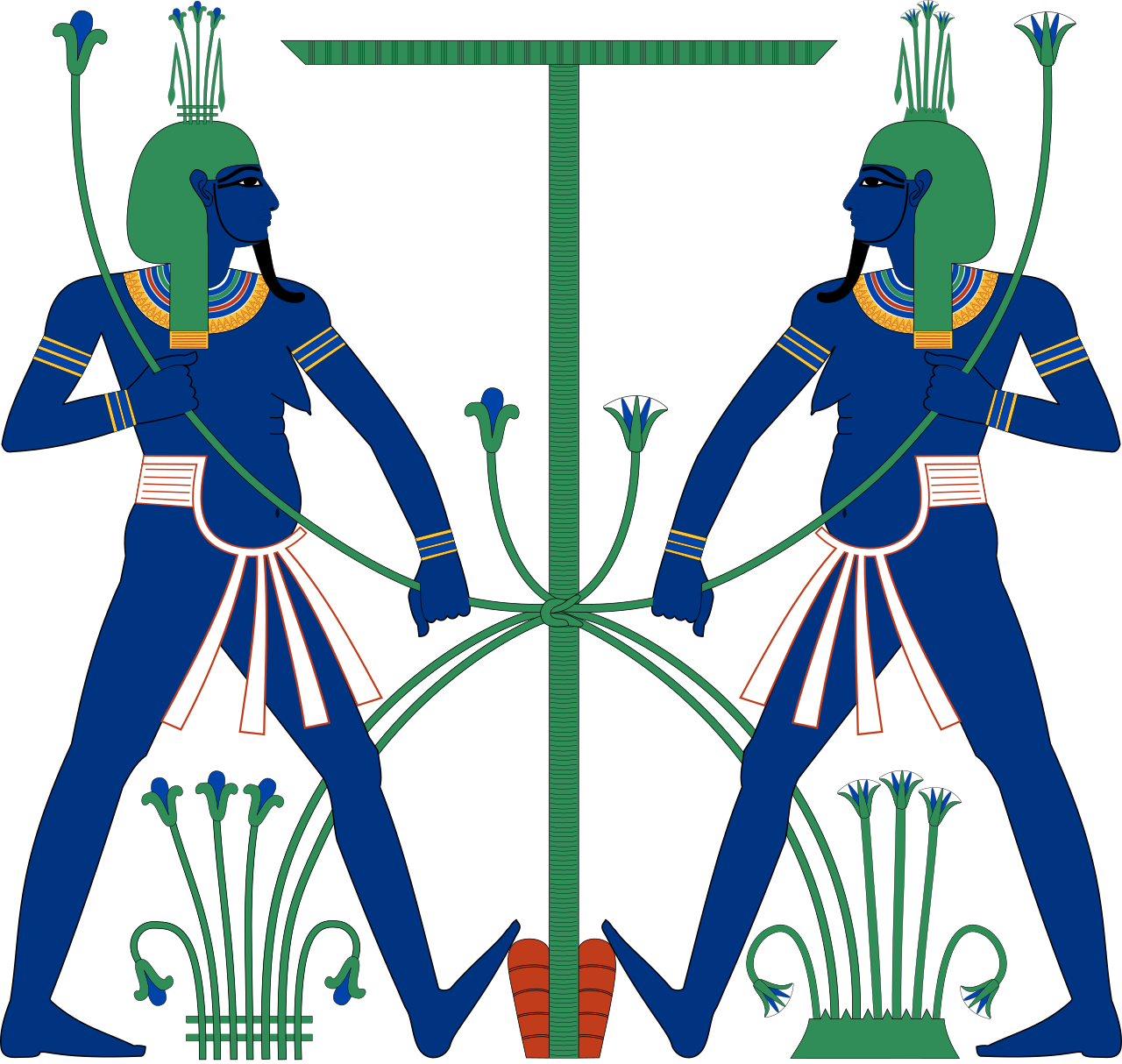
- This is a dual-depiction of Hapi representing Upper Egypt (left - the lotus plant) and Lower Egypt (right - papyrus plant). Blue represents life-giving water. Vegetation, breasts, belly symbolize fertility.
-
- The Nile was celebrated by procession, offerings, festivals, etc.
1st Century
- Christianity entered Egypt and did not abolish Egypt's ancient reverence for the Nile, but instead transformed it by giving it Christian meaning.
- Nile gives life? Christ is the giver of life
- Flood renews the land? Baptism renews creation
- Hapi provides abundance? God blesses the waters
- Nile maintains order? Christ restores true order
2nd-3rd Century
- Earliest documented celebration of this Feast in Egypt is reported by St Clement of Alexandria (150-215 AD)
- "And the followers of Basilides hold the day of His baptism as a festival, spending the night before in readings. And they say that it was the fifteenth year of Tiberius Caesar, the fifteenth day of the month of Tubi; and some that it was the eleventh of the same month." (The Stromata, Book 1)
- Basilides: Gnostic leader (120-140 AD)
- Celebrating Theophany (Epiphany) as multiple epiphanies of Christ:
- His Nativity according to the flesh
- His Baptism in the Jordan
- (In some places) His first miracle at Cana of Galilee
- Rising Gnosticism taught that:
- Matter is evil or corrupt, only spirit is good
- Thus, God could not POSSIBLY have taken flesh
- At the baptism of Christ, the Divine Logos descended upon the human Jesus temporarily
4th Century
- The Nativity Feast is celebrated separately from Theophany
- The Nativity Feast became a witness to the correct doctrine:
- Christ was born and took real flesh
- Matter is not evil or corrupt, but is redeemable
- Theophany's focus is now on the events of the Baptism of Christ and His Sanctification of the Waters
- This also refutes Gnostic ideas since water is material; it is sanctified by Christ
- Theophany becomes one of the days for administering baptism (with Pascha and Pentecost)
- "And consider how Solomon reproves you who are too idle or lethargic, saying, 'How long will you sleep, O sluggard, and when will you arise out of your sleep? You rely upon this or that, and "pretend pretenses in sins;" I am waiting for Epiphany; I prefer Easter; I will wait for Pentecost. Is it better to be baptized with Christ, to rise with Christ."
- St Gregory Nazianzen in Oration 40 is attempting to convince people to be baptized and to stop delaying
5th Century
- Rituals for Sanctification of the Nile
- St Shenouda the Archimandrite and his disciple Abba Wise do a sanctification of the Nile waters
- Water may be brought from the Jordan River (Palestine) and used to sanctify the Nile River
- Theophany is celebrated with lighting torches, processions, dipping into the Nile, etc. around 10pm
- There are 3rd and 5th Century sources that say that the Lord was baptized in the night and that at 10pm is when the heavens opened
- After celebrating the sanctification of the Nile and dipping in, they would go back to the Church for the Vigil and Liturgy of the Feast
10th Century
- Fatimid Caliph Al-Hakim bi-Amr Allah persecuted the Christians and forbade Christians from celebrating Theophany on the banks of the Nile
- Christians are forced to celebrate inside, so they develop large fonts ("maghtas") - this is also the origin of the baptismal font
- Later on, in the 20th Century, the large fonts will be replaced with lakkan basins
The Baptism of Christ
Circumcision and Baptism
- Circumcision came as a sign of the covenant made between God and Abraham in Genesis 17
- A Covenant has two sides - on God's side, He will establish the descendants of Abraham as a nation, He will give them the land of Canaan as an everlasting possession, and He shall be their God. On Abraham's side, they must be circumcised
- God deigned to bring salvation upon the world through the incarnation of the Logos IN THE BEGINNING. And He foreknew everything.
- Part of this economy of salvation was that God would not take one of the existing nations and become their God - for example, He did not go to the Canaanites and become their God. He did not go to the Hittites or the Amorites or the Amalekites. Of the 70 nations listed in Genesis 10, the descendants of Noah and those that were scattered after Babel, God did not choose any of those families. But rather, He chose Abraham and brought from him a new family. God's family. And Circumcision would be the sign of participation or membership in this family. It would be a sign that you forsake everything else and become one of God's family.
- Circumcision was participation with God in His covenant with Abraham
- Together with the Passover, they are a sign that you forsook everything else and became part of God’s family
- “And when a stranger dwells with you and wants to keep the Passover to the Lord, let all his males be circumcised, and then let him come near and keep it; and he shall be as a native of the land. For no uncircumcised person shall eat it.” (Exodus 12:48 NKJV)
Where did Baptism Come From?
- If you read the Old Testament, you won't see baptism mentioned anywhere.
- We have types of it like Noah's flood and Moses' crossing the Red Sea and Joshua's crossing the Jordan River - salvation through water.
- We have other hints like the four rivers that flow into the Garden of Eden that water the Tree of Life, or the Spirit of God that hovered over the waters in the beginning.
- But Baptism itself is not a regular practice in the Old Testament.
- In the New Testament, St John the Baptist started to baptize people in the Jordan a baptism of repentance
- Actually, this was not an abnormal practice
- By the time of the New Testament there are a lot more Jews than before - a lot of people who have a lot of ritual washings to practice. They had the idea of Ritual Impurity and before you could become ritually clean, you had to offer sacrifices and you had to have ritual washings.
- Around the time of the Hasmoneans, many Jews would come for pilgrimage on the feasts and required ritual washing to enter the Temple
- When Herod renovated the Temple, he added many pools (including Solomon’s pools, including expanding the Pool of Siloam)
- But there were so many people that it would have been impossible for everyone to wash every day
- So they setup in the Temple several pools that were used for ritual washings. The people would get in in large groups and come out the other side ritually clean.
- So when John started baptizing, people were not surprised by the practice. But what John was doing was very different
- He was baptizing in the Jordan on the other side away from the Temple - some people (especially the Sadducees were offended by this and took it as a sign that John was against the Temple)
- He was baptizing a baptism of repentance - he called the people to "bear fruit worthy of repentance"
- He was announcing the coming of Someone after Him - the Messiah
- He was not doing it on his own authority, but he was instructed to by God
- And John bore witness, saying, “I saw the Spirit descending from heaven like a dove, and He remained upon Him. I did not know Him, but He who sent me to baptize with water said to me, ‘Upon whom you see the Spirit descending, and remaining on Him, this is He who baptizes with the Holy Spirit.’ And I have seen and testified that this is the Son of God.” (John 1:32-34)
- John's role was forerunner - to prepare the way for the Christ
The Baptism of Christ
- The Lord Jesus Christ went to be baptized before beginning His ministry
- He approved of the work that John was doing and asked John to baptize Him, himself
- When Christ entered the water, some things happened:
- The Father spoke from heaven and affirmed that the Lord Jesus is the Son of God, the Messiah
- The Holy Spirit showed Himself as a dove and came upon the head of Christ anointing Him as High Priest, as King, as Prophet. These are the three roles that were expected of the Messiah.
- When the Holy Spirit came upon the Lord, He opened the door for God the Holy Spirit to dwell in humanity, Who we will accept on the day of our Baptism
- Christ, in the water, conquered the demons and the chaos and renews the Creation
- "You have crushed the heads of the dragon hidden therein [in the Jordan]" (Lakkan Liturgy of Water)
- "You divided the sea by Your strength; You broke the heads of the sea serpents in the waters. You broke the heads of Leviathan in pieces" (Psalm 74:13 - used in the Tasbeha Canticle for Theophany)
- Creation in Genesis 1 came "out of the waters"
- God's salvation for Israel through the Red Sea is a type of "new Creation"
- Christ sanctifies the NATURE of water (St John Chrysostom)
Themes of the Theophany
The Manifestation of the Holy Trinity
"This is My beloved Son in whom I am pleased. He has performed my will; obey Him, for He is the Giver of Life." - Verses of the Cymbals
"You have seen the Holy Spirit • coming down from heaven • and you have heard the voice of the Father • proclaiming and saying: •
'This is My beloved Son • with whom My soul is well pleased • He does My will; hear Him • for He is the Life-giver." - Second Doxology
The Sanctification of the Waters
"The sea beheld and fled, • and the Jordan turned away. • O sea, why have you fled? • Stand firm that you may be blessed. •
Behold the waters have seen • the Maker and Creator • and they feared; • agitation and confusion overtook them." - First Doxology
"The only-begotten God • came to the Jordan • and the portrait that was destroyed • and ruined by sin, •
He restored it once again • by the baptism of water; • He demolished the head of the dragon • upon the waters of the Jordan." - Second Doxology
Veneration of St John the Baptist
"A proud name is your name, • O kinsman of Immanuel. • You are great among all the saints, • O John the Baptist" - Verse of Cymbals, ⲟⲩⲣⲁⲛ ⲛϣⲟⲩϣⲟⲩ
All of the Theophany Psalis
Rite of the Theophany
The Readings
| Paramoun Vespers | Matthew 4:12-22 | Jesus beings His ministry; prophecy from Isaiah "The people who sat in darkness have seen a great light..." |
| Paramoun Matins | John 3:22-29 | John the Baptist exalts Christ ("He who has the bride is the bridegroom; but the friend of the bridegroom, who stands and hears him, rejoices greatly because of the bridegroom's voice. Therefore this joy of mine is fulfilled." |
| Paramoun Liturgy | Luke 3:1-18 | John preaches to the people |
| Feast Vespers | Matthew 3:1-12 | John the Baptist Prepares the Way |
| Feast Lakkan | Matthew 3:1-17 | John the Baptist Prepares the Way; John Baptizes Jesus |
| Feast Matins | Mark 1:1-11 | John the Baptist Prepares the Way; John Baptizes Jesus |
| Feast Liturgy | John 1:18-34 | John's testimony of Christ |
| Second Day Vespers | Luke 3:21-22 | John Baptizes Jesus |
| Second Day Matins | Matthew 3:13-17 | John Baptizes Jesus |
| Second Day Liturgy | John 1:35-51 | "Behold the Lamb of God" - |
Theophany Paramoun
The Rites of the Paramoun are identical to that of the Nativity.
Theophany Feast
- Vespers Praises & Vespers if the Feast is on Sunday or Monday (because it means the Paramoun was prayed early)
- Veneration for St John the Baptist
- Midnight Praises
- Great Canticle
- Midnight Alleluia
- 7 & 4 - Psali and Exposition for each Theotokia
- Liturgy of the Waters (Lakkan)
- On Covenant Thursday and Apostles' Feast, the Lakkan is prayed AFTER Matins (as all church services are - wedding, baptism, etc.). On Theophany it is prayed before Matins. This is a remnant of the original practice that the Nile waters were sanctified and THEN the people went to Church to pray the Feast
- Matins
- Like Nativity and Resurrection Feasts
- Divine Liturgy
Lakkan
Order of Lakkan
- Thanksgiving Prayer, Incense, Verses of Cymbals
- Prophecies
- Incense & Pauline
- Ⲟⲩⲣⲁⲛ ⲛϣⲟⲩϣⲟⲩ, Ⲡⲁϭⲟⲓⲥ and Trisagion
- Psalm & Gospel
- Ⲫⲛⲟⲩϯ ⲛⲁⲓ ⲛⲁⲛ
- Gospel Response
- Litanies (Sick, Travelers, Seasons, Leaders, Departed, Oblations, Catechumens)
- Supplications
- Litanies (Peace, Fathers, Assemblies) - Can be Inaudible
- Creed
- Aspasmos Adam
- Anaphora
- Absolutions
- Distribution
- Concluding Prayer
Prophecies
- Habakkuk 3:2-19
- Christ sanctifies the Creation through His Baptism
- "The everlasting mountains were scattered, the perpetual hills bowed"
- "You walked through the sea with Your horses, through the heap of great waters"
- God reveals Himself in the Theophany
- Baptism
- Christ sanctifies the Creation through His Baptism
- Isaiah 35:1-2
- "The desert shall blossom abundantly and rejoice"
- "The glory of Lebanon shall be given to it" - Lebanon is known for cedar (trees). So if the glory of Lebanon is given to a desert, that means the desert that was dry and dead will become fruitful and full of life - symbol of baptism, but also of water.
- Isaiah 40:1-5
- "The voice of one crying in the wilderness: 'Prepare the way of the Lord; make straight in the desert a highway for our God.'"
- "The glory of the Lord shall be revealed... for the mouth of the Lord has spoken."
- Isaiah 9:1-2
- "Beyond the Jordan. In Galilee of the Gentiles. The people who walked in darkness have seen a great light; those who dwelt in the land of the shadow of death, upon them a light has shined."
- Baruch 3:36-4:4
- Ezekiel 36:24-29
- "I will sprinkle clean water on you, and you shall be clean; I will cleanse you from all your filthiness and from all your idols. I will give you a new heart and put a new spirit within you; I will take the heart of stone out of your flesh and give you a heart of flesh. I will put My Spirit within you and cause you to walk in My statutes, and you will keep My judgments and do them."
- Ezekiel 47:1-9
- "Then he brought me back to the door of the temple; and there was water, flowing from under the threshold of the temple toward the east, for the front of the temple faced east; the water was flowing from under the right side of the temple, south of the altar... he brought me through the waters; the water came up to my ankles... the water came up to my waist... the water was too deep, water in which one must swim; a river that could not be crossed.
Anaphora
- Addressed to the Son
- Meet and Right
- Focuses on the Son as Creator, who created all from nothing, and to whom all Creation submits
- Ⲁⲅⲓⲟⲥ
- Focuses on the Incarnation
- "come to the likeness of men"
- "were not pleased to behold the human race overpowered by the devil. Behold, You have come and saved us."
- "You have blessed the natural births and purified the virginal womb by Your birth"
- "You, while still God, did show Yourself upon the Earth and walked among men."
- Focuses on the Incarnation
- Sanctification
- Invoking the Holy Spirit
- "Sanctify this water"
- "A loosing from sins"
- "A chaser away of diseases"
- "A terror unto demons"
- "May all who drink from it obtain purity of soul, spirit, and body"
- Renewal of our nature by water and Spirit
- The water of Noah
- The water of Moses (The Red Sea)
- The water of Elijah
- Invoking the Holy Spirit
- Concluding Prayer
- "You have made us worthy to fulfill this holy mystery."
- "Reveal to us the knowledge of this mystery."
- The Lakkan is a Mystery! A Sacrament! Per HEMY, it falls under the Sacrament of Repentance and Confession